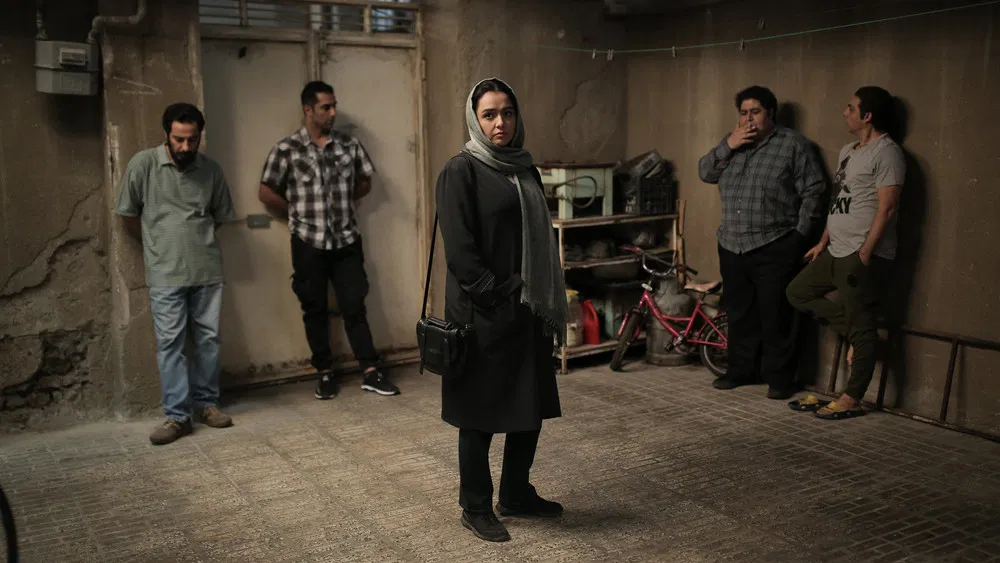
Several weeks ago, after a long, exhausting day at work, I returned home and slipped into my daily routine—one that could fairly be described as lazy—of grabbing the remote control and searching for something to watch. I browsed through Netflix, Amazon Prime, and OSN until I finally came across the trailer for the Iranian film (Leila’s Brothers-2022) «إخوة ليلى». After a long stretch of procrastination, I decided this was the right moment to watch it. As usual, I brought over a few bottles of water and pulled the plate of nuts closer to my floor seat, and in the silence of my apartment and the darkness of the room, the film began.
Two hours and forty-five minutes crawled by, and the film ended as if time itself had stopped—hope extinguished, and a new despair taking shape in the corners of my already-fractured heart. I felt a crushing heaviness, as if the ceiling were pressing down on my body. I cried until I was sobbing, the pain spreading through every limb. Throughout the film, I felt like someone searching for a door or a window in a pitch-black room; and when I finally reached it in the closing scene, I realized—after it was already too late—that it opened onto a bottomless abyss. And the question lingered: Why do we subject ourselves to this masochistic ordeal every single time? What purpose is there in watching films like this? Do we really need a lens that magnifies our pain to such an overwhelming scale?!
The feeling of distress, the tears, the deep sense of pain, and even my resentful stance toward the way reality is magnified to the point that it intersects with my own life—summoning my personal struggles and wounds—none of that changed the fact that I found the film truly remarkable. It is a work worth watching: crafted with precision, made with great care, and written in a way that embraces its details rather than overlooks them. Reflecting on this contradiction between the harsh emotions it stirred in me and the fact that I somehow loved it, I realized that I love Iranian films yet hate watching them—an oscillation between two opposing extremes.
The film adheres to the defining elements of Iranian cinematic realism: long takes, a camera that moves only slowly, extended dialogues, and the complete absence of background music. There is a constant insistence on reality—its presence, its weight—summoned through every possible means. Not only through its story and events, which resemble lives we already know, but also through its artistic choices. You are not watching a fictional tale; you are witnessing life as it is.
Saeed Roustayi’s film brought me back to a long history of watching Iranian cinema—beginning with my early fascination with Asghar Farhadi, then discovering Mohsen Makhmalbaf, and later encountering Saeed Roustayi, Ali Abbasi, and others. They are realists profoundly bound to life and its sorrows; their cameras feel less like cinematic lenses and more like natural human eyes. I find a striking resemblance between Iranian cinema and the wave of Italian neorealism that emerged after World War II. And the resemblance here is not about aesthetic form or artistic components, but rather about how reality is approached and rendered on screen.
In both, reality appears immense—overwhelming even—dominating every corner of the film. It becomes the true protagonist, manipulating the characters and leaving them little room to step outside its predetermined paths. This is a cinema that mirrors life with all its limits, its closed doors, its defeated hopes, and its restrained imagination.
The impact of such cinema on the viewer is harsh on many levels. The death of hope, the shattering of the characters’ dreams—all of it becomes a constant reminder of one’s own wasted hopes and lost dreams. It is a cinema that assures its audience there is no escape from fate, even within dark theaters where the childish hope of experiencing a fleeting moment of happiness will simply never materialize.
In the context of this intersection between post–Islamic Revolution Iran and post–World War II Italy, we must return to Italo Calvino, who wrote a contemplative essay titled “Autobiography of a Spectator”, in which he describes the impact of neorealist cinema on the viewer himself:
“It was the monotonous, banal life of the countryside that pushed me toward the cinema. What did cinema represent for me then? Distance. Cinema answered my need for distance—for stretching reality, expanding its dimensions until they became immeasurable, abstract like geometric forms yet utterly real, filled with faces, situations, and atmospheres, weaving a network of relations with the world of direct experience.
In the post-war period, films were made, watched, and discussed in an entirely different way. Post-war Italian cinema changed our view of the world, yet it offered only one world. There were no longer two worlds: the luminous world of the screen and another, completely different one outside. The dark hall had vanished, and the screen had become a magnifying lens fixed over our daily lives, compelling us to scrutinize them without pause. This function may have its minor or major benefits, but it does not satisfy humanity’s social need for distance.”
So why do we love Iranian films yet hate watching them? It is not only because, as Calvino suggests, they eliminate that small window of distance cinema usually grants us, but also because they are profoundly life-like—films that resemble reality, and resemble us too. Despite differences in language, culture, and political context, we find ourselves reflected in them in countless ways. And just as we hold a complex emotional attachment to our own selves—oscillating between self-love and self-loathing—we navigate our relationship with life and reality in the same way. We love life, yet it hurts us. We chase after our hopes and desires despite a reality that clings to us and enforces its harsh laws.
Yes, we cry at the end of Iranian films—just as we did when watching (Leila’s Brothers) or Asghar Farhadi’s (A Hero - 2021), and the examples are many. Our tears are nothing but an expression of our love for life, a protest against pain, or an attempt to accept it. Deep down, we all know that these films speak on behalf of their creators and on behalf of us; they raise their voice in defiance of reality even as they strive to capture it with absolute honesty.
We love Iranian cinema because it continues searching for that fragile sprout of hope that might grow from stone. And we hate it because, more often than not, it never finds that sprout at the end of its search. Isn’t it, after all, a mirror of who we are and of our own pursuit in life?