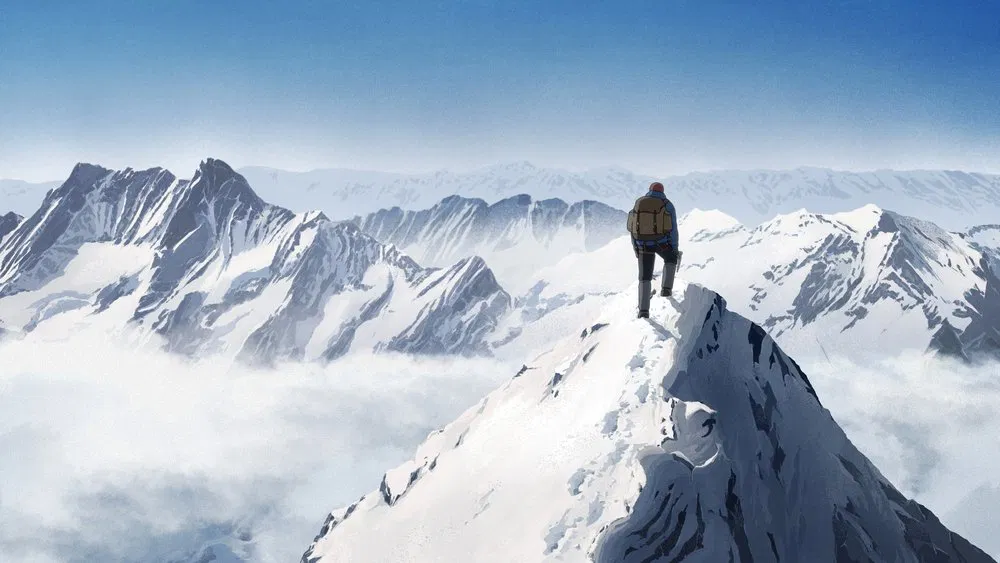
Films based on true stories — or inspired by them — and even documentaries tend to arrive with comprehensive answers. These answers may be carefully constructed, yet they are often convincing in their explanations of the events they depict, the product of long deliberation distilled into existential wisdom. Some deadly adventures, however, present themselves as if they were purely spiritual endeavors with lofty goals that fill every void opened by human questioning. These are adventures that resist satisfying, realistic answers — such as the journey of survival on Mount Everest, framed as an experience that deepens our appreciation for life.
This question of destruction and meaning calls to mind the animated adventure film (The Summit of the Gods, 2021), directed by Patrick Imbert. The film follows a journalist investigating the first British expedition to Mount Everest in 1924, led by George Mallory and Andrew Irvine. His investigation leads him, however, to a different destination: the Japanese climber Joji Habu, a man consumed by an obsession with mountains. Habu tells the journalist that he found Mallory’s camera during one of his own failed expeditions, and sends it to him with a letter that reads
“Keep the camera. It may contain the answers you seek about Mallory. But if you are wondering why he climbed Everest, you will not find the answer there. The same thing that drives us all to climb is something we cannot explain. I don’t know what it is, but I stopped looking for answers when I realized I couldn’t live without it. Everyone is looking for meaning in their lives, but I am not. Climbing is the only thing that makes me feel alive. So I kept climbing, until my last breath, without regret.”
This message, which arrives near the end of the film, serves as a response to the questions that Mallory posed at the beginning. It carries us from an earlier era to the present through the same recurring question: “Hiking, climbing, and always more climbing. What is the point of perpetually seeking the highest point?”
The idea of reaching the summit, and the illusory sense of elevation that follows, resembles the story of the lancet fluke parasite, which invades an ant’s mind and compels it to climb to the top of a blade of grass — an environment as deadly as it is inescapable, as though the ant has been stripped of its will. As Dr. Daniel Dennett has said of this phenomenon: “It is like some ideas that creep into our minds and then hijack us, moving us towards their interests.”
But what is the purpose of this deadly compulsion? It is as though the summit possesses its own invisible, seductive voice that feeds on the souls of those who make the pilgrimage. The answers offered in The Summit of the Gods were, perhaps, sufficient for me — there is no justification for this strange docility or this unpredictable gamble. This is not something I found in the films based on true stories and documentaries I have encountered.
In one scene from the 2015 film (Everest), directed by Baltasar Kormakúr and based on the true story of eight climbers who died, the protagonists explain why they undertook the journey. Rob begins by saying that he climbed to prove to his children that he is not ordinary, that he has reached places no one else has.
I then turned to the Netflix documentary series (Aftershock: Everest and the Nepal Earthquake), which tells the stories of those who survived the earthquake that struck Nepal in 2015. One climber explains that she came to Everest because a professor at the University of California encouraged her to challenge herself and overcome her shyness; she later heard another woman speak of the base camp and was inspired to pursue the goal herself. Another climber, who is HIV-positive, wanted to prove that people living with HIV are not physically weak. Both speak of the benefits they hoped to gain from the experience.
These realistic answers reveal that each of us has our own reasons for taking on a challenge. We might substitute such challenges with other risky activities — driving at full speed and hoping to survive the impact, for instance. But how does one move past the harrowing scenes that so often attend these endeavors, in order to reach the summit with a broad smile and plant a flag at the top?
The joy of reaching the summit is immense, almost euphoric. Yet one cannot help but think of the disappointment experienced by the explorers Hume and Hovell, who climbed an Australian peak some 800 metres high expecting sweeping, beautiful views, only to find the summit obscured by dense trees — a discovery that led them to name it Mount Disappointment. The disappointment on Everest, by contrast, is of a different order entirely: it belongs to those who have lost their sight to retinal haemorrhage, suffered kidney failure and lung damage, lost weight, lost limbs, and, in the worst cases, lost the local Sherpa guides who died in their service. These guides, who burn juniper as an offering to the mountain goddess in hopes of protection, are exploited in the service of a dangerous sport that becomes another entry in a climber’s list of recreational achievements. Their home countries, meanwhile, exploit their children in the manufacture of global brands. As Dr. Zakaria Ibrahim has noted, it is an epic battle between the self and the ideal self .1
I believe there is an illusion that afflicts us all after achieving what feel like extraordinary feats: the need to assert their importance, the reluctance to make an honest comparison between losses and gains, the inability to challenge the answers others give. All faiths, for instance, are unconcerned with empirical proof; faith is a metaphysical matter, both tangible and intangible, and the climber’s relationship to the mountain is a form of faith. This same illusion is what produces the winning smile in photographs taken moments after passing frozen bodies that have lain beside the trail for years — bodies that cannot be brought down, neither carried nor airlifted to their families. Mountaineering as a discipline is one thing; the deadly adventure of reaching the summit, which has claimed 223 lives, is another. The comparison is like deflating a football and filling it with cement — or replacing it altogether with Sisyphus’s boulder.
Despite all of this, the satirist Fran Lebowitz maintains her view of what is called the mountaineering challenge. She says: “A challenge is something you have to do, not something you invent for yourself. There are many things people must do — and should do — but avoid because they are afraid, because they are difficult, or because they are not good at them. Those are the real challenges.2
Perhaps, then, the most honest answer to our question — what does it mean to reach the summit? — is to be found not in testimony or documentary, but in a work of imagination such as The Summit of the Gods. In that film, the absurdity of heeding the voice of the void is rendered more convincingly than any attempt to demonstrate physical strength, follow a teacher’s instruction, or stir the emotional chord of spiritual longing through the solitary approach of a seductive nature. Karl Jaspers expressed this precisely: “I feel that nature is calling me, but when I ask it a question, it does not answer. It remains silent and mute.3