In order to revive our cinematic memories, or let's say typographic ones – if that's the right word – we just have to ask beforehand about our opinion of the blue and red logo isolated at the top of the screen, which used to receive 130 million visits per month or even our opinion of Jizawi’s decorated subtitles. How about the translation of Doctor Ali for the Oscar-winning movie? What is our stance on so-and-so's distortion of that scene?
We sense from the silent answer the miraculous joy, accompanied by a smile, that we evoked with it the nostalgia of the pre-marital cages, the pleasant gatherings in our free times, the vacation that coincided with Thursday, and the moral compass that the provider of the service – the free one – and the receiver had, like the translator when he warned us of the explicit scenes, or when he passed his desirable radicalism to the young group as if he got our mob encouragement when he replaced the description of the scene's image from "Israel" to "Palestine" accompanied by an encouraging phrase, sensing behaviors charged with political and emotional affiliations, or when he opposed an atheistic idea speaking in our voice, or even when he shared a sarcastic phrase aligned with the funniest times, abandoning the expressive entity and honesty while translating. I have always likened the translator with a bridge, of him being the most important figure in the process of presenting movies at the time; he is the one who paves the way between the two banks, and if his position was measured by the ancient world, he would have been a traveler and explorer working for pirates because of the circumstances of the time!
And because intellectual property was more of a culture than a rights system back then, we felt a cognitive gap that created difficulty in distinguishing, like perceiving the single-degree difference between water and ice because of the vagueness of the matter. But I am certain that the pirated sites where these translators worked were like the free trial preview for all of today's platforms, as they created an obsession in searching for additional features that were later provided, such as high video quality, ability to download to your phone and tablet, choosing the size of subtitles or dubbing, and no ads.
These sites simply represented the biographies that paved the way for all movies, directors, actors, and TV shows with multiple seasons that remain popular today. Thanks to these sites, the fertile environment and the good cinematic culture that was suitable for the concept of new entertainment were found, the demographic marketing survey process was very easy, and if I had to liken it to something, I would have said that it was more like the dialectic of the ship of Theseus; if the ship was hypothetically real and all its pieces have been replaced, then people were charged to ride it after it had been a free experience. There is nothing more beautiful than the experience of preventing street vendors – the ads – from wandering on its surface.
If there was a preliminary plan for the platforms, there would be nothing better than introducing pirated websites and their sycophantic translators employed by Arab nationalities. This phenomenon is called "planned obsolescence", which is an economic phenomenon concerned with the production planning for the course of a consumer product, where a product is offered at points of sale, and when people get used to it, it is replaced by another consumer product that performs the same function but with a controlled methodology, and at a higher price, with the discontinuation of the first product's, thereby forcing people to buy the second one!
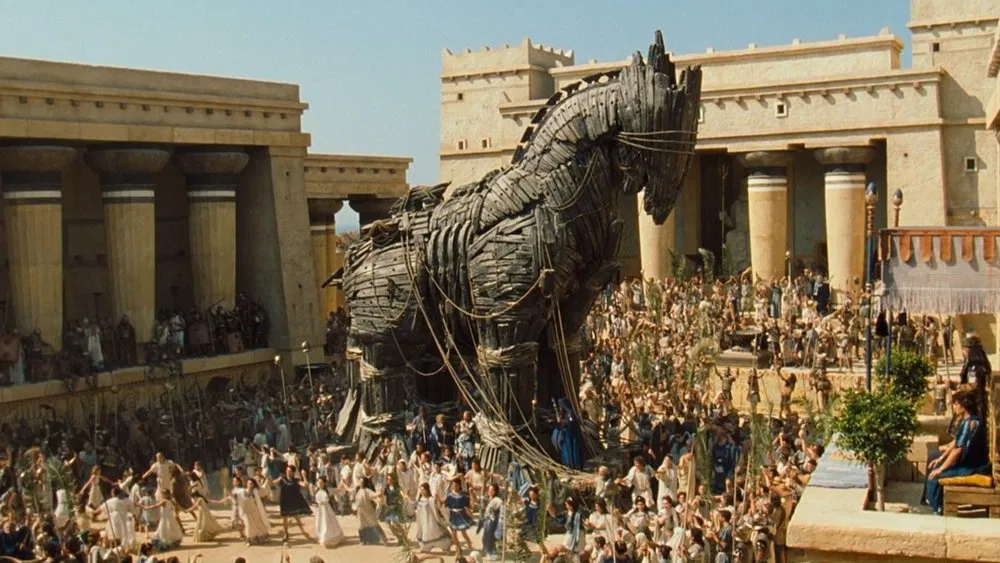
I still remember my colleague who worked as a waiter – was illiterate – and later became a close friend of mine despite his old age when I was in my early twenties, working as a receptionist at the beginning of the popularity of cinematic sites. At the time, I was not completely loyal to my profession, and this led him to develop an addiction to watching movies and series – especially the series The Walking Dead – with me whenever he had the opportunity to evade his duties. I used to translate to him what they said in my funny Egyptian dialect because he was not fully familiar with the Gulf dialect, to sail with me in the magical world of movies, urging me in every break to return him to the scene of the macho Achilles from the movie Troy (2004) fighting Hector with legendary chivalry, to express every time his surprise at the beauty of the actor Brad Pitt, the most perfect cinematic model, as the name of the actor was known to him only because of that movie, that role, that country, and that pirated platform. So, what is the chance that a man in his fifties will fall in love with an art based on understanding English or reading the Arabic alphabet? What an effect!
For my friend, I was the male version of Maria Margarita, the protagonist of the novel The Movie Teller, who used to retell the stories of movies in her own way to her poor family and the residents of the neighborhood, because they could not afford more than one ticket to the cinema. My friend, like all the residents in her village, was astonished at the ingenuity of the events, except that I was not as brilliant as she was in narrating.
I am not saying this in defense of piracy and the positive memories it created but to acknowledge the necessity of its existence during that time. As well as its importance at the time in refining cinematic culture, as paid platforms today serve as an economic resource for countries seeking to diversify their sources of income and a new wheel of development that caused the realization of professional dreams, not voluntary ones. Speaking of which, I would like to thank both Robin Hood and Jack Sparrow –and their respected fictional worlds– for their brilliance that expanded before our eyes, and all those who volunteered or were even paid previously – because of the huge amount of advertising – to enrich us.
The end is close to the last of you, and here we see your virtual ships sailing into the line between the two blues. Perhaps the absence was a plan for a future return; who knows about the tricks of pirates?