When I was invited to speak at a panel during the third edition of the Riyadh Film Criticism Conference (7–9 November), on the theme of the desert in Arab cinema, I found myself instinctively summoning - without any particular order- a host of classic Egyptian films whose titles include the word “desert,” especially those made during the early, formative years from the late 1920s through the 1930s and 1940s.
My selective memory then led me to specific film titles in the careers of major directors like Salah Abu Seif and Youssef Chahine—works that either passed through the desert or unfolded entirely within it at some point in their cinematic journeys.
Gradually, during the research preceding my intervention, a cluster of questions began to take shape, intertwining until they condensed into one overarching question- a question I felt was the natural gateway to the discussion:
Were Egyptian narrative feature films born in the desert?
Was the desert merely a dramatic backdrop- an open space for battles, horses, and Bedouin dialects distinct from urban Egyptian speech, offering a different texture for the eye and a playful escape for the mind?, Or did it also provide a rich and necessary arena for poetry to be heard on the “new screen,” with its rhythms and epics?
Did it offer filmmakers a way to slip out of time- back into stories the city had already worn down- while granting them room for political allegory in an era of stern censorship?
Not to mention the obvious: the visual freedom of shooting outdoors, far from the crowded streets of Cairo, weighed down by architectural ambition and the excesses of modernity.
If the desert offered all of this in the earliest Egyptian productions, does it not deserve to be examined, questioned, and unpacked? At the very least, does it not invite us to meditate on the inclinations of the pioneers who left the city behind and walked toward the surrounding sands?
One of the essential roles of specialized conferences, after all, is to open the door to these kinds of questions- not only within the limited time of a panel, but also in the afterthoughts, reflections, and expansions that follow. Perhaps such questions can spark new readings, or new methodologies, or even new themes for future editions.
In my view, no conference that gathers experts can succeed without ending on such open, provocative inquiries- questions that continue to resonate after the event concludes. And that, to some extent, is what the latest edition of the only film-criticism conference in the Arab region seems to have achieved.
But the Sand Remembered
(Ahmed Shawqi, Jabal al-Tubad)
“We drew our youth upon this hill,
Built four shapes in its gravel,
Then bent to sweep them away.
We traced our dreams into its soft dunes,
But the wind forgot,
And the sand was forgotten.”
The desert is not merely an outdoor location for horses, chases across sweeping dunes, or the darkness of caves and extinguished grottos.The desert is a space where meaning takes shape.
It is a cradle for ambiguity, a vastness through which time whispers in the wind, where footprints dissolve as though memory itself were optional.
It is a richly dramatic environment, ripe with contrasts between Bedouin ways of life and the city’s indifference- where dust and sand are equally unwelcome on polished surfaces.
It is the realm of vast horizons, varied colors, shifting light, proud echoes, the innocence of first illumination, and the majesty of distance.
Egyptian film historian Saad Eddin Tawfiq recounts in The Story of Cinema in Egypt that brothers Badr and Ibrahim Lama arrived from Latin America on their way to their homeland, Palestine. After witnessing the artistic vitality of Alexandria, they decided to stay, contributing to Mina Film before moving beyond amateur work. They produced a silent film- the first Arab feature ever screened in Egypt -”A Kiss in the Desert”, shown in May 1927 at Alexandria’s Cosmograph American cinema, nearly six months before Aziza Amir’s “Laila”. Historians later reclassified “Laila” as the first Egyptian feature because Amir was Egyptian, unlike the Lama brothers who were immigrants.
In “A Kiss in the Desert”, Hilda (Yvonne Gawin), a foreign woman, falls for Shafiq (Badr Lama), a Bedouin youth living with his tribe on the desert outskirts. Shafiq is falsely accused of murdering his uncle and escapes into the vast desert, joining a band of outlaws. During one of their raids, Hilda happens to be among the victims; three bandits kidnap her, and Shafiq chases them, rescues her, and eventually marries her after his innocence is revealed.
The film is considered the first Arab “Cinema of the Desert” work- its tales aligned with the viewer’s imagination nourished by Arabic epics, poetry, bravery, horsemanship, and impossible love. It also featured the first on-screen kiss in Egyptian and Arab cinema, which religious and social authorities at the time deemed immoral.
Ibrahim Lama wrote, directed, and shot the film, while his brother Badr played the lead. The outdoor scenes were filmed in Alexandria’s desert outskirts, while interiors were shot in a villa they rented in Victoria.
As for “Leila”, historians long debated its status as the “first Egyptian feature film.” Originally titled “The Call of God", it faced production setbacks when Aziza Amir rejected the scenes shot by Turkish-born director Wadad Orfi, who also played the male lead. The film was later reshot under the new title by Stefan Rosti, Ahmed Galal, Hussein Fawzi, and Italian cinematographer Tellio Chiarini, with exteriors filmed between the pyramids of Giza, Saqqara, and Cairo streets.
Unlike the American girl enchanted by the Arab Bedouin in “A Kiss in the Desert”, “Leila” presents the opposite image: A wildflower blooming in an oasis near ancient Memphis, pursued by a wealthy city man, yet devoted to Ahmed, the chivalrous young hero who once saved her. After becoming engaged, Ahmed falls for a Brazilian tourist, abandoning Leila- pregnant and disgraced by her community.
Thus, the first two films vying for the title of “first Egyptian feature” emerged from desert narratives- leaving behind the city for epic love stories, chases, tents, and Bedouin legends. Both also included foreign characters who disrupt the equilibrium of desert life- a natural reflection of pre-1952 cosmopolitan Egypt, teeming with nationalities living and working in a vibrant, international Cairo.
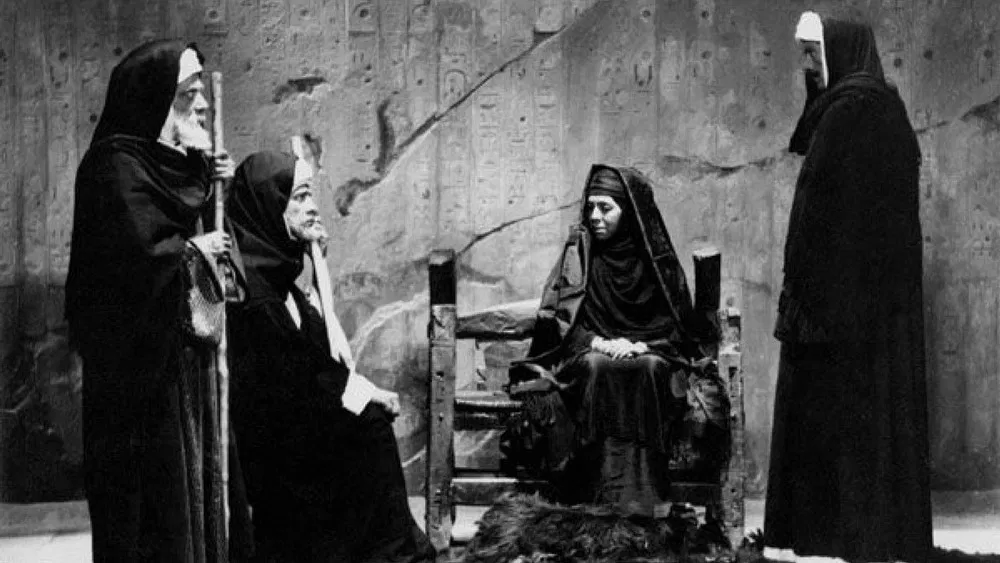
Despite the temptations of the city, Egypt’s first filmmakers went to the desert. “Leila” and “A Kiss in the Desert” occupy positions two and three in Egyptian film history, after the 1923 film “In the Land of Tutankhamun”, written and directed by Victor Rossetto- another work tied to desert landscapes, centered on Lord Carnarvon’s discovery of the pharaoh’s tomb in the southern deserts and the Valley of the Kings.
Even the earliest films funded and made by foreigners found the desert unavoidable.
This detail invites deeper reflection on colonial perspectives of the East, our relationship with the “Other,” and how we viewed- and still view- ourselves.
Yet what remains certain is this:
If Shawqi declared that “neither wind nor sand retained their memory,” then the sands captured on Egypt’s early film stock did remember- they preserved the narratives and anxieties of a generation of pioneers.
Daughter of the Desert
In 1937, cinema pioneer Bahiga Hafiz released “Leila, Daughter of the Desert”, a film she produced, wrote, scored, starred in, and sang for- directed by Mario Volpi.
The plot revolves around treachery, kidnapping, tribal loyalty, and a heroic rescue- classic desert melodrama.
At the time, Princess Fawzia of Egypt had just married Iran’s Crown Prince Mohammad Reza Pahlavi. The Iranian Foreign Ministry interpreted the film as an affront to the Persian throne, as it depicted a Bedouin woman resisting the advances of Khosrow Anushirwan. The film was banned, costing Bahiga Hafiz a devastating financial loss- making it the first film ever banned in Egypt, and once again, a film named after the desert.
Yet the film had already traveled abroad, becoming the first Egyptian film screened at the Berlin International Film Festival, and the first to win a golden award. So can we deny that desert not only gave Egyptian cinema its early productions- It also brought international attention, global awards, and the first censorship battles.
Those Who Passed Through the Desert
We may conclude our inquiry into the early relationship between Egyptian cinema and the desert by highlighting a few striking examples from its history- examples tied to directors who either passed through the desert, journeyed into it to test their abilities, sought adventure within its layers of time and temperament, or experimented with narrative possibilities that the city, despite being their true home, could never offer.
In 1948, the young director at the time, Salah Abu Seif, released “The Adventures of Antar and Abla”, adapted from the famed poetic epic and starring Kouka and Seraj Mounir. Abu Seif had previously worked as an assistant to his mentor, Niazi Mostafa, from whom he absorbed a wealth of experience. Mostafa stands among the Egyptian filmmakers who ventured repeatedly into the desert throughout the 1940s, directing more than seven films- all headlined by his then-wife, Kouka, whose mastery of Bedouin performance and singing made her the era’s most iconic desert heroine. She appeared with him in films such as “Rawiya”, “Queen of the Desert”, “Hababa”, “Layla al-Amiriyya”, and, of course, “Antar and Abla” (1945). That film is considered the first part of the story Abu Seif revisited in 1948 with the same cast, continuing the tale after the famous lovers- an enslaved Black warrior and his beautiful cousin- overcome the impossibility of their union and prepare to marry, only for Abla to be kidnapped and Antar to set off in pursuit.
In 1949, “The Adventures of Antar and Abla” became the first of Abu Seif’s films to screen at an international festival- the prestigious Cannes Film Festival- as if the sacred desert had granted him its blessing during his search for a visual voice and a personal cinematic vision. His early works ranged from melodrama to comedy and crime, until he found himself within the realist movement and became one of its leading masters. Yet this discovery never stopped him from returning to the desert from time to time: in (Dawn of Islam - 1971), set in the deserts of Mecca during the rise of the Islamic call; (Al-Qadisiyya - 1981), depicting the historic battle between Muslim armies and the Persians under Sa’d ibn Abi Waqqas; and finally (The Beginning - 1986), in which the passengers of a downed city plane find themselves stranded in a desert oasis and begin forming the nucleus of a primitive society rife with ideological conflict, all rendered through dark comedy.
The second example of Egyptian directors who passed through the desert early in their careers- exploring unfamiliar landscapes- is Youssef Chahine. He began his filmmaking journey with the urban fantasy-melodrama (Baba Amin - 1950), set in the home of a middle-class family. His second feature, (The Son of the Nile -1951), transported him to Upper Egypt, following a young man seduced by the lights of the city until they nearly consumed him.
Chahine’s tug-of-war with the city would continue for years, though he would also journey to other settings: the deep south in (The Blazing Sun) and the rural-urban edge in (Women Without Men). His most prominent early encounter with the desert came in his seventh film, (Desert Devil - 1954), starring Omar Sharif in his second screen role opposite Faten Hamama.
Through these shifting landscapes, Chahine wandered across diverse visual worlds during the early phase of his career- a phase alive, like those of his peers, with adventure, experimentation, and the testing of spaces unfamiliar to his upbringing, eye, and cultural background.
Later, like Abu Seif, Chahine would return intermittently to the desert, as in the grand historical epic (Saladin the Victorious - 1963) a film widely regarded as Egypt’s most significant propaganda-tinged historical war production, linking the medieval hero symbolically to Nasser’s leadership. During his self-imposed exile abroad, he completed (Sands of Gold - 1971), again starring Faten Hamama.
In the end, what we have outlined here is but a small glimpse of the desert’s vast imprint on Egyptian cinema during its early decades- specifically through its pioneering filmmakers and their feature works. It is merely an opening gesture, an invitation to further research, debate, and exploration of whether our initial question about the desert’s presence has more than one answer- answers that await discovery through deeper study and investigation.
This, in turn, fuels our hope that the upcoming editions of the Film Criticism Conference will spark even more proposals and questions, for such inquiries remain a vital source in enriching cinematic culture, nurturing love for film, and sustaining our passion for the silver screen.