Wearable computers — AKA smart glasses,AKA immersive eyewear — were front and center at this year’s Venice Film Festival’s immersive program. Google has been busy commissioning filmmakers to produce works such as the highly polished (Nevatars) and (Galapagos), both debuting in Venice, to showcase the new hardware’s potential. Nevatars is a tried and somewhat tired tale of a young teenager aspiring to become an artist and struggling with the familiar pressures of producing the perfect piece, while Galapagos, narrated by star power Margot Robbie, leans into National Geographic mode to tell the story of the striking landscape and creatures that populate the Galápagos Islands. The Google glasses felt more like a TV screen pressed against your face, the busy festival landscape happening all around in the peripheral vision, constantly interrupting any sense of immersion.
Now celebrating its tenth anniversary, the Venice Film Festival’s Immersive Program has become a gathering place for the full spectrum of what immersion can be — from commercial ventures and nature documentaries to games and works that lean fully into artistic experimentation, reshaping how we understand narrative space. As Liz Rosenthal, who co-curates Venice Immersive with Michel Reilhac, notes, the field has expanded dramatically since the program’s launch in 2017.
What began as a constellation of short, exploratory VR pieces has unfolded into a wide landscape of formats. Many works now stretch to an hour, are built for distribution, and come from makers who return year after year, developing sustained practices with dedicated teams. The technology has shifted too, moving from heavy headsets to lighter wearable glasses and into forms that require no headset at all — as in (Bowie: Unseen Unheard), an immersive audio-visual experience drawing on Denis O’Regan’s vast photographic archive of the legendary singer, or In 36,000 Ways, a brief haptic work that turns a shard of missile shrapnel into an embodied encounter, translating each visitor’s heartbeat into a low-frequency soundscape.
For Rosenthal, such works show how immersion moves fluidly across disciplines. She defines immersive work less by equipment and more by embodied spatial experience — whether through screens, spatial sound, haptics, or real-time performance. The Immersive Program deliberately spans commercial projects and highly experimental ones, reflecting a philosophy of representing the full sector rather than drawing boundaries around what counts as immersive. At its core, Rosenthal argues that immersive art matters because it reconnects viewers to their bodies at a moment when digital life increasingly separates perception from physical experience.
Yet this expansiveness also reveals how contested the terrain of immersive media has become, opening onto a broader question of where the form is heading. What stands out most is how immersive media gestures toward future directions of storytelling — not only through ever-evolving technology, but through the boundary-bending experimentation with form that defines it.
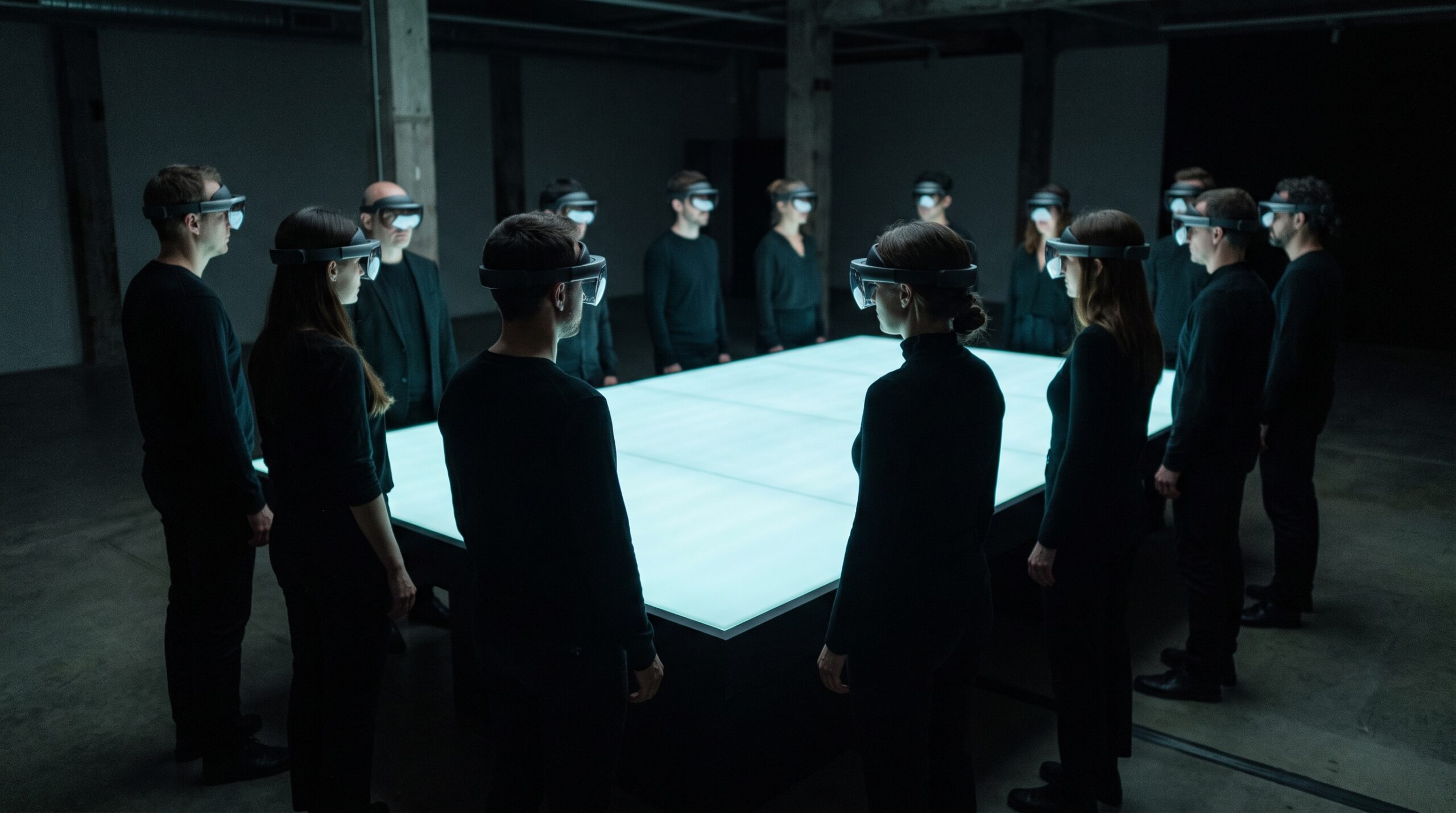
(Empire at Sea), directed by Peter Flaherty and commissioned by Lincoln Center in New York, is a case in point. Narratively somewhat didactic and two-dimensional, it nonetheless gathers eight to ten headset-wearing viewers around a large pool-like table from which a volumetric installation rises into a miniature world, unfolding the story of scientists stranded at sea after a climate disaster wipes out their homes and leaves them unable to return.
Viewers are invited to move around the table as the narrative progresses, sometimes unfolding simultaneously across different parts of the ship. Captured at a miniature scale, the piece leans into its own theatricality and invites viewers to peer in as if looking into a small box of curiosities — close enough to imagine lifting it in their hands, tiny worlds flickering to life, the sense of discovery feeling almost magical. The narrative’s slightness, the miniature scale of its characters, and the top-down filming vantage point all work against deeper emotional connection, keeping viewers at a contemplative distance rather than drawing them fully into the story.
Empire at Sea, alongside other visually striking works in the festival such as (Everest: The First Ascent), (Amsterdam 1652: The Hands of the City), and the (Smithsonian’s Starstruck), demonstrates how far the visual and sensory experimentation of immersive media has come, even as the language of cinematic storytelling still has catching up to do. These major productions deploy the full range of VR’s tools — from being dropped onto a snow-capped mountain in The First Ascent to drifting through the vast cosmic vistas captured by super telescopes in Starstruck, itself a scaled-down version of a much larger 1,500-square-meter installation already running in Washington and London, where groups cycle through the experience every few minutes.
As Rosenthal notes, multi-user worlds like these — in which several people enter and inhabit a space together — are becoming increasingly viable in terms of distribution and audience reach. Works such as Amsterdam and Everest follow the same trajectory, pointing toward a future where shared immersion becomes a central mode of exhibition, particularly in more commercially oriented projects.
At the other end of the Venice showcase were cinematic auteur works that proved absolute delights: (The Pigeon’s Ring), an exquisitely poignant family drama set inside a memory-laden home; Nothing to See Here — my absolute favorite — an XR encounter that lets you watch yourself from above while a virtual stranger slips into your field of vision below and unsettles the ordinary flow of the world; Yesterday Maybe, a quiet meditation on loss and grief; (Sunset Motel), a moody, neon-lit tale of drifting desire; (Voooooo-Peeeeee), a surreal meditation on bodily absence and technological perception; and (Honeyboys), a biting critique of overconsumption and greed.
These are also the works least likely to be shown beyond the festival circuit and the limited, albeit growing, number of dedicated immersive exhibition spaces.
Voooooo-Peeeeee unfolds as a multisensory drift through a body that has been rebuilt as data. A woman discovers she has become hollow, a cavity left behind after her physical self has been translated into information, and wind leaks softly from within. In that void, a strange creature settles and begins to breathe, its rhythms of expansion and collapse echoing the swelling pressure of the virtual world around you.
The work creates a parallel between outlived embodied experiences and our bodies as no more than data points and data voids. A frog-like hand interface adds a soft estrangement, asking you to move in unfamiliar ways, while volumetric light triggered through hand gestures makes it feel as if you are touching brightness itself. An air-inflating suit — a transparent frog-skin garment — breathes against you.
As I experienced its cycles of pressure and release against my body, I could feel it becoming a meeting point between sensation and story. Technology may want to disappear, but the body refuses. The suit makes that refusal palpable.
In Honeyboys, Dutch director Tibor de Jung extends the concerns of his earlier 360 VR work (8 Billion Selves), turning again to the excesses of overconsumption and waste. The piece grows out of a closed delivery-boy ecosystem he first encountered during COVID, in which influencers sold goods and young men cycled them through emptied streets — a miniature economy that became the seed for a looping narrative of birth, death, and consumption.
The work leans into the grotesque and the confrontational, pushing against sanitized mainstream aesthetics. At its center is the “honeyboy,” a composite of de Jung himself as a symbol of fragile masculinity, designed to avoid easy allegory and instead prompt viewers to reflect on their own complicity. Multiplicity becomes a structural device: figures recur across worlds like a hive system rather than individual characters, underscoring de Jung’s insistence that we are not unique subjects but participants in the same cycles of desire and excess.
Max Sacker and Arite Szadkowski’s unabashedly AI-generated (Octopocalypse) hit a raw nerve at the festival, provoking the question of what it means to create a work with entirely synthetically produced images and actors. Framed as a playful B-movie alien-arrival story, Octopocalypse places three participants in a post-impact interrogation room with a fragile, prophetic intelligent octopus whose attempts at contact arrive through music, touch, and flickering visions. The group listens and presses buttons — actions that seem to shape the encounter but mostly drift like gestures rather than true decisions. Only the final fork carries weight: whether the protagonist escapes the government’s attempt to recruit her, or joins the system to shape the future through institutional power. It becomes a choice between trusting a renegade, Robin Hood-like path or believing change can be engineered through the machinery of governance.
While some festival-goers found the work polished to the point of feeling inauthentic, others admitted they would not have known it was AI-generated had they not been told in advance. That split reaction became part of the conversation: Octopocalypse clearly stirred debate around AI’s expanding role in production, and in particular the anxieties tied to authorship, intellectual property, ownership, and the growing threat performers feel as AI-generated acting reaches increasingly uncanny levels of polish.
Climate storytelling appeared across several works in the festival, including (Solwata) and the aforementioned Empire at Sea, but the most ambitious attempt came through Nonny de la Peña and Rory Mitchell’s (Out of the Ashes). The piece uses Gaussian splatting to reconstruct homes destroyed in the January 2025 Los Angeles fires, visually returning people to the houses they lost. Kitchens, hallways, and small domestic corners reappear with startling clarity, letting viewers walk through Altadena and the Palisades as if memory itself had texture again. The seven vignettes, framed by an interactive map and a quiet cinematic overture, make the geography of the fires feel intimate rather than abstract — a way of holding grief without spectacle.
Solwata, centered on Solomon Islands climate refugees, carries a similar tenderness, treating displacement as a lived and ongoing condition. Together with Empire at Sea, all three works show how immersive media can create spaces where climate experience becomes shareable, where loss is met with attention and a clarion call for concrete action. They also expose a deeper question running through the festival: what does it actually mean to feel with others inside these constructed worlds?
In panel discussions and informal conversations over coffee, I often heard that VR is an empathy machine. But empathy is never guaranteed, presence is partial, the device never fully disappears, and if a story is thin or poorly told, immersion cannot make the feeling real.
Immersive storytelling can certainly open us, but it can also steer us, even manipulate us; its power can be used with care or with cynicism. What Out of the Ashes, Solwata, and so many other works in the program achieve so well is to challenge us to treat empathy not as an automatic effect, but as a responsibility.
Livia Alexander is a New York-based digital and expanded media curator, writer, and Professor of Visual Studies at Montclair State University in New Jersey, USA.