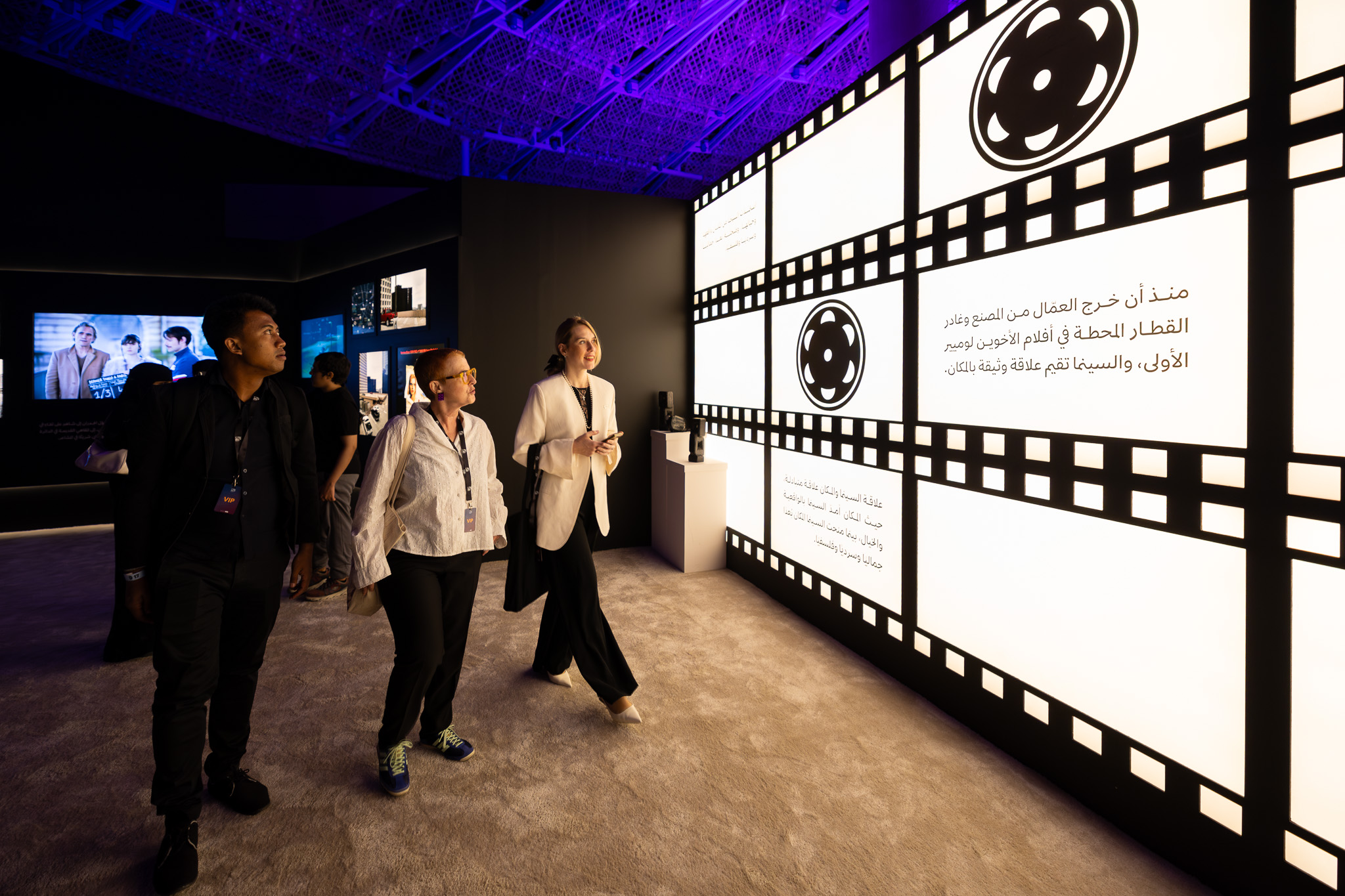
Amid the bright corridors at the entrance of the Riyadh Film Criticism Conference, screens flicker with images capturing place in the art of cinema, reviving a timeless question: What is the value of place within the cinematic image?
Place is not merely a physical site; it is a presence where the tangible merges with the imagined. An empty room, for instance, is only a “place” — yet once filled with emotion, experience, and memory, it transforms into a “space”: a sensory visual memory capable of preserving the human trace. Here lies the distinction between “place” as a material existence, and “space” as a felt, breathing presence.
At this very entrance stood the Lumière Brothers exhibition, as if to remind us of the first bond between human and place in cinema. The brothers did not simply invent a camera; they gifted humanity a new way to see the world. From its very first flicker, cinema was not a mere technical discovery — it was a new language of communion with existence. Through their invention, they redefined our perception of daily life and of the spaces we inhabit, turning the act of seeing into an act of revelation — watching reality breathe before the lens.
Their camera faced the world with the wonder of a child encountering nature for the first time — free from artifice or narrative contrivance. A laughing child, workers leaving a factory, a train arriving at a station — fleeting moments that turned into astonishment, astonishment into memory, and time into a poetic instant preserved forever. In their films, place was never a backdrop but the living essence of the event: the factory not as a building but as the pulse of human movement, the street not as a passageway but as a stage where time flows endlessly.
Perhaps the birth of cinematic awareness was realized in that iconic 1896 scene, (Arrival of a Train), shown before an audience for the first time. The image became a temporal mirror — you feel as though you are present in one of those evenings of 1896: their clothes, their gestures, their rhythm — it is both now and then. This is cinema’s third element: time itself — fragments carved from its continuous flow. That captivating scene marked the first moment humanity saw space move before its eyes. The world was no longer static but alive, and time became something to see, not only to live.
On a winter evening, December 28, 1895, the basement of the Grand Café on Boulevard des Capucines in Paris cradled the first birth of light. Inside a small hall called the “Salon Indien”, the lights dimmed, and upon a white wall appeared, for the first time, the visual presence of the human world as never seen before: a factory, a station, a street, human laughter. None of those gathered then could have known that this darkened space would become the cradle of an art that would forever alter the way we see the world.
The Lumière brothers did not choose their scenes randomly. In each frame gleamed an intentional wonder, an invitation to contemplate the ordinary place that, before the lens, becomes a realm of awe. Their bond with the audience was intuitive and silent — the seed of a new vision of life. From that small basement, cinema was born as an art seen by the eye and felt by the heart.
Curiously, this story began a year earlier, when Antoine Lumière, their father, witnessed Thomas Edison’s Kinetoscope in Paris in 1894 — the first device to record and display moving images, though only for one viewer at a time. Antoine returned to Lyon carrying an idea: “why not make the experience collective?”. His sons inherited that dream and shaped it into the Cinematograph, turning place into something not only visible but shared — as though the entire world were seated together in one hall, watching itself.
Thus, in the cinema of the Lumière brothers, place became the origin of all things — not a mere backdrop, but the wellspring of image, wonder, and reflection: the first mirror in which humanity saw itself moving within the current of the world. Yet as cinema evolved, this primal innocence gave way to a darker vision. With German Expressionism, the meaning of place changed — shadow became language, and walls turned into reflections of inner turmoil.
In films such as (Nosferatu: A Symphony of Horror - 1922) and (The Cabinet of Dr. Caligari - 1920), place ceased to be neutral; it began to breathe, cry, and suffocate alongside its characters. The tilted wall, the distorted angles, the warped perspective, the twisted window — each mirrored the mind’s disturbance. Space no longer reflected reality, but the psyche itself.
Then, in postwar Italian Neo-realism, place returned as a witness to human pain — the ruined city, the empty street, the crowded marketplace — all transformed into spaces that documented life not as we wish it, but as it is. In (Bicycle Thieves - 1948) and (Rome, Open City - 1945), place became the protagonist, narrating stories of poverty, struggle, and dignity.
Later came another cinematic wave that rendered space philosophical- as in the films of Andrei Tarkovsky and Michelangelo Antonioni, place acquired a philosophical depth. In (Mirror - 1975) and (La Notte - 1961), space becomes a mirror of the soul — the childhood home, the rain-drenched field, the silent room — all turned into metaphors for memory, longing, and what cannot be uttered. Here, place is no longer the body of the image but its soul — the living breath of memory.
In modern cinema — particularly in the works of Wong Kar-wai and Terrence Malick — place evolves into pure emotion. The crowded city in (Fallen Angels - 1995) is not a geographic space but a realm of solitude, while the house in (The Tree of Life - 2011) is not a home but a miniature cosmos of light, time, and memory.
In this way, cinema itself has become the embodiment of space — an endless pursuit to capture what cannot be captured: the scent of a room, the warmth of light, the silence between two glances. And when we return to the question — “What is the value of place in the cinematic image?” — we find that the answer is not technical nor aesthetic alone, but deeply existential.
Place in cinema is the memory of humanity when words fail to recall it; it is the visual form of absence — the witness to our passage through the world. Every frame of a place is also a fragment of ourselves, of our transient consciousness moving through time. And so, from the basement of the Grand Café in Paris to the Film Criticism Conference in Riyadh today, place continues to pose the same question:
“Do we give meaning to place, or does place give meaning to us?”
Perhaps cinema, from its first spark, has been nothing more than an attempt to answer that question through light — the light that makes place speak, and makes humanity remember.