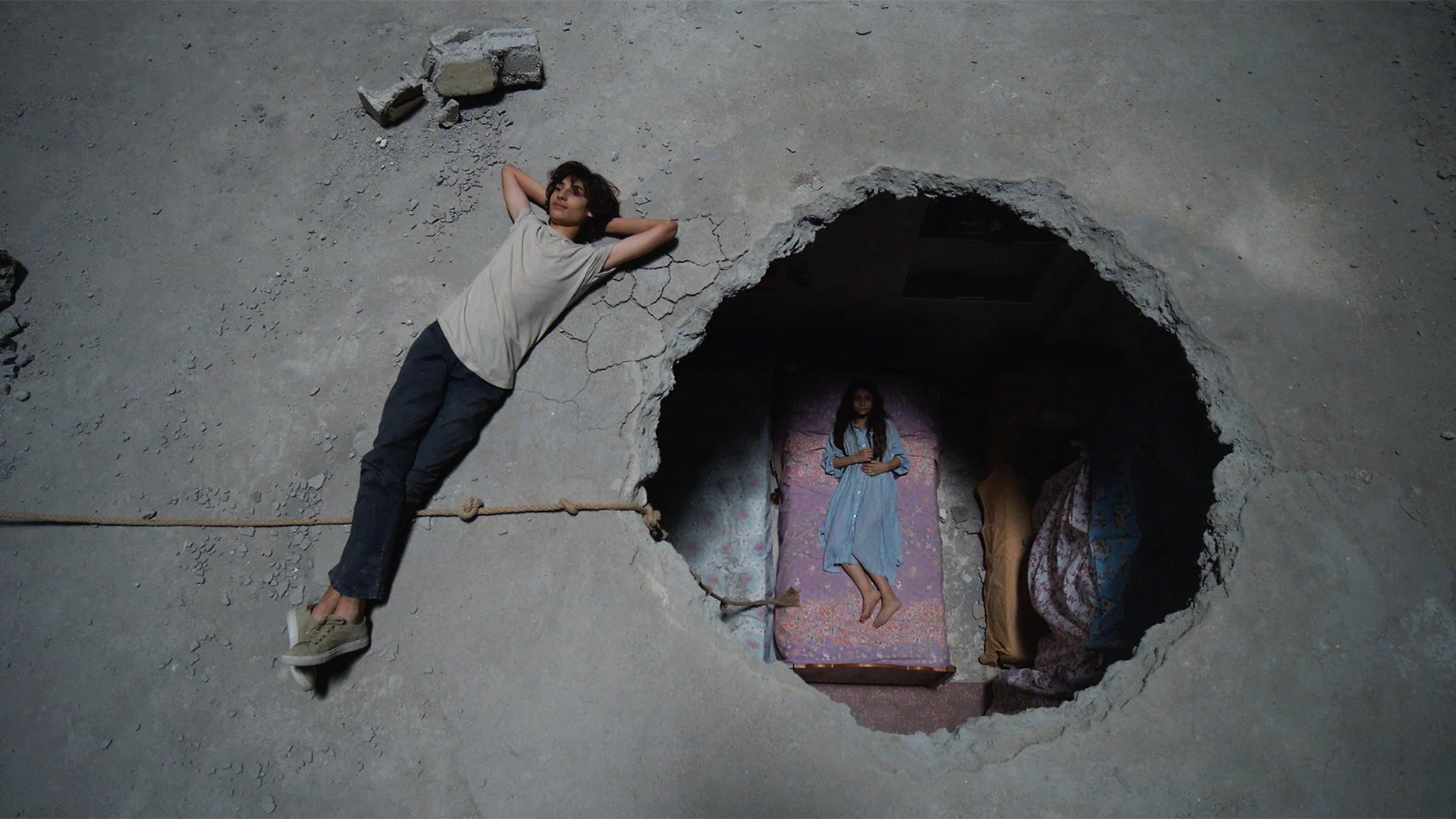
The Syrian film (Nezouh, 2022) «نزوح», directed by Soudade Kaadan, has caused a lot of controversy since it was shown at the second edition of the Red Sea Film Festival and later at the 66th London Film Festival, where it received several awards, including the Baumi Script Development Award in Berlin.
The film revolves around a small family consisting of a father, mother, and daughter living in Damascus. The father decides to stay in his homeland with his family despite the destruction surrounding them due to the armed conflict in recent years. Their house is hit by a missile, destroying and leaving it without a roof or complete walls. The head of the family insists on staying in his homeland, refusing to evacuate and attempting to patch the gaps in the walls and roof with lightweight fabrics that quickly disappear due to storms or rain. The conflict between the couple intensifies, leading the wife to decide to take their daughter and evacuate alone, leaving the father alone amidst the ruins.
Introduction to the Future
Nezouh opens with a narrow frame monitoring the daughter’s situation in the darkness, with a candle as her light source and a pen in her hand as she draws on the wall. This sets the stage for the events to come in the film. It starts with the young woman as the focal point, specifically the teenage girl, and the surrounding darkness reflects the dire situation she lives in. The pen serves as an aid to overcome that situation through drawing and liberation through imagination.
The Picture Between a Surface of Destruction and Internal Liberation
Through its cast and images, the film maps both the internal and external conditions of its characters. It appears, on the surface, to document only the physical destruction surrounding them; in fact, it skillfully conveys — beyond the script and dialogue — the inner wreckage of these characters, their emotional states, and their journey toward liberation.
Gaps are everywhere. The camera observes them from wide angles that reveal their enormous scale within the vast, near-empty space occupied by this single family. The image conveys the weight of the father’s decision to remain, foregrounding the gravity of his error. The gaps, as captured in these compositions, become a metaphor for the voids within the characters themselves. The film adopts an accusatory stance toward the father from the very beginning, guiding the audience toward empathy with the wife as she transforms from an obedient woman to someone rebellious by the end.
The distinguished cast shows the family within the framework of their surroundings to confirm that they are still physically alive but trapped in a narrow space and a clear threat in a state that resembles a prison.
Just as the framing of the gaps traces the psychological devastation of the characters and prepares the ground for the wife’s final decision — she, who perceives the danger clearly, in contrast to the husband, who offers only temporary and illusory solutions, represented by lightweight fabrics that seal the gap without confronting its cause, more of an empty and deceptive closure — those same gaps serve to illuminate the daughter Zeina’s patience and intelligence, as portrayed by Hala Zein. She becomes the catalyst for her mother’s eventual choice.
The camera captures the gaps from the sleeping girl’s point of view, placing a POV shot that has her looking up at the sky through the hole in the ceiling — as though it were the sea in her dreams. All of the film’s characters share a common orientation toward freedom, dreams, and survival.
The girl’s presence symbolizes a liberated future in a shattered land with no apparent horizon. Not once does she appear desperate or in tears; she always has a solution. She sees light in the continuous darkness, gazing at the sky through the gap in her room. She uses the gap to her advantage, turning it into a passage for the friend she loves and supports. The gap becomes a means of escape from the confined frame in which the family is so often held.
The significance of the daughter is evident in the film before even watching it and from the film’s poster, as she occupies the largest composition in it. In the background, the blue color of that charming nature that she saw from the gaps in her room is visible.
From this, it becomes clear that the image played a role in documenting the country's situation, but it did not neglect to express the characters. It portrays a hopeless father and a daughter whose imagination knows no bounds, serving as the savior for the rest of the family and a strength for the mother.
The film illustrates the impact of the daughter on her mother in a specific scene when the father goes down to the street and hears cheerful music coming from the daughter's room, to which the mother joins in.
The film moves from the world of their home, which is full of gaps and cracks, to the actual world of displacement, or rather, the real action within the family’s story—the wife's decision that was not paved by dialogue but was affirmed by the image and the director's focus. The film emphasizes the influence of the daughter's dreams on the family dynamics. The primary driving force is the mother's rejection of the father's decision to marry off their teenage daughter—an attempt to rescue the dreams within her. Thus, the mother's decision to flee is not for her own sake but for the dreamy little girl. It is a journey of self-discovery during her quest.
A Journey to Self-discovery
Following the same approach, the film tracks the risks and realities of displacement on one hand, while deploying them on the other as a means of expressing its characters’ inner lives. The journey of displacement — passing through a narrow tunnel, the mother searching for a way out to survive with her daughter, to live life alone after the life she knew only through her husband — is rendered with care. Despite the difficulty of the journey, the director manages to frame it as a kind of exploratory adventure: the mother sees things she has never seen before, owing to her husband’s complete control over her life. Her displacement and departure from her homeland became her first steps toward liberation.
Although the film engages with political subject matter, it also carries within it a feminist dimension, representing the control exercised over women’s lives and the manipulation of their fates. The film conveys, with quiet subtlety, that the wife had never seen the sea in her country or ventured outside before. Her determination, during the journey, to wear her elegant red shoes alongside the brown fur coat she had always wished to wear speaks to her desire for luxury. She is forced to abandon these items to lighten the load on her journey. These details illustrate the extent of the siege she has lived under, which extends beyond the country’s war and into the dominance of her husband, forcing her to be subservient to him. When the moment comes to let things go, she relinquishes her feminine belongings after coming to understand the value of life around her. This choice is a symbol of the choice of freedom.
The film ends with a shot that shows the mother/wife with control over all decisions and not her husband, as she determines who rides with her on the journey and who does not have the privilege of taking over the top spot in exchange for the depth in which the husband appears in a lower crowd, begging her for a seat in the ride. She eventually allows him to join, but on her own terms, after she has tasted freedom.