We often wonder how the identities of cities are formed and how we come to interact with places. How exactly do we belong to a city?
In cinema and art, a “city” carries a slightly different definition from that of a mere residential area where numerous people live in close proximity. The city is an entity that contains a group of residents with diverse temperaments, thoughts, and feelings. They move within the geography of their city and interact with it — whether it is a desert or a coastal landscape — navigating through its architecture. All of this shapes the personality of the city, and a dual relationship is then formed: the city reflects its identity onto its inhabitants, and the inhabitants reflect the spirit of their city back onto it.
The culture, ideas, and architecture of a city all contribute to its public identity. As a result, some places encourage walking, and others seem to forbid it. Cities also carry a strong sense of privacy, so there may be places we alone find pleasure in walking through. The most important reasons for our sense of belonging to cities are always personal. Setting and location are fundamental to any intimate memory and cannot be ignored; they revive values and emotions within us, and as soon as we return to them — even in imagination — memories come flooding back. That is why cities have always held personal significance for filmmakers, shaping their stories with an importance that matches that of the characters themselves.
Columbus (2017): A Film by Kogonada
I have always struggled to fully appreciate the idea of admiring artworks in which the sole tool is a visual medium, one that is not as diverse and flexible as cinema or music, with their array of expressive tools, and one that is entirely fixed, lacking movement even compared to photography. I am referring specifically to architecture. What Kogonada presents in his film is that architecture is not merely a beautiful creative work, but something that can move and even heal you, something that has its own expression. If you reflect deeply on Kogonada’s film itself, you will find the same effect. It encourages you to do precisely that; and I have not been bored since my father’s eternal attempts to share his love for that art.
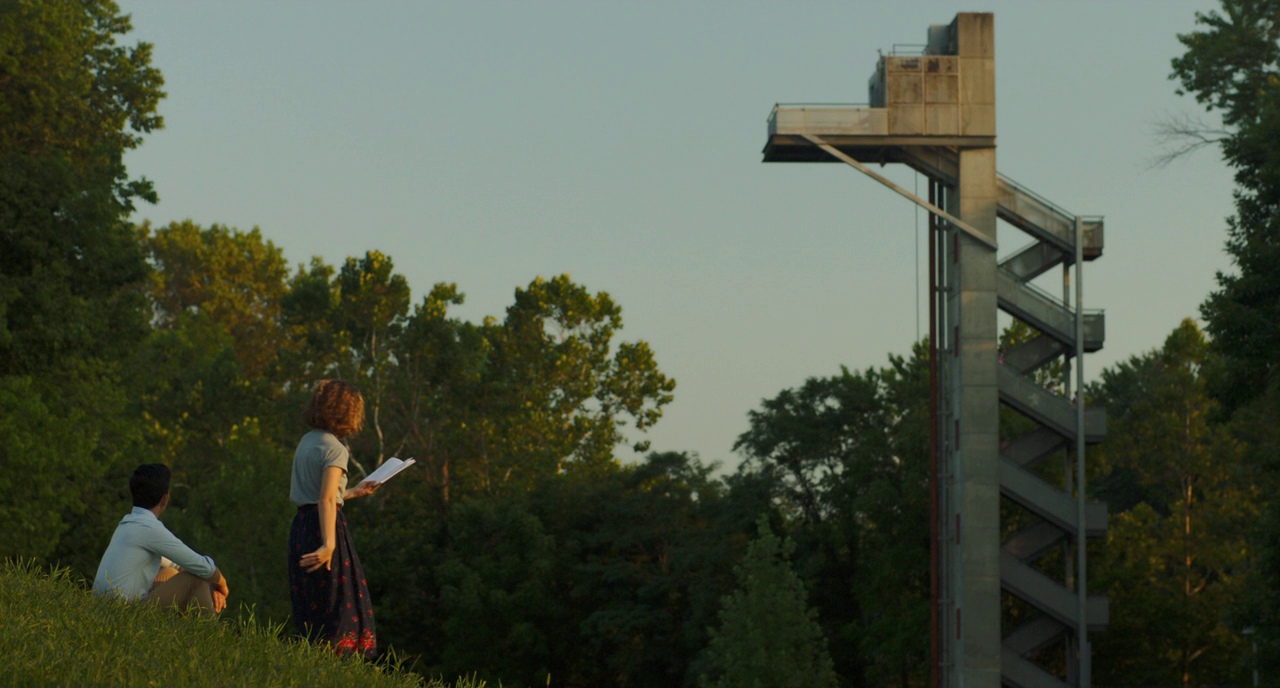
The film tells the story of Casey, a young woman with a deep passion for architecture, and Jin, the son of a prominent academic in the same field, who travels to Columbus after his father falls into a coma. The paths of these two characters converge, and the friendship that develops between them on screen becomes our window into their inner worlds and into Casey’s hometown of Columbus.
The film is centrally concerned with Casey’s relationship with her mother, which is also deeply bound up with the city she loves. It is a warm but complex relationship: Casey loves her mother yet does not admire her personality. She feels the need to leave Columbus, even though she genuinely appreciates the city more than any other place. Jin’s relationship with his father moves in a parallel direction: despite the tension in his feelings toward him, his father’s condition compels him to remain in the city. Casey finds herself needing to overcome her desire to leave, and Jin finds himself facing the same challenge in order to move forward.
The most important catalyst for the conversations between Casey and Jin is her desire to share her list of favorite places in the city. Throughout the film, Kogonada consistently demonstrates his deep passion for architecture through static shots, a keen dedication to barriers and distances as compositional elements, and a purposeful tendency to create moments of quiet contemplation without ever compromising the rhythm of the dialogue or the development of the central friendship, or any of the relationships unfolding alongside it. The result is an intense connection with each character; we find ourselves at different levels of understanding and empathy, regardless of how the story ends.
Most importantly, we find ourselves in intimate communication with the city of Columbus itself — a quiet, warm city that invites walking, and encourages contemplation and conversation, at least as Casey and Kogonada see it. “The spirit of the city” is certainly not a tangible idea, not something concrete to lean on, but it cannot be ignored when it is present. In every film where the director truly cares about the city in which the story unfolds, the city carries significant weight in completing the film’s emotional content. At the very least, it is difficult to deny that cities always reflect an atmosphere in one way or another.
The Hand of God (2021): A Film by Paolo Sorrentino
The pre-Islamic poet’s lament begins with place. When he loses a loved one or is separated from someone dear, he calls out to the place first, and with it collapse the memories, people, emotions, images, and metaphors. All of this exists only to invoke the place — and in my view, this is precisely what Sorrentino does in The Hand of God: he stands on the ruins. He begins with Naples, and from there, everything flows.
Sorrentino tells his story. We begin by getting to know the protagonist’s parents and brother, and things appear calm for a while before he collides with the reality of their strained relationships. His perception of them shatters, and he discovers a quiet, sad connection with his brother — the only one who truly sees his vulnerability. With time, a sense of calm is restored, before they lose their parents forever in a more harrowing and traumatic blow.
Sorrentino presents the city of Naples and its memories, and the character takes shape before us. He speaks the way any man speaks when his eyes shine recounting his adolescence. He talks about Maradona, about his presence in the city, about the tension between dreamers and realists, and about the triumph of the Hand of God for those who dared to dream. He speaks of “Aunt Patrizia” and the beach, reimagining his past with deep nostalgia. He diagnoses Naples as a city of madness and warmth, sadness and coldness. He writes a letter about his past, representing his city — not necessarily a love letter; perhaps more of a monologue.
Perhaps the two films share the quality that both protagonists interact with their home city in such a way that the main character’s relationship with the city becomes inseparable from their relationship with the idea of homeland. Both films may also share the theme of homeland with two other fundamental presences: motherhood and fatherhood. In both films, the trio — homeland, motherhood, and fatherhood — represent the highest of meanings at a certain point, only to become something that cannot easily be reclaimed. This is not because they become hollow notions, but because the fragility of their sanctity becomes apparent. Both characters ultimately choose, with great difficulty, to leave, carrying with them an exceptional and irreducible feeling for their cities.