The investment value of the content creation industry has exceeded one hundred billion dollars, and there are more than three hundred million people in only nine leading countries who share their content through various digital platforms.
We are facing a colossal figure whose size, strength, and impact are multiplying over time; “content streaming”. Millions around the world are now making money by streaming their content, regardless of its value or adherence to any standards, as content is a commodity, most of which is cheap and popular, yet prevailing over the rare and valuable.
The goal in any case is to reach the largest number of followers, as the allure of fame and quick gain of wealth has captivated the minds of youth who, therefore, have become content creators. As a result, there has been an emergence of terms such as YouTuber, Blogger, Tik Toker, and Influencer, among others.
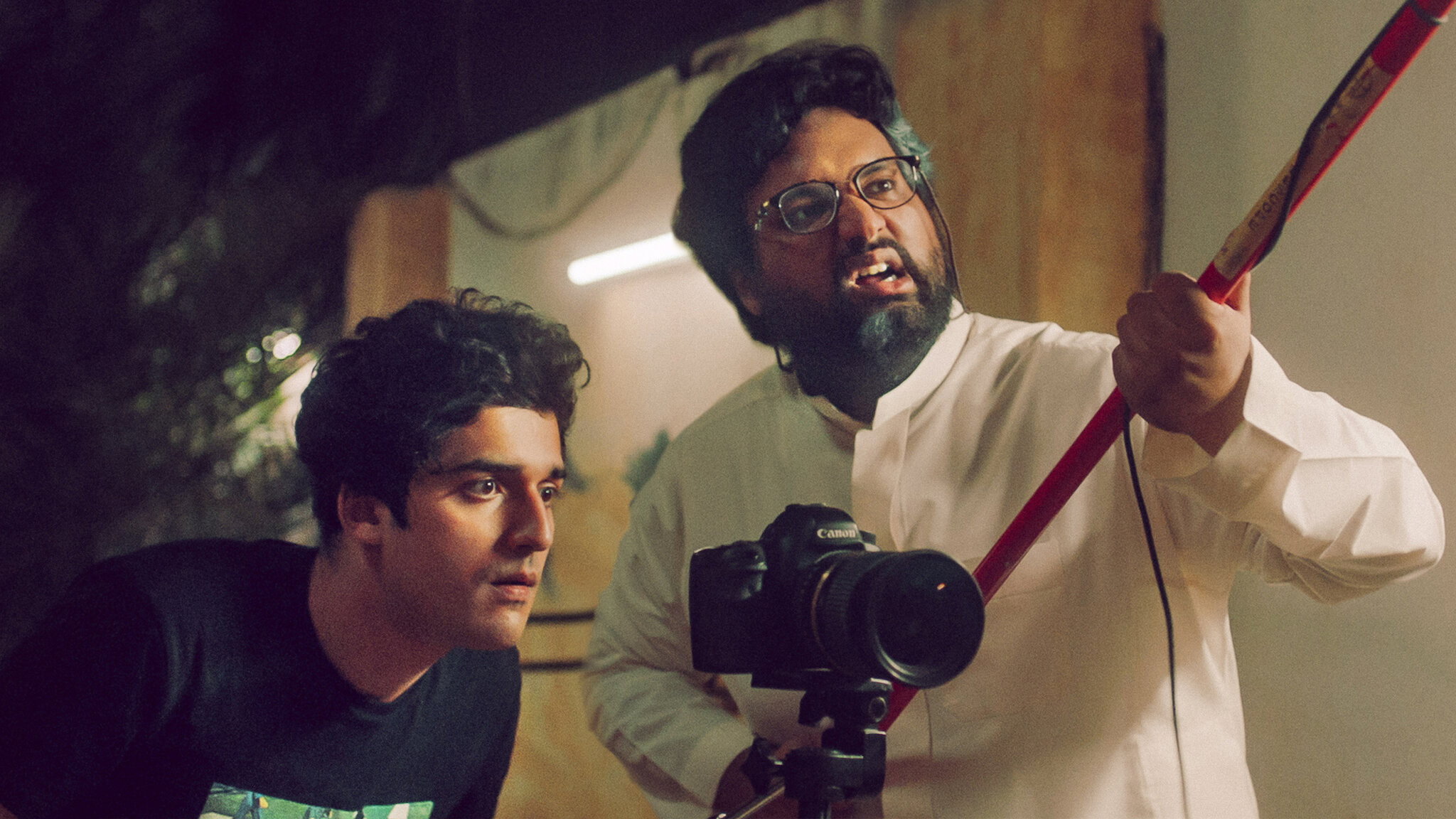
This is a necessary introduction to our discussion of the Saudi film (Shams Al-Ma’arif) «شمس المعارف» when we acknowledge that the filmmakers (the brothers Faris and Sohaib Godus) join the cinema world through the creation and streaming of content on YouTube. Not only them but the protagonists, without exception, have many experiences in this field, as they all emerged from the realm of content creation to the extent that they dedicated their film, Shams Al-Ma’arif, to all content creators in Saudi Arabia.
This aligns with the theme of the film itself, which tells the story of a young man who uploads short clips on YouTube and dreams of making a cinematic film with his friends. This leads us to link the phenomenon of content creation with the art of cinema: has content creation become the Saudi youth’s gateway to the world of cinema? Is this an indicator of the dominance of content creation culture over the arts in general and cinema in particular? Or is it the first step taken by these talented youth towards the world of cinema?
The year 2010 marked the peak of content creation in the Kingdom of Saudi Arabia. Many content creators appeared on YouTube, and content creation became a refuge for talented individuals in fields such as acting, writing, cinematography, and directing, especially given the monopoly of producers over official media and satellite channels.
Comedy became the dominant genre in this content, due to the fact that comedy television series served as a successful model that shaped the artistic awareness of this generation and continued to influence it for years to come. One example of these series is (Tash Ma Tash) «طاش ما طاش», which aired for 15 years starting in the mid-nineties (as a matter of fact, the film strongly criticizes the series and accuses its characters of racism).
With the development of life and its rapid pace, along with the diversity of sources of fascination and attention, these youth have rebelled against the old comedy stereotypes and established new comedy stereotypes through YouTube channels. These stereotypes have progressed into massive production entities that bring together these young talents and produce works that are widely broadcast, garnering hundreds of millions of views. The content creation has grown into creating cinematic films, and Netflix even took advantage of this success and started broadcasting some of these films, such as (Alkhallat+) «الخلاط» and others.
Sohaib and Faris Godus belong to the previously mentioned production entities, where they presented successful programs that garnered large viewership and shone brightly through the content of “Telfaz11” on YouTube. Faris specialized in directing and editing, while Sohaib excelled as a comedy actor, and together they created a short film titled (Predicament in Sight) «ومن كآبة المنظر» in 2017 and then presented their first long feature film, Shams Al-Ma’arif, which received the support from the Red Sea Film Festival Foundation, marking a confident step into cinematic production.
A Girl in a Boys’ School
Shams Al-Ma’arif revolves around Khaled (Baraa Alem), a high school student who despises studying despite his parents' insistence. His hobby is filming comedy clips with his classmate Maan (Ismail AlHassan) and sharing them on YouTube. Khaled films these clips inside the physics lab, where the man with a hysterical personality, Professor Arabi, played by Sohaib Godus, discovers what they are up to. As an audience, we discover, in turn, the spontaneous, funny character who is passionate about art and has enriched the film with a comedic performance that quits the use of fabrication and vulgarity in cooperation with Ismail AlHassan, who has a distinguished comedic presence.
Their fellow classmate Ibrahim (played by the rapper Ahmed Saddam) joins them, and they all collaborate to make a horror film inspired by the pages of the book Shams Al-Ma’arif. This novice team has no choice but to film in the school, to the extent that they smuggled an actress into the boys' secondary school. Starting from there, paradoxes and clashes arise between the characters that constitute the comedic impact of the film, in addition to clashing with the school principal, Mr. Musleh (Nawaf Al-Shubaily), who mastered the role of the director who hated art and talented people.
The film subtly criticizes educational institutions and addresses the issue of parental guardianship, which stifles ambitions and dreams.
Film and Phenomenon
The distinctiveness of the director's cinematic style is the most important feature because cinema is a unique form of art that carries the vision and mark of its creator, who formed the film in his imagination first before filming it. The real film is that it defies time; the more days pass by, the brighter it becomes. Whereas the creation of online content, in particular, has other goals, including spreading fast and reaching a wide range of viewers, using balanced methods with guaranteed effects, but it shrinks the possibility of experimentation, restricts imagination, and does not come engage with the forbidden, because its goal is guaranteed commercial profit.
This wonderful generation that has written, directed, filmed, and created YouTube videos must be aware that the art of cinema, if they wish to be part of it, is loaded with depth, vision, philosophy, maturity, and visual metaphors. Writing for cinema, with all its artistic techniques, tricks, skills, and development of ideas, is not like writing a “script” for digital content. Moreover, the audience who goes to the cinema on a journey towards an art form that they love and respect is unlike the YouTube audience that consumes content while reclining in their beds.
We indicate to this fact so that the precious opportunity that has become a tangible reality is not lost, cinema in the Kingdom now, with the official attention and institutional support we are witnessing, is worthy of being present on the global cinematic scene, and we cannot deny the existence of commendable experiences that have already left their mark.
Considering that Shams Al-Ma'arif is a first attempt, it is acceptable despite the evident influence of modern Bollywood film techniques and styles, and it would have been better for the film to be condensed to just an hour and a half, seeing how the narrative seemed to be falling apart after the first hour and the repetition of the scenes. Furthermore, the confusing endings stretched beyond need, especially in their struggle to present the film at the graduation ceremony and the dramatic suffocation of the characters within the film, although the opportunity was available to develop the characters and the ideas together.
Faris Godus is a talented director who wanted to pour everything into his film, so the specificity was lost, and the generality increased. I believe his next film will have a clear mark of a promising director. His Brother, Sohaib, is a great comedian, and Baraa Alem is a star who has a bright future ahead.
In the end, Shams Al-Ma'arif is a joyful and entertaining film, aiming to touch the hearts of cinema audiences, but its core and spirit lingers with YouTube viewers.