How can a first experience carry such sincerity, maturity, and the ability to embody a vision and adopt new ideas? We are faced with a mature piece of work crafted by talent and the remarkable determination to create something authentic and distinctive. If we try to analyze it a bit further, we find the creators imprinting themselves on this emotion-filled work.
We may not notice the illusory line separating them from the protagonists of the film; they share their dreams and human concerns. The crisis extends behind and in front of the camera. From this personal and lived experience emerges the significance of the film (Roll’em) «رولم», which I consider a powerful statement, revealing the concerns and aspirations of young filmmakers who have fallen in love with cinema. Their hope and passion drove them to create something so innovative. This film, in intensely eloquent visual language, expresses the shattered dreams of this generation and their sincere endeavor to revive this absent art for its audience and enthusiasts.
It seems that the film's messages, embodying the aspirations of a generation filled with passion, have borne fruit in what the Kingdom is witnessing now—a profound interest in cinema. Dozens of theaters have been inaugurated, events are held to encourage serious experimentation, and support is provided for various film projects.
Whom shall I Seek Refuge with?
With the voice of Talal Maddah and his spiritually charged invocations, Alqurashi begins his film with an intense visual reportage of the historic city of Jeddah. We savor the taste of the houses and feel the views of the alleys that time painted with the brushstrokes of a lover. We inhale the scent of the sea that embraces the city. The documentary shots unfold, capturing the markets, shops, artisans, and even the stray cats peacefully sleeping in the city. This flow succeeds in charging the emotions of the audience with a spiritual energy that aligns with the rhythm and content of the film, which explores the beauty in places and the souls that dwell within them.
Muhammad Nassif's music, with its graceful rhythms, takes us along on a journey of Omar Nizar, played by Khaled Yeslam. He is a young director returning from America after studying cinema. Omar works at an advertising agency, but his ambitions and aspirations go beyond superficial promotional films that he designs for product owners.
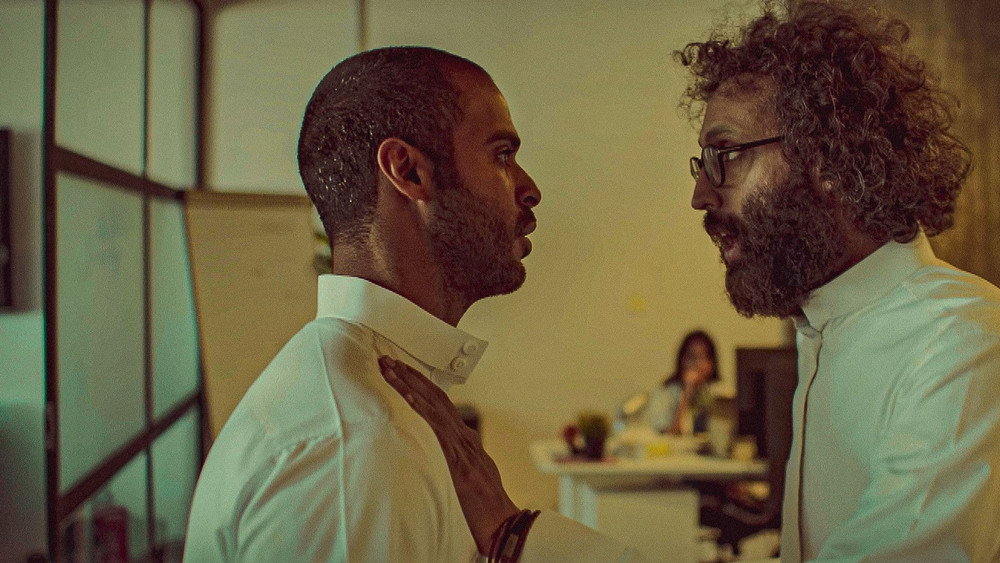
Omar's rebellious and defiant nature continually leads him into clashes. At times, he collides with his closed social reality, landing him in the police station. Another time, he clashes with a client who disregards his ideas and artistry, prompting him to leave the advertising agency. Finally, there is a confrontation with his girlfriend Lina, played by Sarah Taibah, a bright artist, who drives him to insult his rival with classism and arrogance, thanks to his jealousy over her. Lina gets angry with Omar, distancing herself as if he betrayed the pact of this enlightened new generation that believes in the principles of freedom. Omar loses his job and leaves his girlfriend, but he has not lost his dream, which he is still seeking in the streets of Jeddah.
The success and uniqueness of this film lie in the screenplay, written by Alqurashi along with Yaser Hammad. Its smooth and seamless narrative growth, free from the pitfalls of verbose storytelling and diversions, sets the foundation for its success. Additionally, the skillful establishment of characters and taking them beyond the confines of stereotyping and singularity contributes to the film's strength. The interplay between characters results in dialogues that subtly convey messages without feeling forced or deliberate, a skill not often seen in the current landscape of films lacking a well-crafted screenplay.
The Godfather
Omar is serendipitously led to an antique shop owned by a seventy-year-old man named Farid, or Al-Khawajah, who is played by Shaher Al Qurashi. It seems that Omar has found what he was searching for in this cramped place filled with antiques, curiosities, and human marvels. Abdulelah Al Qurashi’s ability to employ this exquisite scenography to create formations rich in symbolism and meaning is manifested. The visuals unfold tales from a distant past, invoking a nostalgic sentiment that captivates the heart and soul. Omar and his friends move within the narrow space; old photographs narrate tales of glory and recite defeats. The voice of Umm Kulthum resonates through the scenes; rare vinyl records fill the view alongside a camera struggling to capture an image of Abd Al-Nasser, which carries many meanings. This visually detailed scenography serves as a dramatic prelude, inviting the audience into the world of this old artist, a cinema lover with deferred dreams and a collector of heritage who generously shares his valuable books and curiosities with those who appreciate and value them. Omar witnesses this nobility, sophistication, and ability to give and let go, falling in love with his new benefactor, who opens his treasure chest for passersby.
Farid's eyes to this world were first opened in Egypt. He studied in Alexandria, where he learned from Youssef Chahine and witnessed the Nasserist dream. He then traveled to France, where he studied cinematography. Upon returning, his dream dimmed. This is how Farid narrates his story, tinged with the colors of time and shaded with melancholy. This character comes to life through Shaher Al Qurashi's captivating performance, demonstrating a profound understanding of the character and the ability to regulate emotions and tones according to the dramatic requirements of each scene. Perhaps Farid, with all the depth and love he embodies, is the human equation for the ancient city that harbors its secrets, silently gazing at the expanse of the sea.
Omar wants to narrate a view of Jeddah just as Youssef Chahine did about Alexandria in his films. That is what Omar told his friend. However, his friend, whose soul is overtaken by the passing of time, says to him, “You remind me of a director who left the cities that opened their hearts to him and returned to Jeddah, where he was defeated because he was alone.” Here, Farid speaks about his shattered dream as if advising this generation to resist and not surrender. Friendship transforms into an artistic encounter between two generations. Omar represents the bright future, and Farid is the father who wants his son to fulfill his dream. They are two lovers meeting in the embrace of one beloved: Cinema.
Uncle Farid’s Cinema
Omar is looking for Jeddah in the faces of people and the stories of individuals. The dream is achieved, and filming begins with him uttering the word Roll'em, which is an abbreviation for “Roll film”. This term is used by Youssef Chahine when shooting his films (the film pays tribute to Youssef Chahine several times). When Omar finished shooting his film with the help of friends, led by Farid, who gets close to the spirit of youth, he wears modern clothes.
Omar begins to think about a place to screen his film, considering Farid’s abandoned Cinema. However, the authorities refuse to grant permission. The dream starts to fade again. After unsuccessful attempts to reopen the cinema, Farid dies in a poetic and beautiful scene, parting ways with Omar at the door as if advising him not to give up. Farid departs, leaving everything to his artistic heir: the antique shop, the old cinema, and, most importantly, the dream. Yes, Omar has inherited the dream.
It seems that independent cinematic works produced by young directors continue to surprise and astonish us. In this work, many elements came together to paint that picture: a cohesive screenplay and a composition that maintains the emotional thread, inspirational music harmonizing with the dramatic narrative, and the wonderful performance of Khaled Yeslam. The beautiful presence of Sarah Taibah and Fatima Husein, along with Saleem Homsi and Naif Al-Daferi, all contribute to this piece. A large group of dedicated individuals, led by Abdulelah Al Qurashi, came together to fulfill his first dream.
The dream is accomplished, and Omar succeeds in opening “Farid’s Cinema.” Everyone gathers to watch the film, which begins with an inspiring word dedicated to the late inspiration. Here, reality blends with fantasy, and we feel like we are among these attendees, standing in respect for the creators of Roll'em who have delighted us with their art.