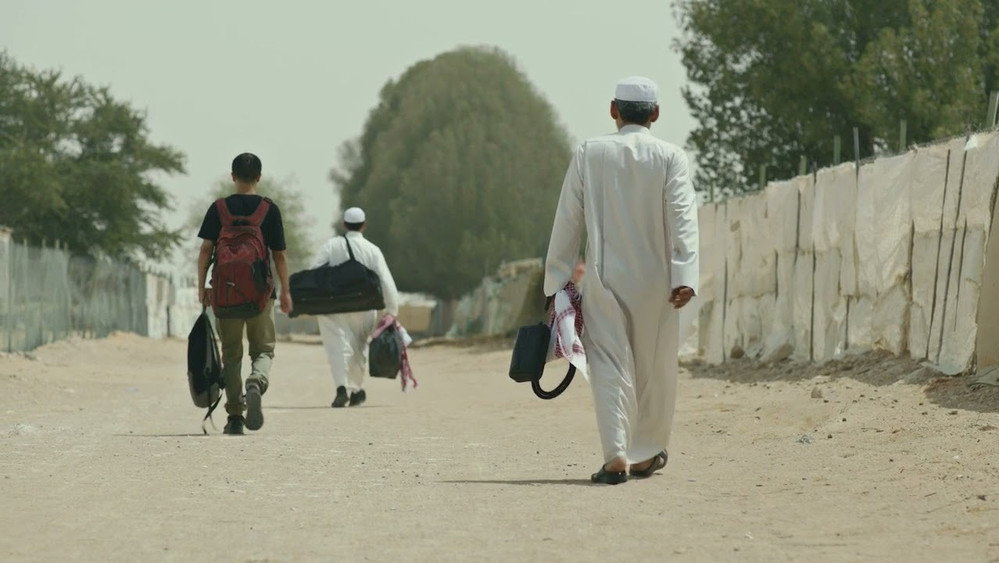
Emirati director Nawaf Al Janahi releases his third feature, (Before We Forget) «قبل أن ننسى», following two previous films:(The Circle, 2009) «الدائرة» and (Sea Shadow, 2011) «ظل البحر»- in addition to a lengthy collection of accomplished short films.
In Before We Forget, a Saudi-Emirati production filmed in Abu Dhabi, Al Janahi attempts to offer a different cinematic experience compared to his previous work, with a focus on narrative structure, aesthetic execution, and the symbolic use of visual elements.
In the film, Al Janahi sets out to describe human emotions visually and to capture the emptiness that encircles souls in a cinematographic language that is abstract and transcends the desire for spectacle. It draws on what lingers in memory, while the visual narrative stretches across the barren desert, evoking a state of inner desolation and the distances that have invaded spirits, turning them into arid valleys stripped of their once lush vitality.
The film delves into the crises of its lost characters and the problems they face in life, narrating through a deliberate rhythm the estrangement of emotions and memories long forgotten, only for them to resurface and be recounted through the remnants of nostalgia.
The screenplay, penned by British writer Ron Thomson, exercises restraint in every aspect. We are not confronted with a developing central idea, narrative threads that extend and intersect, or conflicts that escalate alongside events. This was perhaps intentional, a deliberate choice to delve into the inner worlds of its tightly bound characters within a framework free of narrative complexity and dramatic twists.
The film revolves around three characters from different generations — a grandfather, a son, and a grandson — who embark on a challenging journey to uncover a hidden secret buried on the grandfather’s abandoned farm.
The Old Tree
Veteran actor Ibrahim Al-Hasawi plays the grandfather, Ismail, the most richly drawn character in the film. He is a man from the remnants of a more beautiful time, upon whom age has left its mark through bouts of forgetfulness and a stubborn, childlike disposition. Yet he still remembers his wife Fatima and tends to the lemon tree that reminds him of her.
He recalls: “Fatima used to plant fruitful trees along the road for passersby,” yet he can barely remember his grandson Omar, played by Ghazi Hamad. For him, the world exists only through his son Muhammad, a physical therapist who cares for him with the help of an Asian housekeeper who has not been paid for months. Ismail constantly asks about the dogs on his abandoned farm and who feeds them; his son answers, for the thousandth time, that they all died many years ago.
Al-Hasawi delivers a nuanced and deeply felt performance, conveying the psychological complexity of a man standing on the threshold of death, clinging to any memory he can while seeing only the faces of those who have already departed. He makes us laugh at times and brings us close to tears at others.
The Linking Piece
Mishal Almutairi plays the son, Muhammad Ismail, the film’s central figure. He is grappling with a severe financial crisis stemming from the renovation of his medical clinic and his inability to repay a debt to a contractor acquaintance who pursues him with threats of imprisonment. This, however, is not his only crisis: the woman he wishes to marry has left him, and his only son, Omar, is demanding a substantial sum of money to start his own business, a hope Muhammad cannot bring himself to disappoint.
Caught between his ailing father’s vulnerability and the estrangement of Omar, who lives apart with his mother, Muhammad struggles to satisfy everyone. He attempts to resolve his crisis by persuading his father to sell their large house, but Ismail staunchly refuses and instead reveals to his son the secret of money buried on the farm near a Mesquite tree. Yet how can Muhammad trust the words of a man whose memory has been consumed by time?
In the end, he finds himself pursuing this last hope as the only way to save himself from imprisonment, and the journey of the three men into the unknown begins. Al Janahi takes us on a visual journey across vast deserts, where the landscape transforms with a narrative rhythm and a philosophical dimension. He incorporates documentary shots of landmarks along the long road, which itself becomes a distillation of life’s arc, with all its suffering. This gathering of three men of the same bloodline in a car crossing the desert is an intelligent reinterpretation of the stages of human life, a journey through worldly hardship tinged with absurdity.
All for You, Fatima
In a sublime scene, the grandfather breaks into a frantic run, pursued by his breathless grandson and son. When he falls, they ask him why he ran, but he does not know. He searches for the scent of the departed, speaking of his kind-hearted wife in a scene brimming with tenderness and romance, while his son and grandson remain preoccupied with the buried treasure. When hope fades and they find nothing, Muhammad confesses to his father that he gambled the money away in the stock market and lost it all.
Here, the greatness of fatherhood - its capacity for unconditional support, persisting even through the erosion of memory - becomes clear. The grandfather reveals that the tree beneath which the money is buried is not the living Mesquite tree Muhammad and Omar have been digging under, but a severed root nearby. Hope is renewed and the digging resumes. After finding the money, however, they are surprised by Fahd, the contractor. In a somewhat clumsy scene, he effortlessly takes the money from them at gunpoint- a fake gun, it turns out - and flees.
In an earlier scene, Fahd had already caught them unearthing a buried bag containing only glass marbles, a detail for which the film offers no convincing explanation, other than to engineer a contrived moment that paves the way for a revelation between Omar and his father.
After the loss of the money, emotions rise to the surface and the screenplay begins to reap what it has sowed. The grandfather plants a tree by the road in memory of his beloved wife. Omar abandons his selfish demands, and Muhammad becomes the link between the two generations, showering them with the love he himself so deeply needs.
The screenplay reserves its happy ending for the final scene, which unfolds around the dining table, where Omar discovers that his grandfather had quietly tucked away a considerable sum of money in his medication pouch, unknown to them all.
The film successfully achieves its desired goals through a cohesive team led by Nawaf Al Janahi. Among its members is Egyptian cinematographer Tarek Hefny, who has previously worked on significant projects such as (Rags and Tatters, 2013) «فرش وغطا »,(Microphone, 2010) «ميكروفون», (Al-Qot)«القط», and (18 Days, 2011) «يوم 18». The editing was handled by Ali Saloom, with Martin Sullivan serving as production designer. Taha Al-Agami provides the musical score- piano melodies that seem to emanate directly from the soul, carrying an enchanting dramatic impact.
The film is further distinguished by the remarkable on-screen harmony between Mishal Almutairi and Ibrahim Al-Hasawi, marking their second collaboration following the short film (The Bliss of Being No One) «فضيلة أن تكون لا أحد», which earned several prestigious Arab film awards.