Since the Renaissance, art has turned its gaze toward “place/space” as its foremost source of inspiration. The painting became the cradle of the artist’s contemplative vision—absorbed in the depths and dimensions of place, from vast natural landscapes to the intricacies of urban form. Yet the arts did not settle for merely capturing an abstract image of place; they transformed it into a canvas upon which the artist could read the self and its emotions, until the artist and the place became reflections of one another.
With the development of cinema, both critics and filmmakers grew increasingly fascinated by the potential of space once they recognized its vast aesthetic power. Like the early theorists and pioneers of the visual arts before them, they found their own way to illuminate and explore it—turning cinematic space into a kind of boundless studio, where the self could be projected and re-framed conceptually, rendering place a field of multiple meanings. Through time, place has continued to challenge the artist—from its own roughness and hidden complexities to the difficulty of capturing it cinematically in a way that moves beyond surface representation, where idea, meaning, and geography converge within the frame.
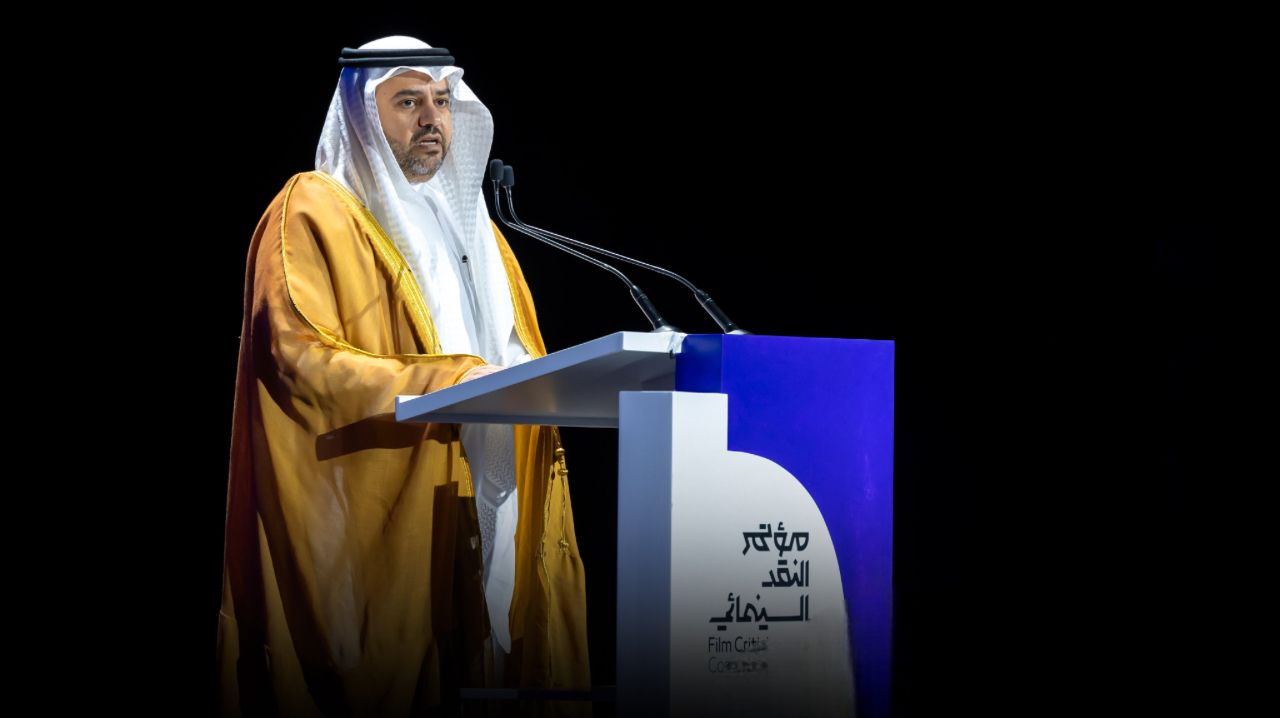
In its third edition, the International Film Criticism Conference arrived with renewed momentum—this time through the gateway of “Art of The Place,” exploring its aesthetic language and its power to reshape narrative and reorient storytelling. The Film Commission announced that the conference would hold its third edition in Riyadh, from November 7–9, 2025, under the theme “Cinema… Art of The Place,” at the Cultural Palace in the Diplomatic Quarter. After touring cities distinguished by their unique geography and landscapes, the conference now settles in Riyadh—a city where heritage and modernity meet—to continue its journey of deepening cinematic dialogue across the Kingdom.
Place in Italian Cinema
In Italian cinema, place occupies a privileged position. Italian cities—ancient or modern—possess an irresistible visual allure and artistic potential, making them a constant motif in Italian Neo-realism. Unlike other European cities, the Italian city stands as a space where modernity and post-modernity intersect—an aesthetic arena through which Neo-realist filmmakers framed the vitality of life flowing through Italian streets, capturing the living bond between human, city, and countryside.
As Italy underwent great transformations, the street itself became an open page upon which history was written. Filmmakers came to understand the city’s importance as a historical, social, and artistic medium. Thus, the street moved from reality to screen—cinematically framed to reveal new dimensions of its subjects and to redefine the city in ever-changing forms.
In this context, to highlight the importance of place in Italian cinema, this theme received the largest share of events and sessions. From the opening session that delves into the aesthetics of Italian cinema—hosting Italian director Marco Bellocchio as guest of honour for this edition, where the urban space shines as the dominant aesthetic element in Italian cinema. A distinguished session follows with film critic and Director of the International Museum of Cinema in Italy Carlo Chatrian delivering an in-depth talk about transformations in contemporary cinema, and the relation of directors to their world and their audience. He highlights examples from Italy and from other parts of the world.
Regarding the city of Milan—an enclave of art and cinema—researcher Chiara Spagnoli Gabardi introduces her concepts on cinematic representation of cities, reviewing the strong relationship between her city and cinema. This historic city, long associated with numerous films, directors and events, has become a mirror of Italian cinema and its transformations. The critic begins with Italian films set in Milan such as Visconti’s famous (Rocco and His Brothers - 1960) and ends with (House of Gucci - 2021), which presented the city from a contemporary American perspective. Through her reading, the Italian critic explores how cinema’s look at cities shifts over time and across cultures.
Drawing on Bernardo Bertolucci’s cinema, critic Saeed Al-Mazwari and researcher Eva Peydro Sanz explore the narrative power of place—not as mere décor, but as a psychological and existential mirror for the characters. Films like (The Dreamers - 2003), (Last Tango in Paris - 1972), and (The Last Emperor - 1987) show how enclosed environments, expansive spaces and architecture become media for expressing isolation and internal conflict. Sanz highlights how Bertolucci’s use of setting turns space itself into a living, symbolic entity.
The Conference as a Cinematic Atlas
Cinema, at its essence, is a vehicle for travel through both time and place; through which we explore humanity’s inner worlds and diverse cultures. Every city is both a cultural facade and a mirror of human experience. In this sense, the International Film Criticism Conference has woven its own cinematic atlas: tracing cities across the globe to capture their cinematic magic, revealing how filmmakers have succeeded in framing the world’s metropolises and giving voice to their hidden narratives through the camera’s gaze.
From Milan to Dhaka and Tbilisi, on to Beirut and Alexandria, from Portuguese cinema to Kazakh and Georgian film, and ending with Arab cinema, sessions and presentations pass between cities to capture their enchantment and record the vibrant interaction between human and city, demonstrating how the filmmaker succeeded in presenting cities cinematically.
A View on Place in the Arab Sphere
In Arab cinema, the local environment—rich in both material and spiritual depth—has long stood as the Arab filmmaker’s greatest inspiration and most fertile ground. It remains an inexhaustible treasure that artists continually revisit: at times with the dissecting eye of the critic, and at others with the wonder of one seeing the world anew.
The desert, as the most mythic, poetic, and dramatic of spaces, receives particular attention in a special session featuring Saudi filmmaker Abdullah Al-Habib and critic Rami Abdel-Razek, who embark on a journey through the desert’s cinematic poetry and enduring allure—a space that has long captivated Saudi and Arab directors alike. The discussion highlights Saudi films such as (Hobal - 2024) and (Hajjan - 2023), alongside the North African production (Deserts - 2023), exploring how filmmakers transform the desert’s vastness into a site of beauty and contemplation.
In celebration of Arab cities and capitals, a rich panel discussion will explore the memory of cities in cinema—from Cairo to Beirut, Damascus and Riyadh, reaching Alexandria—presented by Dr Soumaya Dhemaied and Dr.György Báron and director Ammar Ezzat. Meanwhile, Ali Al-Majnouni takes place from the vantage of place as memory, discussing how geography transforms into character in film through varied readings of cities in movies.
From the Magic of Place to the Realm of Criticism
Each year, as the Film Criticism Conference concludes, it rekindles a vital question: What role does film criticism play in advancing cinema?
This year’s edition offers a series of workshops and masterclasses dedicated to the tools of cinematic analysis. Canadian critic Mark Branson and scholar Richard Peña share their insights on reading films critically and uncovering their aesthetic and artistic layers. Additional workshops feature Fahd Al- Astaa, who explores the foundations of film criticism, and director Sara BalGhuneim, who delves into methods for analysing visual language in cinema.
Criticism remains the beating heart of any cinematic movement—a comprehensive practice grounded in deep understanding of cinema as both art and industry. Through critical analysis and theoretical reflection, the critic excavates the aesthetic core of films, fostering continuous renewal in cinematic form and vision.