“The Bless of Being No One - 2016” «فضيلة أن تكون لا أحد» is the first real cinematic experience of the young Saudi director Bader Alhomoud after previous attempts that did not live up to the depth of this work. Though we are faced with a visually limited dialogue film, which relies in its basic structure on a long monologue between two strangers who met by chance, the splendor of this short film lies in its success in influencing the viewer’s conscience and capturing his attention without falling into a single moment of boredom. This is achieved through an eloquent dramatic operative loaded with meanings and connotations and the performance of a balanced and calm representation that avoids melodramatic exaggerations. The film features only a camera mounted on the front of a car that travels a long road and two men whose hearts are overflowing with stories that tell the agony of loss, the absence of loved ones, and the fragmentation of the soul.
Abu Mohammad, who is played by Mishal Al-Mutairi, is a young man in his thirties, wandering aimlessly and driving his car without a destination in mind. He cannot face the image of his son mounted in the rearview mirror. He drives down the roads, fleeing from painful memories and a bitter reality. He is a broken man, his soul having just departed, his body still trembling. His voice is filled with sorrow, and his features are etched with worry and gloom. It seems that this man has suffered the most severe calamity that a person can experience: losing a child.
Abu Mohammad lost his son near a Zamzam well four years ago. He searched for him tirelessly but to no avail. He eventually lost all hope of finding him. This is revealed in the context of the dialogue, which begins when he pulls over in front of a man in his seventies, Abu Naji, who is portrayed by Ibrahim Al-Hasawi, and who is waiting for a taxi on the side of the road under the scorching sun.
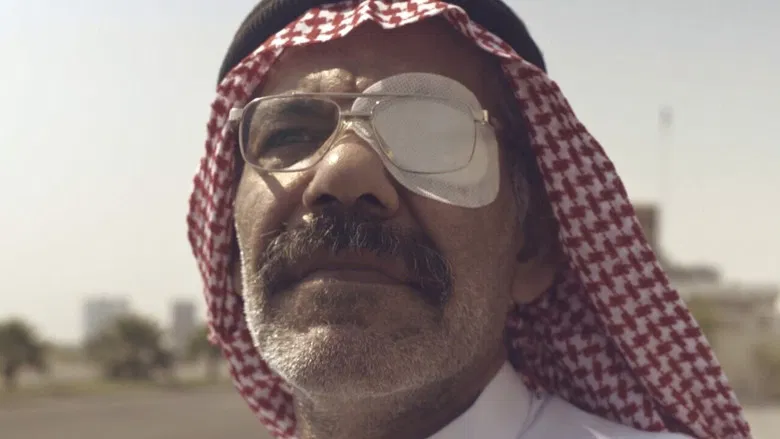
Abu Mohammed offers to take him to the bus station. Even though his heart is still burning with the pain of loss, his chivalry has not dried up. We learn that Abu Naji is coming from Bahrain and is on his way to Riyadh to see an ophthalmologist. The surgical bandage covering his left eye is visible through his large glasses. He also lost his son, who had drowned in Adhari Springs. However, God compensated him after Naji’s death with nine daughters.
Abu Naji, whose son drowned, discovers that the death of his son is easier to bear than losing him and not knowing where he was. The loss of a child is a new death every day, and what a difficult test this is.
This sad atmosphere is reminiscent of the beautiful film “Manchester by the Sea, 2016” and the father whose soul was broken after the loss of his children.
In a recent interview, director Badr Alhomoud said: “Cinema is the language of images, but dialogue is also an essential element. In this film, I felt like a writer more than a director.”
Bader Alhomoud relies on long, one-shot recordings, but he maintains the smooth flow of his films through a script that is heavily focused on dialogue. This requires actors to memorize pages of dialogue for each shot, which could have easily led to a loss of rhythm. However, Alhomoud’s skill as a director and his actors’ commitment to their craft have ensured that the film maintains a strong sense of momentum.
The central theme of the film is the theme of loss in its many forms, beginning with the loss of a son, whether through death or disappearance, followed by the loss of a beloved wife, with whom life is no longer possible after the loss of a son, and then the loss of Abu Naji’s eye, and finally the loss of memory, as we see in the character of the father who suffers from memory impairment. This is why Abu Muhammad cannot see the fingerprints of his lost son, and Abu Naji cannot see the footprints of his son that have been carved into the ground. It is as if those we have lost are still alive and present through the traces they have left behind.
After they arrive at the bus station, Abu Muhammad discovers that the drivers there know the man and refuse to give him a ride, laughing. Abu Naji gets out of the car in a hurry, as if he is fleeing. There must be a secret that we don’t know, and the moment of its revelation will be postponed until the last scenes of the film.
Abu Naji forgets his glasses in the car. Abu Muhammad follows him and invites him to a cup of “Karak” while they wait for the bus. The scene cuts to a long shot of the two men sitting at a cafe table. They begin to talk, and their conversation quickly turns to the crisis of introversion and the nature of people who have become like isolated islands after the lack of dialogue, convergence, and widening distances.
Abu Naji asks his companion, “What scares you the most?” He tells him, “I fear the day when my father with Alzheimer's won't remember me.” Here, the loss of loved ones while they are still alive is a special kind of pain. Abu Naji remembers his late wife, but the thing that scared and terrified him the most in the past was the moment Talal Maddah fell dead. He describes how difficult that moment was for him and the audience of this great creator who was associated with art. Here, the dialogue does not miss the opportunity to pass a message condemning religious extremism.
In the end, after the two men parted, the moment of revelation comes when Abu Naji removes the bandage from his eye. We realize that he is not blind and that everything that happened before was a trick that he had been playing all day. He waves to another car after replacing the bandage on his eye. He gets in the car and introduces himself as Abu Muhammad, saying that he lost his son in Makkah. He repeats everything he hears from Abu Muhammad as if it were his own and listens to the story of the new driver, who will be meeting his twin brother in Pakistan.
Abu Naji lives through all the stories. He hears them and repeats them with the passengers he rides with because he has no story of his own. He escapes from the cruelty of loneliness, getting lost in the crowd of tales and human stories. He creates his own world with his characters, whom he summons and banishes at will. He hides from a reality in which he feels lost and alone.
Infused with the art of the short story, the film captivates with its paradoxes, symbols, and intricate character development. However, the narrative's effectiveness is somewhat hindered by protracted scenes and dialogue that disrupt the camera's pacing and the story's momentum.
Meshal Al-Mutairi and Ibrahim Al-Hasawi are a successful duo whose special chemistry has given this work a great deal of cohesion. However, Bader Alhomoud, the writer and director of this wonderful work, is the real hero.