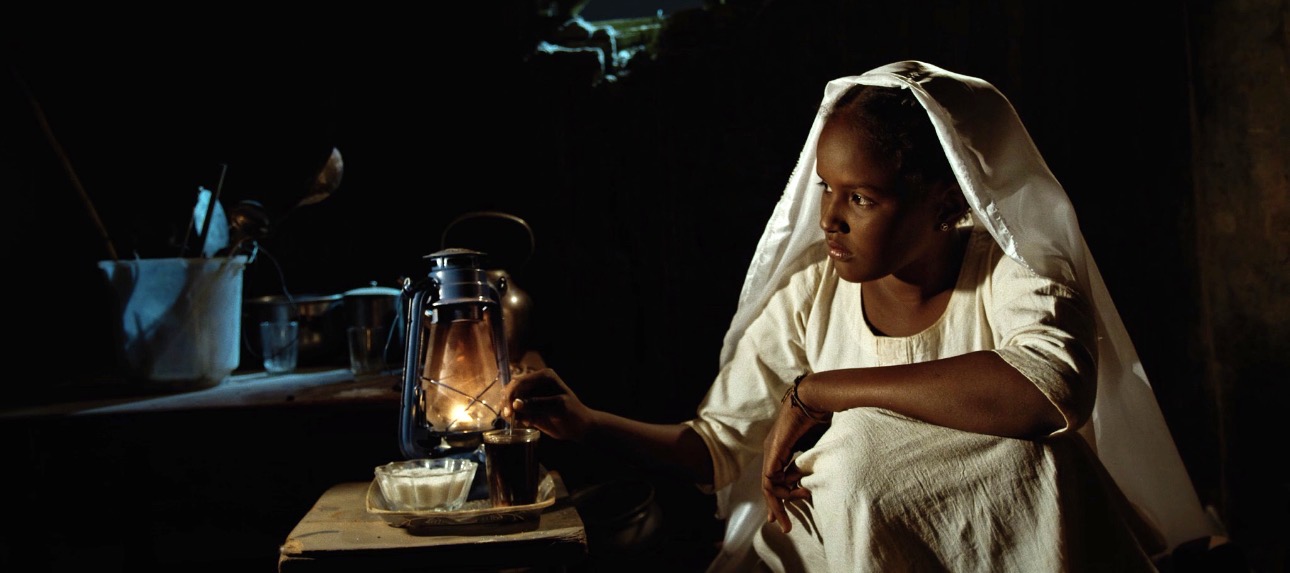
The Sudanese film (Al-Sit, 2020) الست, written and directed by Suzannah Mergani, won the award for Best Arab Short Film at the Cairo International Film Festival for Short Films. This award adds to the numerous awards the film has received during its participation in Arab and international festivals.
The film received multiple support and funding, winning the award presented by Canal Plus Cinema, the French channel, at its international premiere during the Clermont-Ferrand International Short Film Festival in France. It also received the Development Workshop and the Production Grant from the Doha Film Institute, as well as the Production Design Grant from Virginia Commonwealth University in Qatar, during its world premiere at the latest edition of the Ajyal Youth Film Festival in Doha.
In Al-Sit, Suzannah tells a delicate love story between a girl and a boy, Nafisa and Babakr. Their love faces a crisis when an expatriate man, returning from abroad, proposes to marry Nafisa. The family, especially the mother, finds it difficult to reject him because he is handsome, wealthy, and charismatic, and tempts them with a major investment project. However, according to tradition and the father’s insistence, the final approval must come from the elderly grandmother, Al-Sit, who strongly opposes the marriage. Nafisa spends a day with her grandmother, sharing her life experiences and personal struggles. She then returns to meet her beloved boy, and they continue their innocent love story, while the expatriate man marries the neighbor’s daughter.
The director, Suzannah, possesses a strong cinematic language that allows her to imply rather than explicitly state. She goes beyond conventional storytelling to express herself through a cinematic style that relies on the skillful deployment of various film tools. The imagery almost speaks for itself, and lighting plays a significant and prominent role in giving the images their drama and beauty simultaneously.
The internal and external scenes blend in a skillful montage, adding realism, authenticity, and charm to the image.
The director guides the actors’ movements: Mihad Murtada, Rabeha Mohammed, Mohammed Magdi, and Haram Bashir. She provides them with sufficient space to express agility and flexibility. Through them, she conveys her witty sensibility. The mother, as she walks out onto the street with the groom, showcases her pride and flaunts her actions and voice, while the camera captures her with expertise. As for Nafisa, she relies on the language of silence to express her confusion and lack of experience. The elderly grandmother possesses sufficient space and appropriate dialogue that suits her nature and captivating personality, giving the film its social character and simple philosophical vision.
On the other hand, the film heavily relies on wide and long shots that sometimes resemble a theater stage. This style has become common in independent films, particularly due to production constraints or the nature of this type of film. However, this approach often detracts from the effectiveness of the work. Close-up shots appear necessary, even essential, in many instances to capture emotions and details that wide shots cannot convey. This is an issue worth considering for young filmmakers, regardless of its contradiction with the postmodernist approaches they adopt.
Despite this, Al-Sit is overall one of the best Arab short films that have been screened in recent years, if not the best. It also confirms the artistic ability of a new generation of Sudanese filmmakers, in particular, to deal with heritage and traditions in an advanced artistic style. It discusses and re-examines them with a progressive consciousness that does not hide behind false claims of sanctity and misguided concepts. It challenges those who appoint themselves as guardians and those who claim to possess absolute truth.
Many outstanding works in Sudanese cinema often emerge from this approach of confronting outdated customs and traditions that need to be re-evaluated. Among these works, the films (You Will Die at 20, 2019) « ستموت في العشرين» and (Talking About Trees, 2019) «حديث عن الأشجار» have achieved significant accomplishments in winning awards at major international and Arab competitions, not only in Sudan but also in the Arab world.
Undoubtedly, Al-Sit joins them, having won numerous important awards that are difficult to enumerate. These include Best Director at the Beirut International Women’s Film Festival, Best Short Film and the Sherman Award at the Zanzibar International Film Festival, Best Short Film at the Ismailia Film Festival, Special Mention and the Emerging Filmmaker Award from the Arab Film Festival in Toronto, the Grand Prize at the Tampere Film Festival, which qualifies for the Oscars, Best Screenplay and Special Mention at the Huesca Film Festival in Spain, the Jury Award at the Busan International Short Film Festival in Korea, and the Excellence Award for Best Filmmaker from the European Independent Film Festival in France.
It seems that Sudanese filmmakers from the new generations are eager to continue what was interrupted in the field of cinema after a long absence and a significant decline in production. Even though Sudan has been acquainted with cinema since 1912, its cinematic output has been limited. Serious attempts to achieve advanced films in terms of ideas and style are almost confined to a few films, including the works of the late Sudanese director Gadalla Gubara, one of the founders of narrative cinema in Sudan, with films such as (Tour Elgar in the Clinic) تور الجر في» «العيادة, (Tajouj and Mohallak), (The Sheikh’s Blessing) «بركة الشيخ», and (Les Misérables), as well as the experiment of the late director Anwar Hashem in (Eyes Journey, 1983) «رحلة عيون». Then came the stage of the first cinema students, including Ibrahim Shaddad and At-Tayeb Mahdi, and most of their works were characterized by an experimental and mixed approach between narrative and documentary.
In reality, despite the difficult political and economic circumstances that Sudan is going through, its talented individuals have managed to achieve and reveal themselves. This confirms that talent is like a fetus ready to come into life, and it will not be deprived of the means to do so.
In the absence of stable film production companies with comprehensive plans, coupled with the lack of support and state production, all these successful Sudanese films that are being realized these days largely rely on independent production, with support from some international institutions and Arab festival platforms. It seems that this is the only way for Sudanese artists to achieve their cinematic aspirations under the current circumstances.