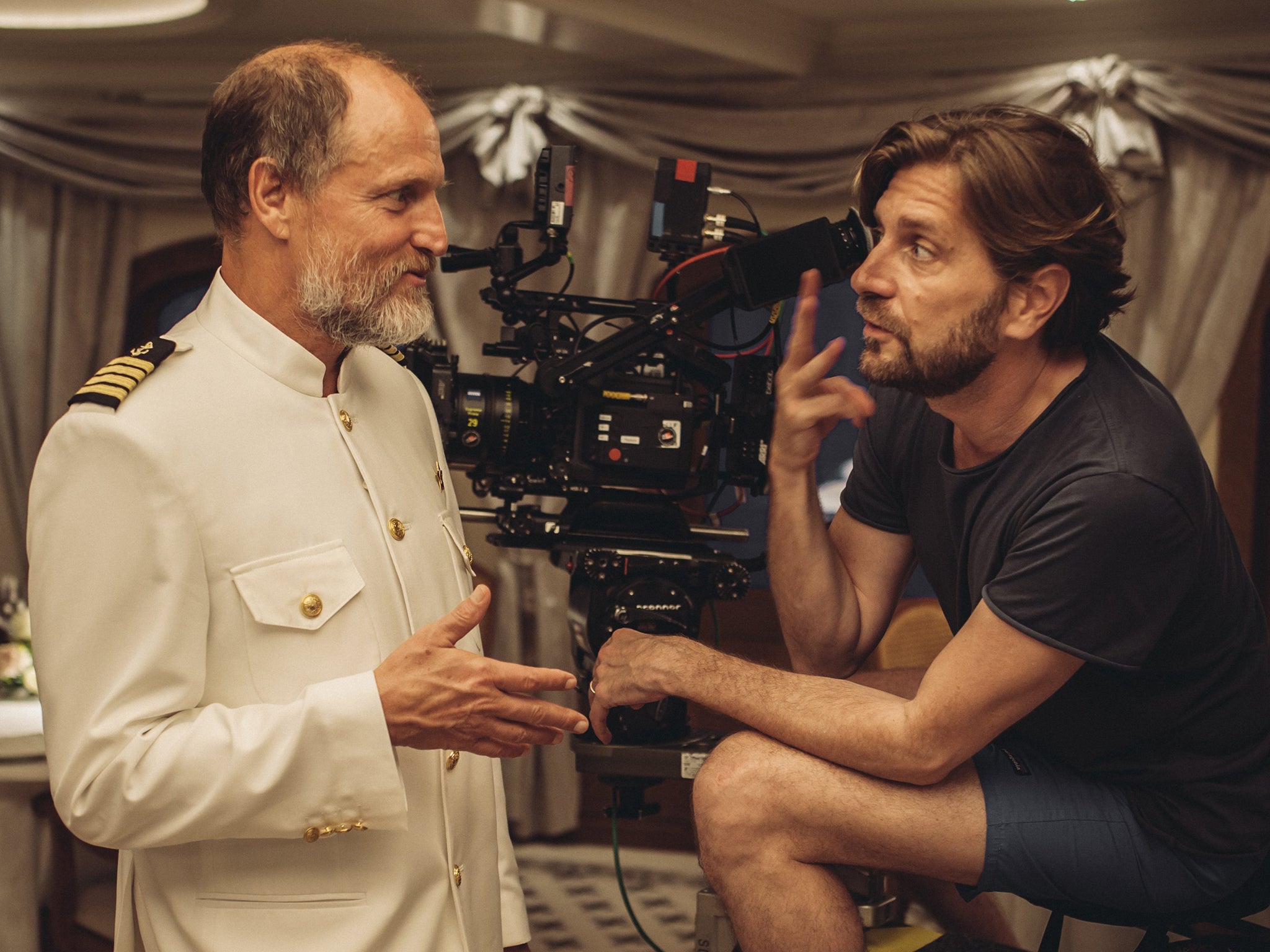
Ruben Östlund, a Swedish director who does not conceal his frustration with Ingmar Bergman, not only in relation to the latter’s films, which embody a vision entirely different from his own, but also through his openly expressed comedic tendencies that frequently surface in his sharp and often sardonic remarks, as evident across all his films and even in his responses when questioned about Bergman in the press and media.
In a documentary by the German director and actress Margarethe von Trotta entitled (Searching for Ingmar Bergman, 2018), Östlund appeared expressing his discomfort with Trotta’s decision to invite him and question him about her revered director, “The Master” Bergman. With a tone that is playful, ironic, and somewhat impatient, he remarks in the film that he prefers Bo Widerberg and Roy Andersson to him.
Claes Olle Ruben Östlund is a director, screenwriter, film editor, and producer. He was born on April 13, 1974, in the Gothenburg archipelago in southwestern Sweden.
He grew up in the town of Styrsö, where snowfall is rare and for which he openly expresses deep affection, a setting that would later feature prominently in one of his most significant films. For this reason, he spent his winters in Haparanda. After completing high school, he worked as a ski instructor in the Alps. It was there that he began filming skiing movements and sharing them with his friends. His talent quickly became apparent, leading a film production company to hire him as a cameraman, for whom he continued to produce films on a regular basis.
During his work on these so-called “film newspapers,” he spent five years filming skiing stunts, which were later compiled into films that attracted some attention, though they did not receive substantial critical acclaim.
Following this relatively extended period, he pursued formal training in film directing at the University of Gothenburg (Department of Cinematography and Film Directing). During his three years of study, he directed a documentary that was nominated for the Golden Scarab, a prestigious Swedish film award presented annually across various categories.
After completing his professional training, he made his debut as an independent filmmaker in 2004 with (The Guitar Mongoloid). The film received a mixed, somewhat lukewarm reception, yet it was nominated for Best Film in the Nordic Council countries. Critics consider (Involuntary, 2008), released four years later, to be the true turning point in his cinematic trajectory, as it became a critics’ favorite in Sweden, garnered exceptional international attention, and premiered at the Cannes Film Festival.
His short film (Incident by a Bank, 2009), which won the Golden Bear for Best Short Film at the Berlin Film Festival, significantly elevated his status, positioning him as a potential new “Master” whose cinema demonstrated a striking ability to challenge conventional filmmaking perceptions through a single shot.
It came as no surprise to critics when his third feature film (Play, 2011) premiered at Cannes. The film also received extensive coverage in Swedish newspapers.
However, critical responses were sharply divided, with some accusing him of racism for his portrayal of suburban children in Sweden’s African communities through what was described as a “superior ugly white face.” At the same time, Östlund won the Golden Scarab Award for Best Director for this film. He did not retreat from these accusations, instead reiterating that his aim was to allow the oppressed to recognize how the tools of oppression - typically used against them - could be appropriated and reversed.
In 2014, he directed his fourth film (Force Majeure). Months before its release, considerable discussion surrounded the avalanche scene, which some - perhaps with slight exaggeration - described as an unprecedented moment in cinematic history in terms of its technical precision. The film received a Golden Globe nomination, and Sweden submitted it for the Academy Award for Best Foreign Language Film. It also set records at the Swedish Film Institute’s Golden Scarab Awards in 2015.
Taken together, these achievements made it evident that Ruben Östlund was steering Swedish cinema in a bold new direction. In 2017, his film (The Square) was awarded the Palme d'Or.
There is little doubt that (The Square) places the perceptive viewer in a state of heightened astonishment, as its narrative threads occasionally appear to slip beyond the control of its creators. Yet this impression quickly dissolves as the film unfolds with a form of suspense rarely encountered in cinema. The work operates within a hybrid mode that fuses social surrealism with comedy, aiming to expose the concealed contradictions of modern societies before they fracture under the weight of deeply entrenched conditions produced by contemporary civilization.
(The Square) does not conform to conventional standards of critical evaluation, and the widely circulated claims that Östlund required certain scenes to be filmed over a hundred times may ultimately be irrelevant. While such methods may appear excessive and taxing on both moral sensibilities and endurance, the final outcome unequivocally serves the film, which rightfully secured the Palme d'Or.
The film follows Christian (played by Danish actor Claes Bang), the director of the Museum of Modern Art in Stockholm, who seeks to launch an exhibition titled “The Square,” intended to remind individuals of their social responsibilities within an increasingly anxious and fragmented world. A seemingly trivial incident - the theft of his mobile phone in broad daylight - evolves into a complex situation that propels the narrative into increasingly unexpected directions. As he attempts to identify the perpetrator, and as the narrative grows more intricate, both critic and viewer are compelled to examine the moral compass guiding this successful figure. He becomes entirely dependent on a hired advertising agency to achieve objectives that appear unattainable without it, placing the institution of modern art - backed by an almost omnipotent museum - at risk. In essence, the film reflects both the crisis of modern man and that of modern art itself, which appears precarious and fundamentally rooted in a form of active visual deception.
With (Triangle of Sadness), which earned him his second Palme d'Or in 2022, Östlund adopts an even harsher approach in deconstructing contemporary modernity. His characters navigate a world in which satire and ridicule function as inverted weapons, seemingly directed not only at the characters themselves but also, with precision, at the audience.
What form of intelligence can emerge from such an “unmerciful” critical framework? It can be argued that Östlund’s sophistication is most evident in his use of wide shots, which serve as open spaces accommodating multiple ideological perspectives across both socialism and capitalism, ultimately exposing the inherent falsities embedded within human relationships that have come to define modern civilization.