Unlike the social and comedic works that have dominated Saudi cinema in recent years, Saudi films have broken into the genres of suspense and thriller through several attempts marked by a degree of boldness, earning the admiration of both audiences and critics alike.
Among the most prominent of these films are (Sattar, 2022) «سطار», (Junoon, 2021) «جنون», and (The Matchmaker, 2022) «الخطّابة». Notably, the comedic and social dimensions remain intertwined with suspense and thriller: the former is an action-comedy film, while the latter two belong to the category of social horror. This raises the question: what are the key features that distinguish these films as pioneering works in this field?
To address this question, the following discussion examines the three films in detail.
Sattar «سطار»
In Sattar, Kuwaiti director Abdullah Al-Arak presents a different form of the Saudi film through a simple premise centered on Saad (Ibrahim Al-Hajjaj), a young man who has been passionately attached to professional wrestling since childhood. Upon reaching adulthood and deciding to marry, he seeks to fulfill his professional and social aspirations by practicing this sport, despite lacking the technical and physical qualifications required for it.
The director preserves the Saudi comedic spirit while presenting his idea through the American style associated with professional wrestling, characterized by excitement, suspense, and mysterious nocturnal worlds revolving around deception and betting. The film’s comic parody of wrestling carries an implicit critique of the sport and its mythical universe, which attracts millions of spectators through a shared and tacit acceptance of the permissibility of excess.
The defining feature of professional wrestling as a free-form sport grants the screenplay the liberty to invent situations that generate comic moments, particularly those arising from the contrast between Saad’s limited physical and technical abilities and the strength and fitness of his opponents. This contrast recalls the 1939 Egyptian film (Lend Me Three Pounds) «سلّفني ثلاثة جنيه», starring Ali Al-Kassar.
Suspense and excitement emerge from Saad’s journey, which begins in broad daylight as an insurance company employee and concludes in an underground nocturnal world, driven by his desire to marry Falwa (Shahad Al-Qafari), the woman he loves. This journey carries mythic and folkloric dimensions, which the director successfully situates within a contemporary context by incorporating the virtual world of social media. The result is a striking paradox in which the real and virtual worlds overlap, and the boundaries between victor and defeated ultimately dissolve. In the end, the winner is invariably the one most capable of producing suspense and excitement- the sole prevailing value in a world that no longer celebrates truth, goodness, or beauty.
There may be no message deeper than the simple narrative drawn by the screenplay for its characters; nevertheless, the symbolic meaning of wrestling - as a struggle between good and evil or as a pursuit of success and glory - remains the film’s most prominent theme. This is reinforced by the mysterious opponents Saad defeats and by his ultimate victory in the competition, which enables him to marry his beloved.
Junoon «جنون»
If Sattar clearly reflects the atmosphere of American professional wrestling, Junoon demonstrates a complete correspondence with American horror cinema and, more broadly, with American life itself. The film was shot in the forests of California, and its characters speak a hybrid language combining Arabic and English. Moreover, American culture dominates the lives of the film’s young protagonists, producing a form of cultural alienation in which Arab - and particularly Saudi - cultural features recede into the background. This is evident in clothing, food, and social practices, culminating in a group of young men and women traveling to the United States and residing in a secluded house overlooking a frightening forest, solely to film an adventure for YouTube in pursuit of fame.
A youthful spirit permeates the film both in front of and behind the camera, as most of the cast members also participate in production roles, especially the director, Maan bin Abdul Rahman. Consequently, experimentation governs the filmmaking process: the film dispenses with musical scoring in favor of natural sounds, relies heavily on handheld cameras, and adopts the found-footage technique, lending the scenes a documentary-like immediacy. This approach is integral to the narrative, as the two protagonists, Khaled (Maan Abdul Rahman) and Essam (Saleh Alem), insist on recording every event, no matter how trivial it appears.
Suspense arises from the group’s desire to document a séance intended to summon jinn, an act that exposes them to a malevolent curse that ultimately destroys them all. Only the cameras remain, recording the terrifying fate of those who attempt to turn their lives into spectacles in pursuit of illusory glory. A particularly harrowing example is the scene depicting a young woman drenched in blood, while viewers’ comments flood the channel, reflecting a spectacle-driven society more invested in superficial interaction than in the gravity of catastrophe itself.
Both Sattar and Junoon are shaped by American cultural influences and infused with youthful energy - through rap music in the former and the dynamic handheld camera in the latter. Despite this, both films critique social media culture among young people. Sattar reflects a traditional upbringing that confines youthful aspirations to work and marriage, whereas Junoon depicts a modern upbringing that encourages openness to the world and a willingness to venture beyond local boundaries. For these reasons, the atmosphere of suspense and horror in Junoon proves more intense.
The Matchmaker «الخطّابة»
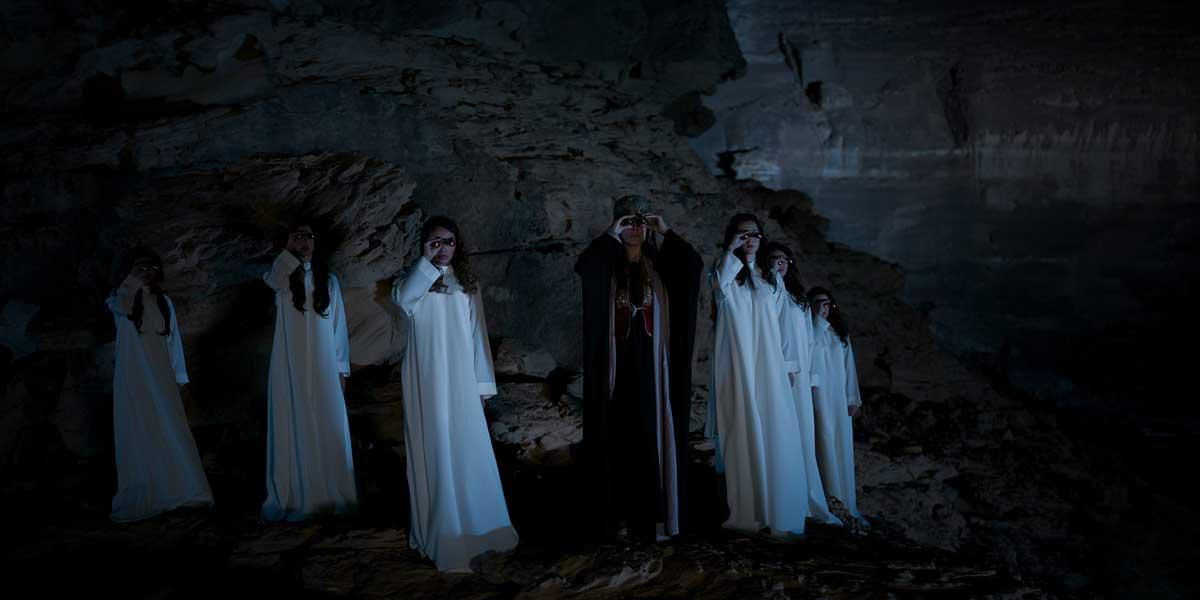
The Matchmaker differs from Sattar and Junoon in that it avoids the pitfalls of experimentation that often lead to cultural alienation. Instead, it draws upon Arabic oral tradition by presenting a local myth passed down through generations, set within a desert mountainous environment- specifically the historic city of Al-Ula -well suited to the film’s atmosphere of terror.
Just as Saad moves in Sattar from the urban surface to the underground world of wrestling, and Khaled and his companions in Junoon journey from Saudi Arabia to American forests, Tariq (Hussam AlHarthi) in The Matchmaker travels from the city to a desert resort. Horror, in this sense, often resides in an unknown fate, particularly when characters embark on journeys fueled by romanticized expectations that sharply contrast with the catastrophic outcomes awaiting them.
The myth unfolds within a small family - a father, mother, and daughter - living in apparent harmony. Yet Tariq feels estranged from his family, especially his wife, and becomes emotionally attached to his colleague (Nour AlKhadra). His infatuation leads him to follow her to a mysterious desert resort inhabited by eccentric figures under the authority of the matchmaker (Reem AlHabib), a powerful woman who promises male visitors the fulfillment of their emotional desires by marrying them to those they love.
The calm rhythm of life at the resort initially creates a sense of comfort for the viewer, but the surrounding atmosphere of mystery and Tariq’s dreamlike hallucinations gradually instill fear and anxiety. The film is rich in symbols, and its strange characters function as codes requiring interpretation. Their language resembles talismanic utterances, while Tariq appears psychologically unwell, or as though hypnotized, within this environment.
Director Abdul Mohsen AlDhabaan skillfully employs the desert landscape and towering mountains to construct a visual language that conveys awe and dread, blending human presence with nature in a manner befitting the myth’s grandeur. Unlike Junoon, Tariq ultimately survives the curse haunting the resort and returns to his family in a state resembling purification. He perceives his wife - perhaps for the first time - as more appealing, suggesting that true magic lies in the meaning of home rather than in perilous desert adventures.
In conclusion, the venture of Saudi cinema into suspense and thriller represents a commendable development within a cinematic movement eager to innovate and move beyond the dominance of social drama and comedy. Although these early attempts have not reached the extreme boundaries of horror, they successfully draw upon both Western and Arab cultural elements to produce works within the thriller genre. The shortcomings evident in these films are characteristic of beginnings, and the future promises further refinement as long as the spirit of renewal persists.