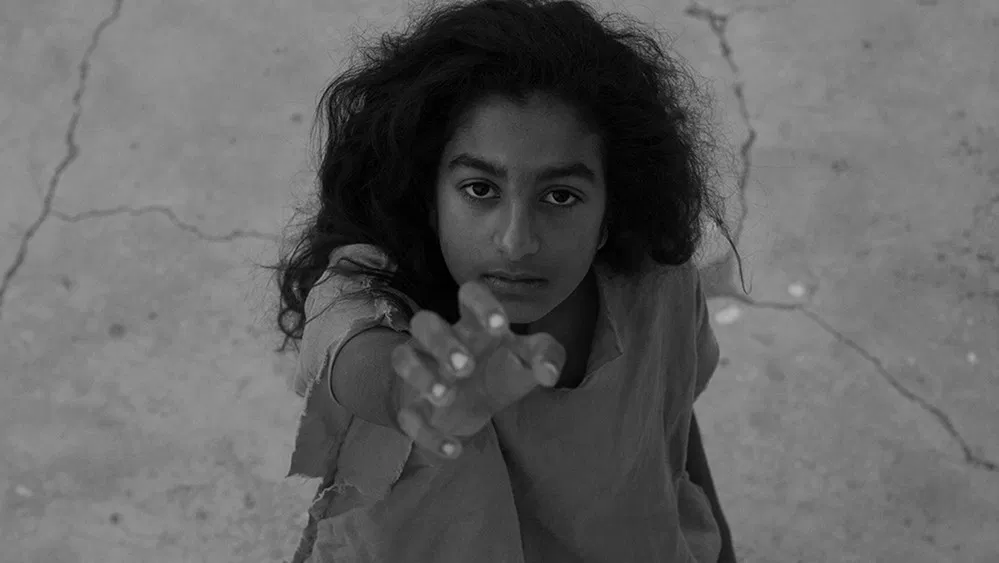
(Scales - 2019) «سيدة البحر» was the debut feature film by young Saudi director Shahad Ameen, who was only 31 years old. In the “Critics’ Week” section of the Venice Film Festival, it was undoubtedly an exquisite surprise, as the film showed great ambition from a young director who clearly assimilated the achievements of the cinematic world.
(Scales) belongs to the realm of poetic cinema, which, although it may tell a story, does so in an allegorical manner. The film revolves around imagination with a deliberate tendency toward abstraction, avoiding specific locations and setting its time in the recent past, before the development of modern fishing vessels. It uses cinematic tools—image, composition, camera movement, light, shadow, montage, and music—in a non-conventional context. Instead of focusing on experimentation and freedom from the plot, it relies on the visual impact on the viewer's mind.
Director Shahad Ameen draws inspiration from reality but weaves it into a series of scenes and shots that encapsulate her vision of female suffering in traditional Arab society. She portrays this society as patriarchal, one that oppresses, excludes, and ignores women, even denying them the right to life. Ameen depicts women as being seen as inferior to men and symbols of weakness. This is evident in the story of the young heroine, Hayat, whose name means "life." The fishermen refuse to let her join them, cruelly depriving her of living her life as she wishes. They claim she is the lowest and weakest, incapable of enduring the hardships of the sea voyages that the men undertake.
Fishing is inextricably linked to the availability of fish in the sea, which in turn depends on the fishermen's satisfaction with the sea. At the heart of this relationship lies the belief in the lady of the sea, or the evil mermaid, who must be constantly appeased with sacrifices and offerings. The required sacrifice is a young, virgin girl. Without these sacrifices, which have become a sacred tradition passed down through generations, the sea withholds its bounty. Fishermen fail to find what they seek, and cruel storms can arise, destroying ships and their crews.
Women and Shame
The story unfolds on an isolated fishermen's island in the middle of the sea. A woman gives birth to a girl named Hayat, destined to be sacrificed to the rough sea and its demons or nymphs, who are believed to crave such offerings. However, Hayat's father saves her from drowning, as she is his only daughter. She grows up to be a strong and independent woman.
In the fishermen's community, Hayat is viewed as a burden and a source of shame. They believe that her escape from drowning has brought them bad luck. Determined to prove her worth, Hayat demonstrates her skills as a fisherwoman, often venturing out into the rough seas to catch fish.
When Hayat's mother gives birth to a boy, the community becomes even more insistent on offering Hayat as a sacrifice, seeing her as a threat to their traditions and way of life. Although reluctant, Hayat knows she has no choice but to comply.
Hayat jumps into the sea and disappears. The fishermen believe she is dead, but she returns a few days later as a mermaid, instilling fear in everyone.
A Bold Experiment
The film is a bold and daring experiment in Arab cinema, standing out for its unique form, visual poetry, and distinct environment. It closely aligns with the world of the film (Cruel Sea - 1971) «بس يا بحر» by Kuwaiti director Khaled Al-Siddiq. Both films belong to a special kind of magical realism. In (Cruel Sea) fishermen throw a cat into the sea to calm it, while in (Scales) the fishermen replace the cat with a girl.
The most notable aspect of Shahad Ameen's debut feature film, which builds on her short film (Leila's Window- 2011) «نافذة ليلى», is her strong emphasis on creating a poetic structure rather than focusing on a tightly woven narrative. This is evident in the film's use of puzzles, symbols, and unconventional angles. The film's composition is crucial, and Ameen capitalizes on the extensive experience of director of photography João Rebro to craft images that emphasize the vitality of life amid nature's strangeness. The black-and-white cinematography evokes a sense of the past, while folk songs and music forge a harmonious relationship between the auditory and visual elements. The film's deliberate, slow pace underscores the mythic depth of the story. Additionally, the dialogue's writing and delivery contribute to the "Westernization" of the subject and characters without succumbing to overt directness.
Mohammed al-Daradji, from Iraq, produced the film. It was produced in collaboration with Image Nation, Abu Dhabi, and Imaginarium, UK. Palestinian actor Ashraf Barhoum and young Saudi actress Bassima Hajjar, who previously starred in Shahad Ameen's short film Leila's Window, played the main roles with distinction and professionalism. The supporting cast includes Yaqoub Al-Farhan, Fatima Al-Taei, Haifa Al-Agha, and Hafsa Faisal.