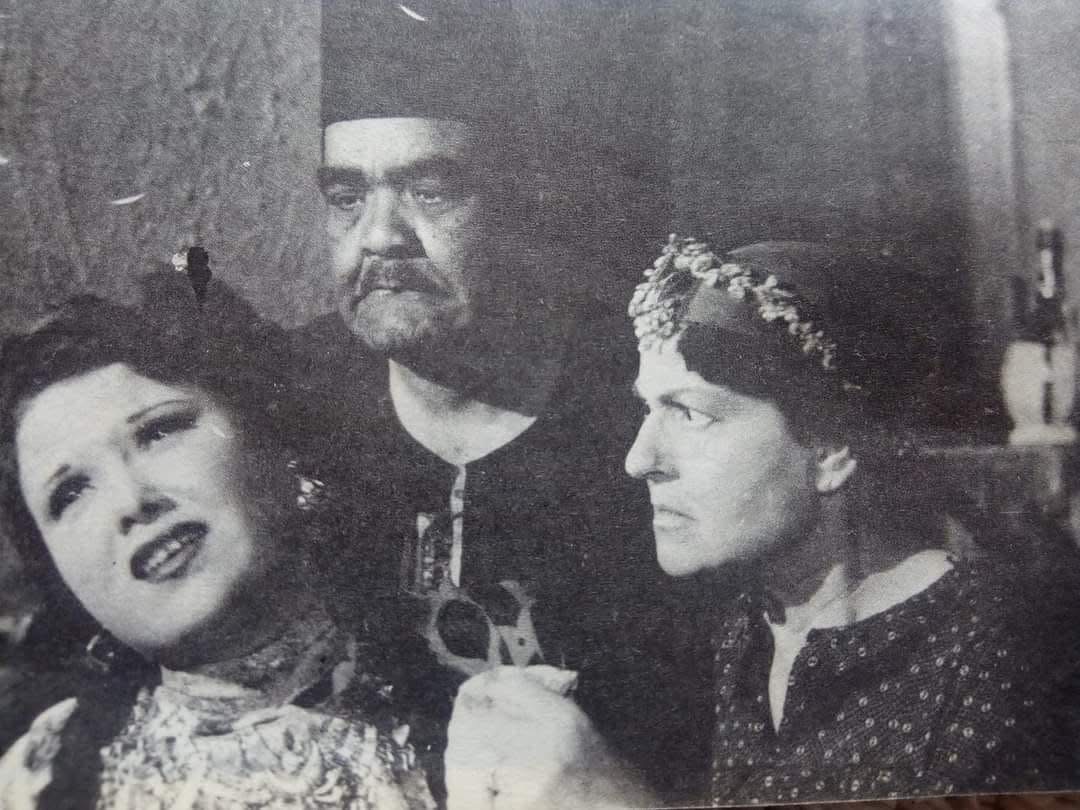
The story of Raya and Sakina is not merely a criminal case in Egyptian history. Over time, it has become one of the most deeply rooted narratives in Arab collective memory, sustained by its singular blend of mystery, violence, and social complexity. The two sisters' names grew inseparable from a series of crimes that shook Alexandria in the early twentieth century, and the shockwaves never quite settled.
As the decades passed, their story transformed into rich material for storytelling and interpretation, suspended between historical record on one hand and artistic reinvention on the other. Cinema and drama were quick to claim this case as their own, producing a wide range of adaptations: films such as (Raya and Sakina), celebrated stage productions that rendered the story in satirical and comedic registers, and television series that approached it from entirely different angles.
Yet this persistent artistic presence raises a critical question, one that reaches beyond representation into the very nature of the relationship between reality and its reproduced image. Have these works genuinely contributed to a deeper understanding of the Raya and Sakina case, unpacking its social and historical layers? Or have they, on the contrary, reshaped it to serve the logic of suspense and entertainment, reducing a complex event to consumable material that answers more to audience expectations than to historical truth?
Between the Historical Record and Cinematic Representation:
The distinction between a "historical event" and an "artistic representation" is not merely a difference in form, it is a difference in the very nature of truth itself. A historical event rests on documents, testimonies, and the social and political context that gives it meaning. Artistic representation, by contrast, rearranges these elements according to the logic of storytelling: it selects, simplifies, and constructs character in ways that serve dramatic pacing and satisfy audience expectation.
In this sense, cinema does not present reality as it is; it rewrites reality through its own aesthetic tools, illuminating certain aspects while quietly setting others aside. A complex event can thereby be transformed into something designed for visual consumption. It becomes essential, then, to interrogate the works that have portrayed the story of Raya and Sakina, not only for what they chose to show, but for what they chose to omit.
The film (Raya and Sakina, 1952), directed by Salah Abu Seif with contributions from Naguib Mahfouz to the story, represents one of the earliest cinematic attempts to portray this case. However, when the film is read in light of the historical account presented in Men of Raya and Sakina by journalist Salah Isa, a clear gap emerges between reality and its representation.
The film tends to reduce events to their immediate criminal dimension, concentrating on suspense and the slow accumulation of tension. The historical source, by contrast, offers a far broader narrative, one that moves beyond the crime itself to examine the social and political structures surrounding it: poverty, urban marginalization, the uneven distribution of power. Despite its foundational importance, the film does not reach for this complexity. Instead, it reshapes the case within a dramatic framework in which the logic of spectacle consistently outweighs analysis.
Where Raya and Sakina (1953) preserves, to some degree, the criminal character of the case in its realistic dimension, (Ismail Yassine Meets Raya and Sakina, 1955) marks a decisive turn, reworking the event entirely within a comedic framework. Featuring Ismail Yassine and Thuraya Helmy, the film makes no attempt to reconstruct historical fact; it borrows the name "Raya and Sakina" and places it inside a structure built on exaggeration, misunderstanding, and comic irony.
Although the film retains a loose outline - a gang that lures and kills women - it is delivered in a register so light that the crime serves merely as a backdrop for comedic situations, filtered through the misadventures of a young man who stumbles upon the case by accident. The crime is no longer presented as a disturbing reality; it becomes the scaffolding for entertainment.
This shift reveals something important: artistic representation can drift not only from historical accuracy, but from the fundamental nature of the event itself. The crime loses its social and human depth and is reduced to a source of amusement. When set beside Salah Issa's Men of Raya and Sakina - with its meticulous attention to the social and historical conditions that shaped the case - the distance becomes stark. The book builds complexity; the film dismantles it, leaving Raya and Sakina less as real historical figures than as fictional characters molded by the needs of the story.
This comedic current runs through later works as well, including the 1983 (Raya and Sakina), directed by Ahmed Fouad and starring Sherihan and Younes Shalaby. The film holds to the same entertainment-driven approach, treating the historical event as a light backdrop against which comedic situations unfold, rather than something to be reconstructed or examined.
What recurs in this pattern is the use of the name "Raya and Sakina" as a ready-made cultural label, one that draws audiences by its familiarity rather than by any genuine engagement with its origins. As in earlier versions, the social and psychological dimensions of the case go unaddressed. Events and characters are lifted free of their historical context, widening further the gap between the event and its representation. "Raya and Sakina" becomes a mode of entertainment rather than a means of understanding - and in doing so, reinforces the tendency of cinema, in certain of its forms, to choose spectacle over documentation.
The Stage as Memory-Maker
The peak of this trajectory is reached in the famous play (Raya and Sakina, 1980), written by Bahgat Qamar and directed by Hussein Kamal, with performances by Shadia, soheir el bably , Abdel Moneim Madbouly, and Ahmed Bedir. The play does not simply retell the story in a comedic key; it fully assimilates the case into the logic of popular theatre. Crime becomes a source of humor, and Raya and Sakina are rendered as near-caricatures, vivid, playful, performed for laughter rather than gravity. Verbal wit and theatrical energy take precedence over any serious dramatic or historical reckoning.
What makes the play significant is not only its commercial success, but also its impact on collective memory. Raya and Sakina are no longer seen mainly as figures connected to brutal crimes. Instead, they become playful and entertaining characters, remembered for amusement rather than fear or violence. The play marks a shift from historical "event" to "popular icon", a moment at which artistic representation overtakes historical fact, and collective memory begins to be shaped more by performance and reception than by what actually occurred.
A Counterweight: The 2005 Television Drama
In contrast to the entertainment-oriented approach, the television drama (Raya and Sakina ,2005), written by Mustafa Moharram and based on Salah Issa’s book, directed by Gamal Abdel Hamid, and starring Abla Kamel and Somaya El Khashab, is considered one of the closest works to the historical reality of the case. The series is built on a genuine documentary effort, drawing on scholarly writing that re-examines the crime within its social and political context.
Rather than presenting the characters as straightforward symbols of evil, the series attempts to show them as products of a complex environment, one shaped by poverty, marginalization, and the disorienting pace of a changing city. It offers an interpretive reading of the case rather than a sensational or simplified one.
However, this “closeness to reality” does not necessarily mean full accuracy. Despite its serious tone, the series is still shaped by the demands of television drama. It relies on narrative tension, heightened conflicts, and a stronger emotional focus on the characters.
Even so, "closeness to reality" does not guarantee full accuracy. Despite its serious register, the series remains shaped by the demands of television drama: narrative tension, heightened conflict, and an emotional pull toward its characters. The work can be seen as an attempt to restore some balance between the historical event and its representation. It reduces the distance between the two by bringing back details and contexts that were often absent in earlier comedic versions. In this sense, the series positions itself as a partial alternative to pure spectacle. At the same time, it does not fully escape the logic of dramatization. It remains a hybrid form, standing between documentation and fiction.
Across this variety of artistic approaches - from the near-documentary to the broadly comedic- the story of Raya and Sakina remains one of the most persistently reworked cases in Egyptian cultural production. With its elements of suspense, mystery, and social complexity, the story has never lost its appeal to creators. Instead, it has become a rich source of material and continues to be reshaped according to the logic and expressive tools of each period.
Between genuine attempts at understanding and interpretation on one hand, and the pull of dramatic and commercial potential on the other, Raya and Sakina stands as a compelling example of how a historical event can outlive its moment. It persists through artistic forms that do not merely reflect it, but actively reshape it, and in doing so, continue to give it new meanings, long after the events themselves have passed into the record.