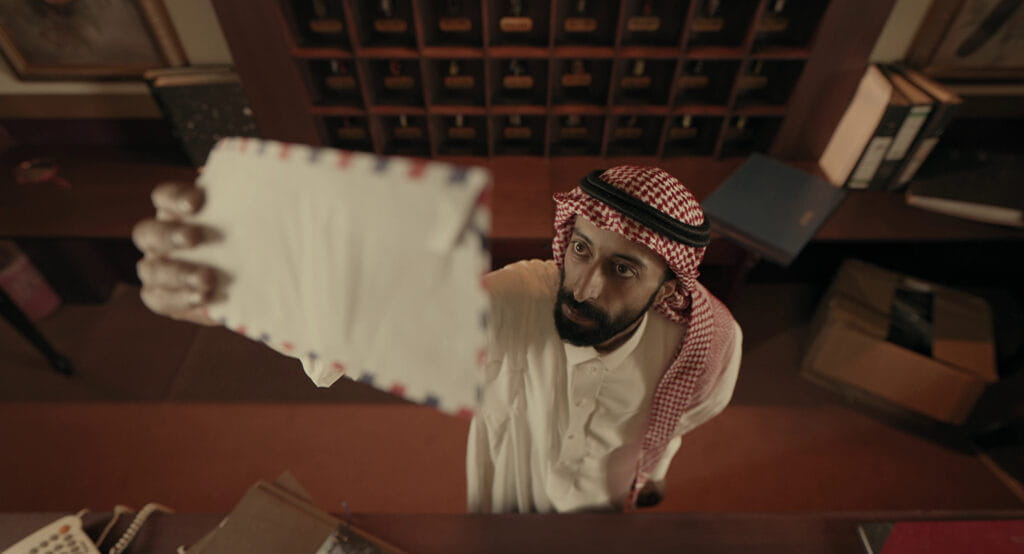
Upon initially watching the award-winning feature film (Raven Song - 2022) (أغنية الغراب), which received the Golden Palm award at the Saudi Film Festival, viewers may perceive it as part of the wave of films that discuss and critique the ‘Woke’ movement, which began in 2015 and has continued since then. The film introduces its protagonist, Nasser, in early scenes where he confronts his father, who derogatorily refers to him as ‘the goat’ while destroying cassette tapes containing various songs, including one attributed to the poet Nasser Al-Ghurab. The father repeats the phrase, “Rush for prayer, Rush for success... and you are neither going to prayer nor success,” as he smashes the tapes with a heavy hammer, causing his wife to scream in terror, “Enough!” which causes the teacups and the coffee pot to rattle.
However, the perception and imagery abruptly shift as soon as Nasser leaves the house. He witnesses brain fragments falling from the sky like rain, illuminated by lightning, onto the structures of the old neighborhood where he resides. The brains progressively accumulate until they form a dense mass, with one eventually landing on Nasser’s head, causing him to collapse. At this point, the initial impression transforms. It becomes evident that the film is not an ordinary exploration of the ‘Woke’ movement or other societal issues, either directly or indirectly. Instead, it unfolds as a peculiar and lengthy film that promises surprising and unconventional images and ideas from the very beginning. Dreams, hallucinations, and fantasies intertwine, creating a fusion of visuals and meanings. This article aims to deconstruct the film’s unique narrative discourse, seeking to unravel the references within the images. It also posits a connection between the film’s style and that of the renowned Greek director Yorgos Lanthimos, which raises intriguing questions regarding Mohammed Al-Salman’s work specifically and the Saudi cinema as a whole.
(Most) Loose Ends are Tied Up in the End
In Raven Song, the narrative unfolds gradually, encompassing multiple timelines at a deliberately slow pace. The film does not commence with Nasser’s discovery of a brain tumor or his fear of embodying the goat metaphor from his father’s dream of his brains falling out. Instead, it begins by introducing the story of Yasser, a poet who remains unseen throughout the film. These fragments and timelines intertwine throughout the narrative: Nasser, who is fascinated with an unknown girl he calls Sheikha, visits Al-Yamama Hotel to inquire about Room 227 only to leave a letter and a collection of poetry for the occupant of the room for reasons unknown at the film’s outset. Sheikh Abu Yasser, revealed later to be the father of the poet Yasser, who died by suicide, approaches Nasser seeking the same room. Sheikh Abu Yasser assumes various personas and stage performances, primarily for himself and occasionally for Nasser, who visits him multiple times.
The film also explores a cultural conflict between classical intellectuals, of whom Nasser unexpectedly becomes a part by blackmailing a journalist, and modernists who find solace in a van traversing the corridors of Riyadh in the year 2002. We later discover that the poet Yasser is among the modernists. These random and peculiar events unfold throughout the film, sometimes in comedic scenes and more often in strange and disquieting ones. However, Mohammed Al-Salman weaves them together into a collection of poignant scenes that help elucidate the underlying narrative. The film’s notable silence and the calmness of the actors’ performances and dialogues are not a weakness in the dialogue itself. Rather, it serves as an intentional strategy to immerse the viewer in contemplative moments, mirroring Nasser’s own dreams and fantasies. This is further exemplified by the film’s almost non-existent soundtrack, except during moments of heightened imagination and dream sequences.
Towards the film’s conclusion, the intuitive connections between the various events and timelines become clear. The girl who frequents Room No. 227 at Al-Yamamah Hotel is revealed to be connected to Abu Yasser. In one of the bizarre scenes skillfully portrayed by the brilliant actor Abdullah Al-Jafal in the role of Abu Yasser, we learn that Room No. 227 is where Yasser took his own life. The girl, referred to as Sheikha by Nasser and his companion Abu Saqr, constantly visits this room, burdened by guilt over Yasser’s suicide. Yasser’s poems, recited on the day of his memorial, reveal the anguish caused by his lover, whom he often compares to a dove. Yasser is the author of the poetry collection associated with modernity.
The film ultimately highlights that Nasser's story is peripheral, primarily serving to uncover the tale of Yasser’s love. This is further reinforced by Abu Yasser’s quest for revenge on behalf of his son. The film’s conclusion unveils that the raven murderer is, in fact, Abu Yasser himself, seeking retribution against all women after discovering the artist’s role in his son's torment due to the mysterious girl of unknown origin or lineage, which ultimately led to Yasser's suicide. However, this narrative merely reflects the surface of the film.
On its clear surface, the film aligns with the previously narrated plot. However, it possesses a deeper layer that is completed by visual and symbolic details, surpassing mere plot-related elements. By focusing on these visual and symbolic aspects, we can reverse our previous understanding of the film and emphasize the centrality of Nasser’s own story. Nasser’s attempt to escape his goat-like existence by adopting the nickname Ghurab (The Arabic word for Raven) intersects directly with his state of love and infatuation, leading to his false ambition to become a poet, hence adopting the artistic name Nasser Al-Ghurab.
The film presents a character caught in a challenging predicament, with his crisis stemming from his father’s treatment. The father’s cruelty is evident in the dream that follows Nasser’s survival from the accident in the modernists’ van. Nasser unknowingly attempts to emulate Yasser, albeit in a distorted manner. Yasser represents the poet of love and passion who successfully captivated Hadeel (or Sheikha) with his art. However, Nasser fails to embody the raven who loves the dove, Hadeel. Yasser is the modernist who derives inspiration from his own experiences and self, while Nasser embraces fundamentalism without comprehending its essence. It can also be said that Nasser fails to be the other raven, the raven murderer.
The film underscores that Nasser is not truly a raven, even in his desire for revenge and his criminal tendencies, as he lacks a genuine story, as confirmed by Abu Yasser. “All the stories are repeated except for you. You don’t have a story!” These words are spoken before Nasser concludes his final play and subsequently gets arrested amid the resounding and dramatically intense score of Mozart’s Funeral March.
The film employs elegant and symbolic means to establish these parallels. Nasser’s recurring encounters with goats serve as poignant reminders of his true nature. The van accident involving a pickup truck carrying goats is deeply intertwined with the falseness of Nasser’s persona, as depicted in the newspaper, and the insincerity of his poetry, which is abruptly interrupted by the accident. As Nasser exits the van, covered in his own blood, one of the goats stands before the door, seemingly confirming his goat-like nature, regardless of his claims to the contrary. Another significant moment occurs when Nasser is fired from his job at the hotel. The hotel owner appears with a goat in hand, ordering its slaughter, symbolically reinforcing the film’s subtle message that Nasser is indeed a goat and not a raven. Eventually, Nasser himself becomes convinced of his goat-like identity, leading him to agree to undergo surgery to remove the brain tumor. The doctor, aware of the operation’s high failure rate, repeats to Nasser at the beginning, reminiscent of a goat’s bleat as it is about to be slaughtered, “Sleep, my love... Sleeeep.”
Through the fragments presented in both the clear and intuitive narrative form of the film and its visual symbolism, the meanings conveyed are not entirely definitive, and the references extend beyond their immediate implications. The film sets a broader horizon, albeit to a limited extent, by delving into the understanding of its characters and their motivations. By placing Nasser at the center while highlighting his marginality, the film raises questions about the possibilities for someone like Nasser, a seemingly ordinary person. Can Nasser transcend his goat-like existence and become something more? The film also prompts inquiries about doves and ravens or their symbolic counterparts among us. Can a peaceful, angelic, and beautiful girl possess a mischievous nature?
Furthermore, is the raven at fault when it consumes the heart of a dove? As one of the characters states about Abu Saqr’s dove, killed by a raven, “The dove’s heart is delicious. Can you blame it?” These questions and references contribute to the film’s uniqueness within the Saudi cinema landscape.
Will Mohammed Al-Salman be Freed from Lanthimos’s Shackles?
The Greek Director Yorgos Lanthimos is widely regarded as one of the most significant non-American directors to have contributed to American film production. His works have been featured in prestigious film festivals, including the renowned Cannes Film Festival. Several of his films have received multiple Oscar nominations, and the lead actress in his latest film was honored with the Best Actress award. It is impossible to overlook Lanthimos’ impact on contemporary world cinema. When discussing unconventional cinema characterized by a deliberate pace, biting sarcasm, and rich symbolism, his films inevitably come to mind. This brings us to the connection between the peculiarities and symbolism of Raven Song and Lanthimos’ own distinct cinematic style. We specifically singled out two of his notable films, (The Killing of a Sacred Deer - 2017) and (The Lobster - 2015), to address the two key aspects of Mohammed Al-Salman.
Raven Song presents numerous prophecies throughout its narrative. The first scene of the film features a cassette tape with the lyrics of poet Nasser Al-Ghurab, portraying a prophetic element. We quickly realize that this scene is a dream, and it is revealed later that Nasser had not even chosen his artistic name, Nasser Al-Ghurab, at the time of the dream. This initial prophecy confirms that Nasser will become a lyric poet and adopt the name Nasser Al-Ghurab, despite his initial rejection of the name Ghurab, given to him by his companion, Abu Saqr. At first glance, this prophecy may seem inconsequential, and without careful observation of the film’s events, it could be mistaken for a technical or directorial error. How could Nasser dream of Nasser Al-Ghurab when he hadn’t even considered becoming a lyricist until after the dream, with the idea originating from Abu Saqr, an aspiring singer who wrote a song for Nasser? However, this prophecy is one of several in the film, affirming that it is not a technical or plot error. Al-Salman intentionally includes these prophecies, including the central prophecy of killing the dove. The prophecy of killing the dove is first hinted at when we encounter a painting in room 227 of Al-Yamama Hotel. The painting depicts a dove with a black line on its neck, suggestive of beheading or, at the very least, murder.
The intentional nature of the black line becomes evident in a crucial moment we mentioned earlier: Abu Saqr, Nasser, and their third companion discover the slaughtered dove, partly consumed, on their resting spot. They speculate whether a dog or another animal killed it, and the third companion remarks, “That’s a raven.” When one of them asks why a bird would eat another bird, the third companion replies, “The dove’s heart is delicious. Can you blame it?” This scene foreshadows Abu Yasser’s knowledge, the raven murderer, of the contents of a letter left by Hadeel, his son Yasser’s lover. It precedes Abu Yasser’s act of killing Hadeel in the hotel room, hanging her body on the wall, and placing her neck against the dove’s neck in the painting from room 227. Through these two prophecies and the symbolism of the goat, the film unequivocally signals its anticipation of events through symbolism that should not be overlooked.
This aspect bears resemblance to Lanthimos’ penultimate film, The Killing of a Sacred Deer, which heavily relies on a historical Greek prophecy and myth. In both films, Al-Salman’s work shares the same peculiarities in dialogue, silence, and foresight found in Lanthimos’ films. However, the primary influence in Al-Salman’s film is the prophecy of The Killing of a Sacred Deer. In this story, a doctor fails to save a man during a crucial operation, an act considered patricide by the man’s son. As retribution, the doctor is compelled to sacrifice one of his own children to restore balance between the two families. The son recounts a detailed prophecy, predicting the illnesses and deaths of each family member, ultimately coming true in a horrifying manner as if it were a divine intervention.
While Al-Salman’s prophecies may appear simple and fleeting compared to the elaborate prophecy in The Killing of a Sacred Deer, it would be unfair to attribute his inspiration solely to Lanthimos. Instead, the primary influence in Al-Salman’s film can be traced to Lanthimos’ The Lobster, which justifies the connection between the prophecies in both films, including the prophecy of the Sacred Deer. The Lobster takes place in a peculiar world where individuals are compelled to find a romantic partner to fulfill their lives; otherwise, they face transformation into an animal. This strange institution grants individuals the freedom to choose the animal they wish to become if they fail to form an emotional connection within its highly totalitarian framework. Each character selects their animal based on personal reasons, reflecting their unique personalities. One chooses to be a dog, another a small fish, and the protagonist opts to become a lobster.
The film’s plot unfolds with rich symbolism exploring totalitarianism, political ideologies, and the power of love to transcend such oppressive systems. Despite its distinct premise, The Lobster shares the same sense of peculiarity found in The Killing of a Sacred Deer and Raven Song. There is a notable connection between the two films: the protagonist of Raven Song strives to avoid becoming a goat, while the hero of The Lobster endeavors to avoid transforming into an animal, even if it is a choice of their own.
However, the animal symbolism in Raven Song extends beyond the goat. We encounter a goat aspiring to be a raven, represented by Nasser, as well as a dove symbolizing Hadeel. Abu Saqr possesses an exceptional ability to memorize car numbers and letters, while Abu Yasser, portrayed as a raven, kills the dove. Additionally, we come across an ostrich representing the journalist Khaled. Both films feature a multitude of animals, each carrying various symbols and references that can be interpreted through the animals and their associated symbolism.
In all fairness, we can discern Mohammed Al-Salman’s creative flair as he endeavors to break free from the shackles of the influence of Lanthimos. Lanthimos has undeniably exhibited brilliance in his ideas, with films like Dogtooth and The Lobster employing raw and striking symbolism related to totalitarianism and hidden agendas. The Killing of a Sacred Deer, his penultimate film, heavily relies on its distinct and explicit prophecy as its foundation. Without an understanding of this prophecy, the intricacies and underlying themes of the movie would be challenging to grasp. However, Al-Salman demonstrates great skill in utilizing these techniques, incorporating clever references without overwhelming the viewer. This skill deserves recognition, considering it is his first feature-length experience. It has been acclaimed as one of Saudi Arabia’s finest cinematic achievements to date and has earned him a nomination for Saudi Arabia’s Oscar submission.
Nevertheless, the challenge lies in whether Al-Salman can transcend these influences, whether they stem from Lanthimos or others, and find his own distinctive touch that establishes him as a pioneer rather than a mere product of influence. This journey towards artistic independence is crucial not only for Al-Salman but also for the broader Saudi cinema. Despite the film’s remarkable quality on all fronts, it is difficult not to associate it with another director. While Raven Song promises a bright cinematic career for Mohammed Al-Salman, it also sets a condition for its own development, which aligns with the requirement that Saudi cinema needs to fulfill: the cultivation of a unique and individual artistic style.