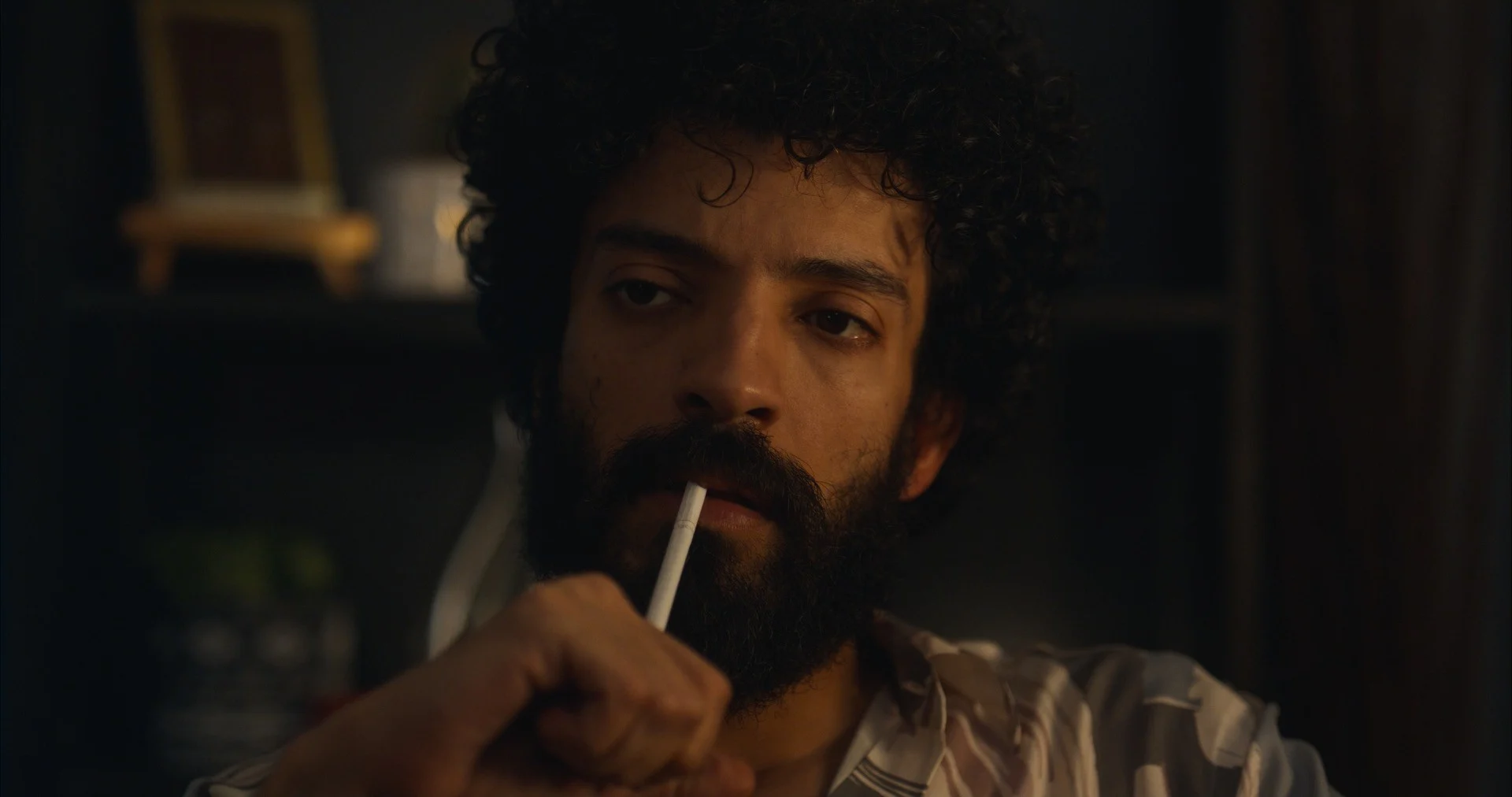
The bias towards poetic cinema is evident in the Short film (Old Phone Number, 2022) «رقم هاتف قديم» by Saudi director Ali Saeed. Starting from the film’s title, which is derived from the name of a poem by the Iraqi poet Muzaffar Al-Nawab, it is not the only point of affinity with the poem in terms of its general sensibility; there is also an intersection with the poem itself, which leans toward the past and declares a break with the present:
“My love, the phone keeps ringing
It has not stopped ringing for thirty years.
But due to my love’s excessive use of it,
The numbers were erased.
As I turned the erased numbers time and time again,
At times the silence returned.
They were here yesterday.
They left nothing to remember them by,
Except for the silence.”
Some might think that the film is an interpretation of the poem, but upon closer examination, this assumption proves inaccurate: the intended interpretation is of the past itself, not the poem. The title of the poem is simply a carrier of intertextual resonance, a reference to a compressed past that awakens many things — a story, messages, a place — as well as the ringing sound of the phone, which turns out to have stopped despite the realism of the present.
The dilemma faced by most writers attempting to write about poetic films is that if they approach the film through the tools of conventional film criticism, the possibility of deviating from the film’s poetic value is highly likely, if not inevitable. The traditional or naturalistic approach to cinema — which relies on interpretation, revealing the signifier and the signified, or the cause and the meaning — greatly undermines the ultimate goal of poetic cinema, which is to answer the question: “What did you feel?” rather than “What did you understand?”
In most cases, a film that belongs to the realm of poetry will inherently carry its defense of poetics within it, which prevents the recipient from grasping rational connotations and instead draws them into the illusions of poetic suggestion. This is a significant matter in which many visions are intertwined. The poetic film does not have to be directed toward an elite audience who already knows what poetic cinema is; it is, rather, more deserving of being addressed to the general public, provided that it carries within it its poetic justifications — which prevent the recipient, even an inattentive one, from reducing the work to a fixed meaning. This is one of the reasons that ambiguity is a necessity in poetic cinema. Ambiguity is an artistic component and one of the most important elements of poetic cinema — not the ambiguity of detective mysteries, which responds to the mechanisms of using the mind to solve riddles, but the ambiguity that resists mental analysis.
Old Phone Number is loaded with this kind of defense of poetic cinema, despite the plausibility of its story and the clarity of its central premise: the protagonist Hamed, played by Yaqoub Al Farhan, clings to the past and attempts to withdraw from the present, or abandon it entirely. This is evident in his abandonment of his work, his self-denial when he answers a phone call and insists that there is no person named Hamed, and his abandonment of his dog — a gesture whose poetic weight we feel when we hear the animal’s barking as Hamed speeds away in his car, and in the hesitation of his fingers moving between radio channels. All of these are symptoms of withdrawal from reality. But to what end?
All the poetic and formal signs in the film point toward Hamed’s desire to move toward the past — a past that is illuminated in several scenes, revealing its location. It lives in the old phone number, which Hamed takes from his wallet and uses to attempt what Muzaffar Al-Nawab attempts in his poem: to call it. The result is inevitable; as the poet says, the only response is silence — a silence that Hamed cannot accept. So he tries another approach: ringing the doorbell of a house, which succeeds in returning him to his beloved Haya, played by Oumkalthoum Sarah Bard. A brief dialogue unfolds between them about this past, in which small images and memories surface, leading us through the essence of the poetic film. The central question is: what does Hamed want — or what do we all want — from this past? And do we even have the right to interpret it, or at least to attempt to do so?
What reaches us through the film’s narrative — not through its dialogue — is a rich set of poetic visual symbols. In addition to the small narrative portion of the film, dominated by compression, we are confronted with symbols alone: the title, with its vivid reference to a number from the past described as “old”; the presence of a car from that same era; a dog expressing the theme of loyalty; and the general appearance of the protagonist through the surrounding décor, the clothes he wears, the music he listens to, and the beloved’s house, which carries the story of this past on its shoulders. All of these express currents that can only be interpreted poetically — through a sense of the general atmosphere the director creates.
It is an emotional interpretation, not a rational one, and because the goal is purely poetic, it inevitably places us before the beloved’s questions to the protagonist and his childlike attachment to the past rather than to her. That places us before a compelling truth around which everything in the film revolves: what did this past do to us? What do we make of it as viewers? Since the poetic film elevates the value of significant questions, and the question of interpreting the past is the most important among them, the director leaves us with an open ending — or an indeterminate one — in which the protagonist finds himself before one of the doors of this past, in an uncomfortable position in front of a neighbor who represents the surveillance of the present. We do not know whether Hamed overcame this observer of the present and crossed through the door of the past, following the calls of his old number — or whether he retreated and turned his back on it once more.
“Let the days sleep,” Muzaffar Al-Nawab says in one of the verses of the same poem, and if we try to listen carefully to this counsel, we find that with Hamed’s solitude and his sustained state of nostalgia, the past remains the past after all. But if we were less poetic and preferred to lean toward joy — a joy for which our film offers no justification — we might imagine Hamed crossing into this past, which will itself eventually become the past, and the circular state of nostalgia will repeat itself, with a phone that keeps ringing forever. The film’s poetic brilliance lies precisely in the presence of this dialectic at its end, which resembles a poem — expressing the finest and most beautiful aims of poetic cinema.