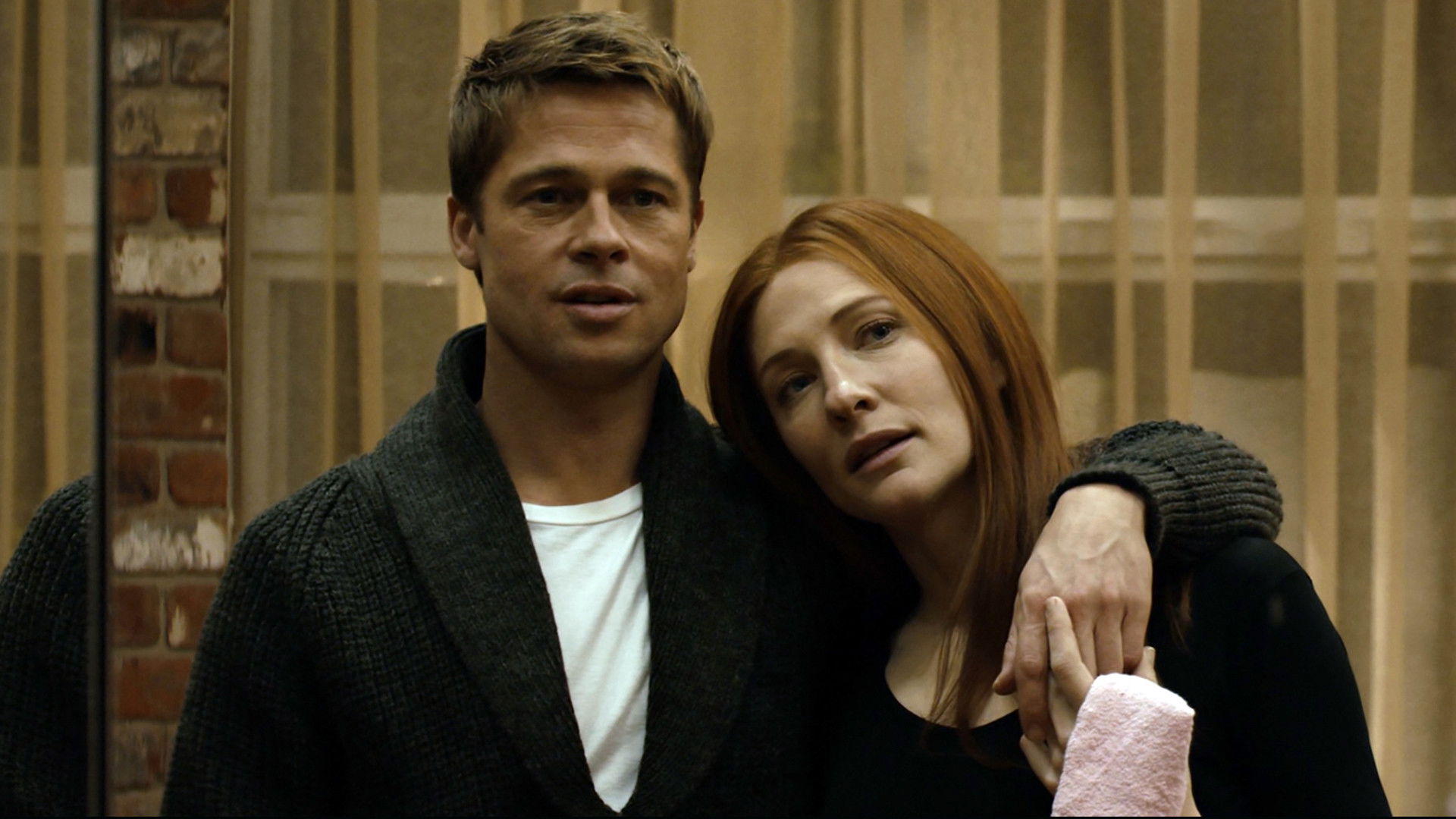
“Time stole me away,” these were the words of Daisy, the elderly woman, on her deathbed. We live in the pursuit of a painful idea that we are squandering our lives, caught between making the right choices and finding the right time to fulfill our potential, the loss of desire, numerous attempts, and long periods of waiting that waste our lives. The greatest burden truly is to die with more wishes and scarce memories, meaning that we haven't lived the one life that was destined for us. The Greek god of time, Chronos, would devour his children after their birth, indicating that time devours everything in life, and the movie (The Curious Case of Benjamin Button - 2008) is more than just a narrative about the human struggle with time, which devours everything.
The film is adapted from a story written by F. Scott Fitzgerald in 1921 about a man who is born seemingly old and ages backward to childhood. The story takes place in New Orleans, one of the cities in the state of Louisiana, USA, from the end of World War I in 1918 to the beginning of the 21st century. Despite the fantasy in the creation and development of the main character in the film, watching it is by no means easy. The film resonates greatly with each of our fears of loneliness, loss, and the lack of any ability to stop the passage of time. What is gone is gone forever. “Our lives are defined by opportunities, even the ones we miss,” as Benjamin says.
In the manner of Benjamin, I grew up next to my grandmother, which means my understanding of the proximity to the concerns of death that Benjamin experienced in the nursing home. He went through everything in reverse, contrary to what is customary, making the truths we escape from in our ordinary lives very pronounced in his life. It is a rare existential experience to understand the meaning of death before life. The first time I watched the movie, I cried because I thought that someday I would lose my grandmother. After she passed away, I expected to avoid watching it forever, but I managed to watch it again and confront my fears about the death of loved ones. Now, I am writing about the movie, which has always managed to move my tears despite myself.
This one-sided aspect is not the only difficult part of watching the film. On the other hand, there is a gloomy impression of life that creeps into your soul, as if you are in a novel by Franz Kafka or Albert Camus. Life and fate are things that move beyond our will, and we must accept and try to salvage what is available. In the manner of the myth of Sisyphus: “Oh my soul, do not aspire to the impossible, but exhaust the limits of the possible.” Immortality, or the absence of death, or eternal love, all of these things are impossible. We must surrender to death when it comes and fight against time, in the manner of Albert Camus, who states that noble love is the one that does not last. Despite knowing that it is not eternal, we engage in it as if it were everlasting, like the relationship between Daisy and Benjamin. Like Rose in the movie (Titanic- 1997), Daisy keeps the love story in her memory, appearing as an old woman in her final hours inside a hospital bed. While waiting for death, she asks her daughter to read her memoirs, which is an indirect way of telling her about her father, whose story she didn’t know.
The film focuses on the impact of sounds. Daisy awaits death amidst the sounds of the wind, which foreshadows the arrival of Hurricane Katrina, as if the hurricane itself is time, carrying death, and she must surrender to it. In the scene where Benjamin worked on the ship being bombed in the war, the sounds were powerful. The soundtrack reflects anxiety and danger, with the sound of waves, strong air movement, and gunfire, and the scene ends with the sound of water falling from top to bottom of the ship, symbolizing the devastation it went through. The general, who is the captain of the ship, declares a stoic philosophy when death arrives, saying, “You can be as mad as a mad dog at the way things went, you can curse the fates, but when it comes to the end, you have to let go.”
The film relies on the use of fade-in and fade-out effects to transition between scenes, accompanied by Benjamin’s narrative voice. However, the most notable of these scenes is the one where Benjamin meets Daisy at a restaurant table. It was their first meeting after his return from the war and his transformation into an old man, while Daisy had become a woman by then. She spoke passionately and impulsively about things he didn't know or care about. Yet, he listened to her with interest, attempting to highlight the stark contrast between their two worlds at that moment, feeling that he was old enough to keep himself away from her. David Fincher, the director of the film, used the separation between sound and image motion to convey this significance.
One of the most important scenes in the film is when they go to a park late at night. Daisy, who works as a dancer, climbs onto the marble body inside the park, walking around in her red dress with a black jacket over it, which she takes off after removing her shoes and placing them on the ground. She tells Benjamin that dancers don’t need beautiful clothes and that she can always imagine herself naked. She begins a seductive conversation about sex, accompanied by a provocative dance and jazz music. The scene ends with a sense of disappointment that the timing is not right, as he is still an old man in her eyes. I don’t know how Benjamin resisted Daisy’s temptation, but his peculiar condition was the barrier and his great hindrance.
The love story in the film was not present in the original Fitzgerald story. In the film, Benjamin falls in love with General Moncrief’s daughter, whom he marries. After a few years, she grows older, and her beauty fades, which leads him to go to war to avoid staying at home with her. The relationship dissolves, and she moves to Italy, and she is not mentioned again in the rest of the story. However, the film’s treatment weaves a legendary love story instead, capable of conveying the same ideas about life. The name Daisy is derived from the novel The Great Gatsby by the same author, referring to the complete and most fascinating woman, or the immortal woman, as expressed by the German Johann Wolfgang von Goethe.
Although death and the invitation to accept it are essential parts of the work’s message, creating a melancholy mood for the viewers, the love story has a more profound impact because it reinforces one harsh idea: nothing lasts, and it is up to the individual to live a life of struggle, like Sisyphus rolling the rock up the mountain, fully aware that it will fall back down to the abyss. It’s not only the obsession with death that connects me to Benjamin Button’s situation, but there are other concerns as well, such as the loneliness he experiences in the nursing home with the departure of many people. There are moments of stagnation and monotony in my life as well. I have already bid farewell to many, and I don’t know what to do during my weekly breaks or long vacations. I wander alone all the time, travel alone, and rely heavily on encounters with strangers on the journey.
However, I found solace in the words of Mr. Ngunda Oti, one of those passers-by in Benjamin’s life: “Plenty of times you be alone. You are different from us; it’s gonna be that way. But I'll tell you a little secret I find out. We know we are alone. Fat people, skinny people, tall people, white people. They just as alone as us, but they scared shitless.” Freedom from fear comes from accepting fate and not allowing defeats and tragic lives to defeat us. Marginal and transient people play an important role in Benjamin’s life, including the lady whose name he can’t remember, but he says about her, “She taught me to play the piano and what it meant to miss somebody.” After he confides in her about his secret of aging backward instead of growing older, she tells him that he must see the people he loves die before him, affirming that “we’re meant to lose the people we love. How else would we know how important they are to us?”
From the preoccupations of death that affect life and the loneliness we try to get rid of, I united with him on the greater preoccupation: lost love. It is as if you are kicked out of Eden. Daisy, since she was a child, gave Benjamin the necessary energy to feel deeply happy. It is a critical condition when we discover it and get used to it; then, it becomes nothing but a memory in the brain and remnants of images from the memory that cannot be retrieved. I know well, like Benjamin, that as soon as stories begin, they move towards their end, making love a sorrowful experience coupled with wild pleasure and the deep pain that plumb the depths of our souls.
Benjamin takes on the role of the narrator. I feel as if he is telling his tragedy from inside my brain. Even time is not a linear progression of events moving forward; it is like a state of digging into memory, a continuous movement between personal history and the present moment. The former combines Benjamin's sadness as a narrator, and the latter combines Daisy’s regret as she listens to his memoirs through their only daughter, who discovers their secret in the final moments of her life.
In the end, he acquires the lightness of a feather moved by the wind in the film (Forrest Gump - 1994), or Benjamin’s own words: “I will go out of this world the same way I came in, alone and with nothing.” He accepted his flaws, his imperfections, his transience, and he told his daughter in his final letter, “For what it’s worth: it’s never too late or, in my case, too early to be whoever you want to be.” Life does not know stability, and changing circumstances are a destined part for everyone within it, as we cannot explain it; everything in it is a mystery that does not require solving or explanation. And since it is a mystery, we must stop thinking, accept fate, and search for what nourishes the heart and alleviates it. If life is a tragedy, we can give it a touch of beauty by being who we want to be and not ceasing our attempts, even if the ultimate outcome is a devastating defeat.
Benjamin knew his fate and the end of his relationship with Daisy, and yet he embarked on a relationship that made him feel in harmony with himself and the world. Some of us are passionate about a woman, others are passionate about children, and some are passionate about achievement or escaping to tranquility and nature, or whatever it may be. The important thing is to do what we want or don't want; it is our personal decision. However, this decision requires us to see life reversed from the end to the beginning through the eyes, mind, and heart of Benjamin, to possess his patience in facing all the storms of life, and to emerge victorious from experiences despite his defeat before Chronos, the god of time.