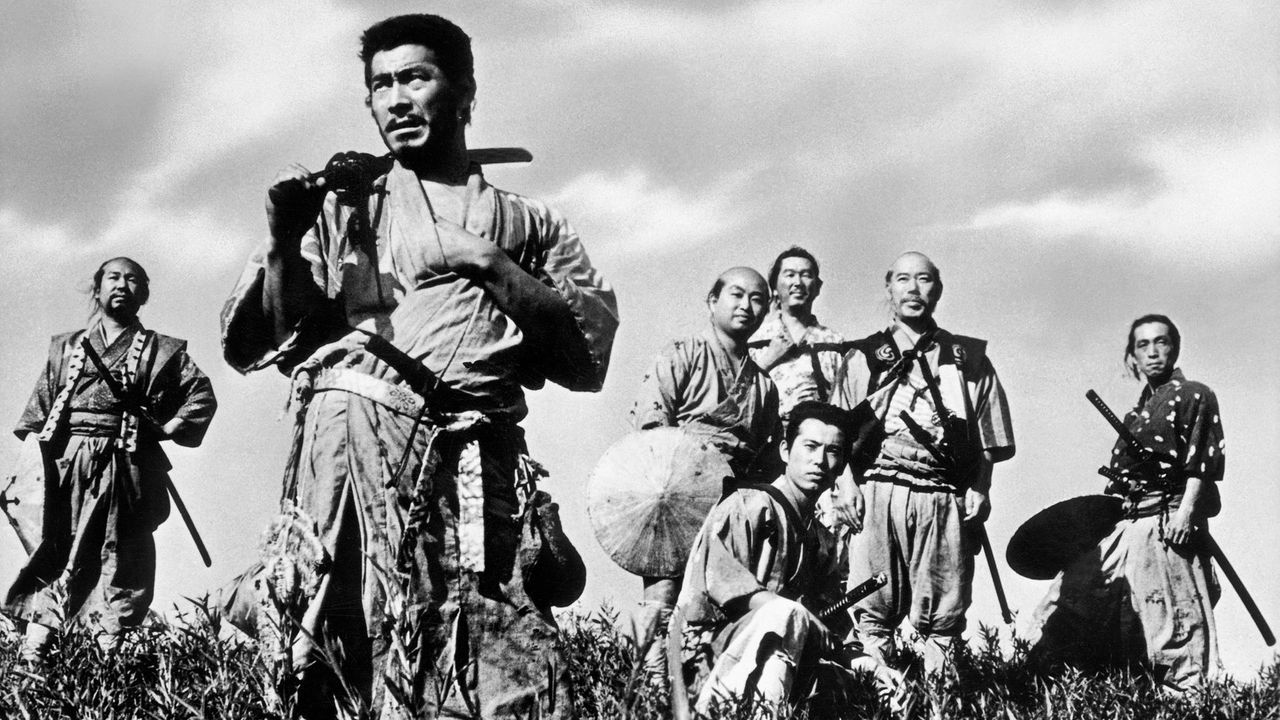
A village inhabited by poor rice farmers falls under the tyranny of a gang of bandits. Seeking deliverance from this injustice, the villagers turn to the advice of their eldest, who urges them to seek the aid of a band of samurai to liberate them. Three villagers embark on a quest for help, finding a skilled warrior willing to assist. He starts assembling a team of wandering fighters with no allegiance, bringing together six warriors driven by a sense of moral duty or a desire for heroism. They confront the bandits, some of them falling in battle, yet in the end triumph and village is freed
But the story does not end there. It may seem simplistic as I recount it in one of its many versions, perhaps even poorly. However, this is the main story, and no other major events can be added to it—only the details of days, names, places, battle plans, and casualty figures, which serve merely to expand the narrative. What matters here is how Kurosawa portrays both killer and the killed, how he strips the bandits of their humanity and turns killing into a purely humane act, and how he transforms the cowards into participants in what seems like a murderous festivity.
When I first watched the film years ago, I looked it up and came across these quotes, “Death and violence – in this film – are nasty, dirty, brutish, and shocking. When people die, they die in the mud.” – David Desser. “We feel every death, even the deaths of the bad guys, the bandits. We know what death means. This [film] is one of the first samurai pictures, which really lets us know what death is about. It is not decorative." – Donald Richie.
Death appears real in this film because we do not see the faces of the dead; they do not die in front of the camera. They die on the battlefield, under the rain and in the mud, sometimes brutally and primitively. There is an image of the killer—whether a samurai or a group of peasants—without an image of the victim, except in a state of horror or in the moment of falling, without showing whether the killer is a samurai.
Akira Kurosawa's camera is heavily biased: the killers are completely stripped of their identities and faces. They enter the realm of the stranger, known only by their actions and nothing else. We know they are thieves of livelihoods and women, and sometimes murderers, but nothing more. Thus, they are entirely deprived of human value. We see the killers in only a few scenes, none of which gives us a story beyond the nature of their deeds. They remain fixed in the category that Akira created for them; he never moves them out of the realm of the unknown and the stranger. We see them in the first scene when they plan to raid the village, in their hideout, and during their attacks and battles. Even then, these scenes reveal little of their nature, serving instead to express the terror they experience during the peasants' killing frenzy, when a group of peasants attacks them primitively, killing one of them.
On the contrary, there is the peasant whom we know and know his full story—his past, present, livelihood, and fears. The village is laid bare, and we live through its story. Certain aspects of it touch us directly, while others we condemn. Kurosawa excels in depicting both the gullibility evident in the peasant and the cunning deceit he practices. It reflects the ordinary life that people live and how their stories are written.
The same applies to the samurai fighters. We come to know at least some part of each of their stories. There is a kind of reporting, even from a distance, about the history of each one, sometimes revealed by the fighter himself or through the event—as is the case with Kyūzō (Toshiro Mifune), for example.
We do not sympathize with others without knowing their stories. It is as if Kurosawa is saying that a person is a story that reaches us—a story that requires no verification. This is where empathy between people arises, and their faces become familiar to us. In this way, individuals are immortalized in their daily lives and the memory of humanity. The more a story is revealed to us, the stronger our connection with them becomes.
Kurosawa's erasure of identity in the case of the gang isolates them from society, deeming them unassimilable. The gang is not merely a band of thieves; they are outsiders—ostracized and incapable of integration. This is because they lack a complete, shareable story within the community. They embody social isolation, defining themselves by the nature of their actions and being defined by it. They are nothing more than external threats to the village. Through this isolation, Akira strips the gang members of their humanity, nullifying any possibility of empathy for them and legitimizing the gruesome violence of their killings.
In contrast, the village itself—and the village with the samurai—form a model in which a shared social history is created, resulting in a community with its own conflicts and culture. Within this society, conflicts emerge between the peasants and the samurai, where the latter becomes a source of concern and fear for the former regarding their culture. In this community, the threat posed by the samurai seems greater than that of the gang, precisely because they are assimilable. There is a potential for influence—for instance, the fear of a peasant losing his honor, an act that can also be committed by the samurai.
In contrast to Akira's stance, John Sturges' version of the film The Magnificent Seven (1960) and Samir Seif's adaptation of Shams El-Zanati (1991شمس الزناتي؛) humanize the gang more than Akira does. This is achieved through the names and relationships that develop between Calvera's gang (in the 1960 remake) and Marshal Buraii’s (in the 1991 remake) and the villages. There is an intertwining between the gang and the village, even if it is based on exploiting the weaker side. The law of the strictest rules dominates the social relationship between the two groups.
However, there is a distinction between Akira's gang and those in the remakes: the former even steals from the women, while the latter is solely concerned with survival. Sturges introduces an ethical question in his work, fundamentally criticizing a society that denies burial rights to a dead Indian. Here, the definition of the stranger is not tied solely to action, as in Akira’s case, but to identity. The ethical aspect presented by Sturges is fundamentally based not on fighting the gang but in criticizing—and at times opposing—the entire society. The conflict emerges first in the place where the Adams reside, a space where all the ethical questions that Sturges tries to raise are born. Here, we encounter the self and the other, and life on the outskirts of the city or civilization.
Sturges' presentation of conflicts delineates the distinction between the ethical and the unethical. When the fighters leave to defend the village, it appears as though they are leaving behind a collapsed moral world. However, upon reaching the village, the conflict transforms from defining human morality in the city to its exploitation in the village by Calvera's gang. Although Calvera mocks the villagers for their inability to defend themselves, he nonetheless maintains an ethical perspective in his relationship with them. This is evident in the fulfillment of his promise to Adams, which preserves a measure of respect from the villagers.
In Samir Seif's version, this aspect is entirely absent, as the focus remains solely on preserving the lives of Shams El-Zanati and his group. The return of Adams with his gang and Shams El-Zanati to the village to fight Calvera and the Marshal represents the epitome of moral commitment. Here, the sole motive—after surviving death—is the salvation of others, seen as a way to ease the fighters’ constant anxiety and troubles conscience.
The rearmament of the Adams and El-Zanati groups becomes another source of internal conflict. The Adams group, represented by Calavera, retrieves its weapons, while the El-Zanati group raids a military vehicle. The former relies on an absolute right for the villagers in return for Calavera's action. While in the latter, Samir Seif adopts a global stance, going beyond the world for this right. Meanwhile, Akira strips the gang of any human connection with the village, even in mere words. The other two, however, grant their gangs such a right, which allows them to humanize the gangs and set clear boundaries on the extent of their action.
The context of the story changes in Antoine Fuqua’s 2016 remake, where the personal and ethical dimensions intertwine. The interaction of self-interest between the gang and the villagers transforms into an extreme model, rooted in boundless enslavement and exploitation by Bartholomew Bogue’s gang. This is evident in the beginning of the film, when the gang ruthlessly kills anyone who opposes them, even burning down the church where the villagers gather. Here, nothing is sacred except money.
This takes an extreme form in the interactions between the Bo gang, the villagers, and Chisholm’s men. Destruction and violence become the sole response to any attempt to change the dynamics of the relationship. However, Chisholm’s ethical stance arises from a personal history that he shares with Bogue. Likewise, some fighters are motivated by stories shaped by non-materialistic self-interest. The nature of motivation is uncertain for some, including Chisholm, who seeks revenge for the murder of his family at Bogue’s hands in the past.
Chisholm serves as a peacekeeping officer but refuses to assist the villagers until he knows the name of their enemy and—his own old adversary. At that point, the logical reasons for refusing help vanish, and the vengeful impulse takes precedence over rational judgment. Therefore, every opportunity must be exploited to achieve his goal. This becomes evident through his recruitment of Faraday and Vasquez, who primarily exploit their legal status. However, things change after their first interaction with the villagers, bringing the ethical dimension to the forefront.
Chisholm's motives are questioned by his old friend Goodnight Robicheaux, who reminds him that revenge will not bring his family back. Only Goodnight recognizes the horror of killing, shaped by his participation in the civil war and the atrocities he witnessed during it. He is the only character with a purely ethical motive, in contrast to Harry in the 1960 version, who seeks money, or Abduh Qaranes in Shams El-Zanati (شمس الزناتي), where wealth is the sole motivation. In the latter case, he flees before the battle begins and, only to return driven by the desire to fight for others and escape a guilty conscience.
What Akira presents in terms of an ethical stance in dealing with the gang—from exclusion and complete alienation to his contemplation of death and the portrayal of horror—gradually diminishes in the works of his descendants. I refer to them as his descendants due to the ethical distancing in the story for each of them. Akira's ethical foundation for humanity is rooted in the experiences he lived through, especially those before World War II.
In excerpts from his memoirs (Frog's Sweat – Mediterranean Publications (عرق الضفدع – منشورات المتوسط)), he recounts the incidents that shaped his ideas and actions, beginning with the history of the place where his father was born, and continuing through the events that instilled in him a sense of fear, an awareness of human degradation, and the loss of his family members. These memories evolve into an ethical questioning of the world he inhabited.
Thus, in the scene where the fighters gather before heading to the village, with misery covering their faces at the sight of the farmers after the rice theft, Akira affirms their collective motives. Through this, he strips the gang of its identity and adds to it the portrayal of death in its terrifying and real form. The death that occurs away from the camera makes it difficult to capture the face of the dying actor. The victim on the battlefield falls and dies without us being able to see his face. They remain distant from us, in a semi-dark place that we cannot clearly discern.
Akira depicts death as a form of loneliness, leaving in the minds of the viewers only sorrow for every fallen fighter, experiencing the lamentation of the final scene, where four swords' blades are put on a hill of graves.