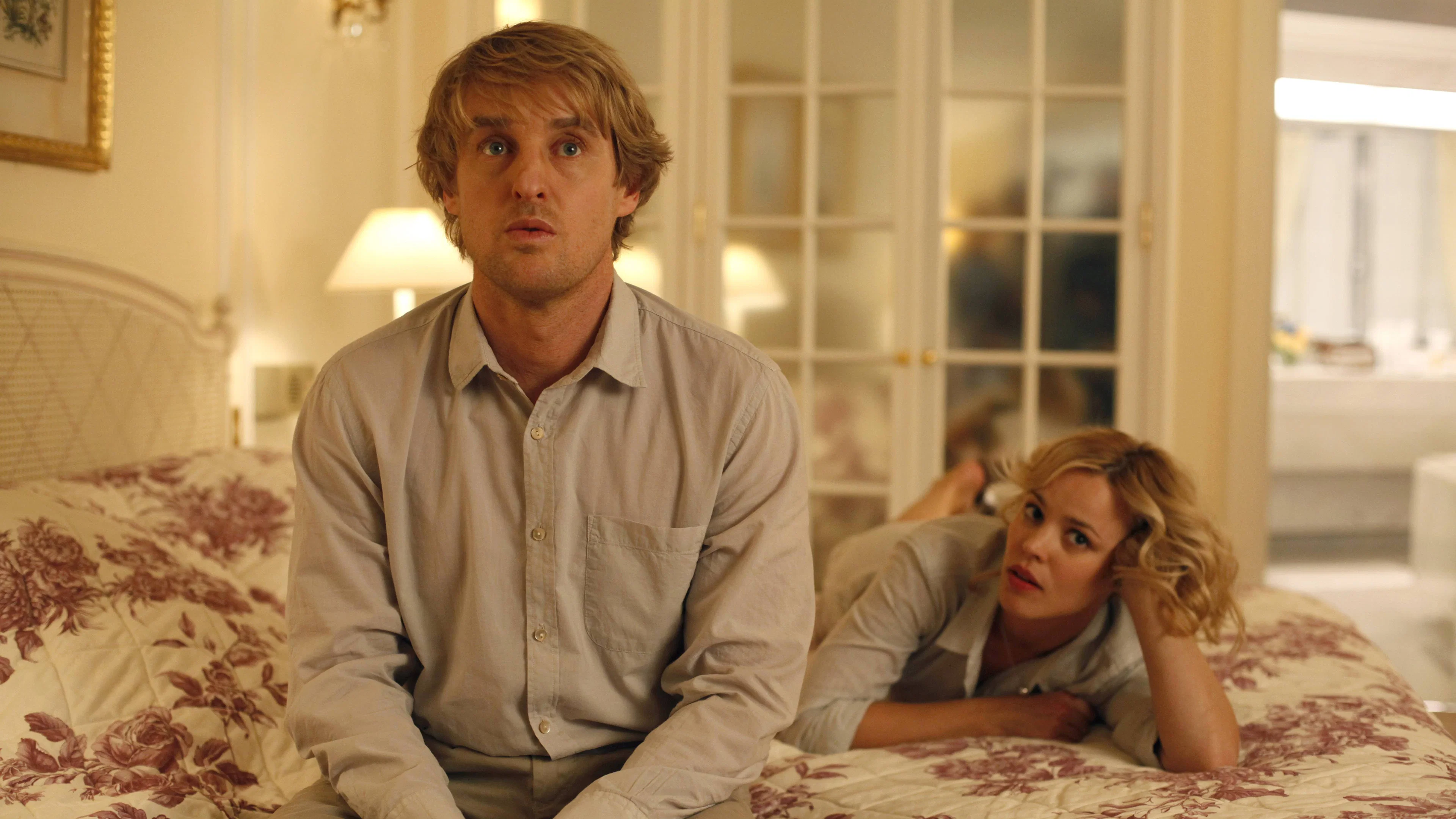
According to existentialist writers such as the French Albert Camus and the Czech Milan Kundera, life should not be taken too seriously, for it is impossible to explain and devoid of inherent meaning.
This is also the view of American director Woody Allen, who tries to create art as a consolation for human beings. In his film (Midnight in Paris, 2011), he presents love as a remedy for the quirks and incongruities of life.
The film’s hero is Gil (Owen Wilson), a hired screenwriter who decides to quit his job and write his first novel — about a man who works in a nostalgia shop. He travels to Paris with his fiancée Inez (Rachel McAdams) before their wedding.
The camera wanders through the streets of Paris, capturing the magic of the city. It aligns with Gil’s perspective as he tells Inez about the beauty of Paris and his dream of living there and walking in the rain. She is bemused by his talk, dismissing his dreams as foolish.
The next day, they visit Versailles with Inez’s friends Paul (Micheal Sheen) and Carol (Nina Arianda). Gil arrives late, uninterested in the conversation, the company, or the surroundings. The three make plain their disdain for his eccentricity and his aspirations for a simple, quiet, or bohemian life. His fiancée summarizes his philosophy: “He wants to live in Paris in the twenties — in the rain.” Her friend Paul responds that it is a case of denial of harsh reality.
Paul, unlike Gil, is always self-assured, has an answer for everything, and carries a showy personality. He presents himself as cultured and erudite, but Gil sees him as pretentious and pedantic. Inez, by contrast, finds him successful and attractive. That evening, they attend a wine party before deciding to go dancing. Gil, however, chooses to walk the streets of Paris in search of the Bristol Hotel. As he wanders, the music of the opening scene plays again and the city’s enchanting atmosphere reappears. Gil is no longer squeezed into the frame or marginalized — he is more harmonious with the scene before the camera.
In the middle of the night, a carriage stops and its passengers invite him to join them. He goes with them to a party set in the 1920s. For the first time, Gil occupies the largest part of the screen as a true protagonist. He finds himself in the company of Zelda and Scott Fitzgerald, who are restless and move on to a bar where they meet Ernest Hemingway. Gil opens up to Hemingway and shares the details of his novel and its plot — things he has always hesitated to discuss with others. Hemingway offers him one of Woody Allen’s central principles: “No subject is terrible if the story is true.” He agrees to show Gil’s novel to the American novelist Gertrude Stein. For the first time in the film, Gil appears genuinely passionate. He stands outside the bar and delivers a theatrical monologue, recounting the events to himself. Then he decides to return and ask Hemingway when and where they will meet again — but finds that the bar has vanished without a trace.
The following day, Gil invites Inez to share the world of his dreams, but she grows bored and leaves. The moment she is gone, the clock strikes midnight and a carriage appears with Hemingway inside. Gil sits beside him, and the camera cuts between them on the small carriage seat. It focuses on the face of whoever is speaking in a tight close-up, the yellow glow of the streetlamps falling across their faces. They share one of the film’s most important exchanges — about Hemingway’s philosophy of love, or rather, how Woody Allen understands love through Hemingway’s work.
“Have you ever made love to a truly great woman? And when you make love with her you feel true and beautiful passion — for at least that moment — lose your fear of death. All cowardice comes from not loving or not loving well, which is the same thing. And when the man who is brave and true looks death squarely in the face, like some rhino hunters I know or Belmonte who is truly brave, it is because they love with sufficient passion to push death out of their minds, until it returns as it does to all men. And then you must make good love again.”
Hemingway appears as a cry of rebellion in Gil’s life — a distant voice from his subconscious, telling him that his relationship with his fiancée is a form of not loving, or not loving well. Later, Gil will learn through Hemingway that Inez has also been unfaithful to him with Paul. Gil is drawn to Adriana (Marion Cotillard), a French woman who has come to Paris from Bordeaux to study fashion. They share secrets, and he tells her about his fiancée’s insistence that he live in Malibu and work in Hollywood, against his wishes.
In the world of his dreams — the era of the 1920s — he loves dancing and going to parties with Adriana, and he shares with her his romantic philosophy: “I love walking with you.” The relationship deepens until they travel together to an even earlier era, the 1890s, where they discover that the people of that time dream of returning to the Renaissance. Gil finally understands that returning to the past brings only a temporary satisfaction, and that the present always feels dull because life itself is dull — there is no golden age, no beautiful era waiting to be recovered. With this realization, his relationship with Adriana ends, just as his attachment to the past does.
He confronts Inez about her infidelity with Paul and tells her that it was Ernest Hemingway who revealed it to him. He ends the engagement, acknowledging their incompatibility, and decides to stop being at odds with the world and with himself. Having been attached to the beautiful dream of the past, and to the hope of a future with a fiancée who was never right for him, he chooses to embrace the present.
He wanders the streets alone, visits cafes, and in one of those moments encounters Gabrielle by chance — the seller from the nostalgia shop, the woman who dealt in old things, whom he had met at the market. They discover a shared love for Cole Porter’s recordings, which he had purchased from her, and for the old objects in the modest shop where she works.
He suggests they take a walk together, or that he buy her a drink. The moment she agrees, the rain begins to fall. She tells him: “Paris is most beautiful in the rain” — revealing the third thing that unites them. Love, Woody Allen seems to say, does not arrive through effort and cannot be willed into the future, nor conjured through nostalgia and escape into the past. Love is both very close and very far, and it may be nothing more than a stroke of luck — requiring neither effort nor imagination.