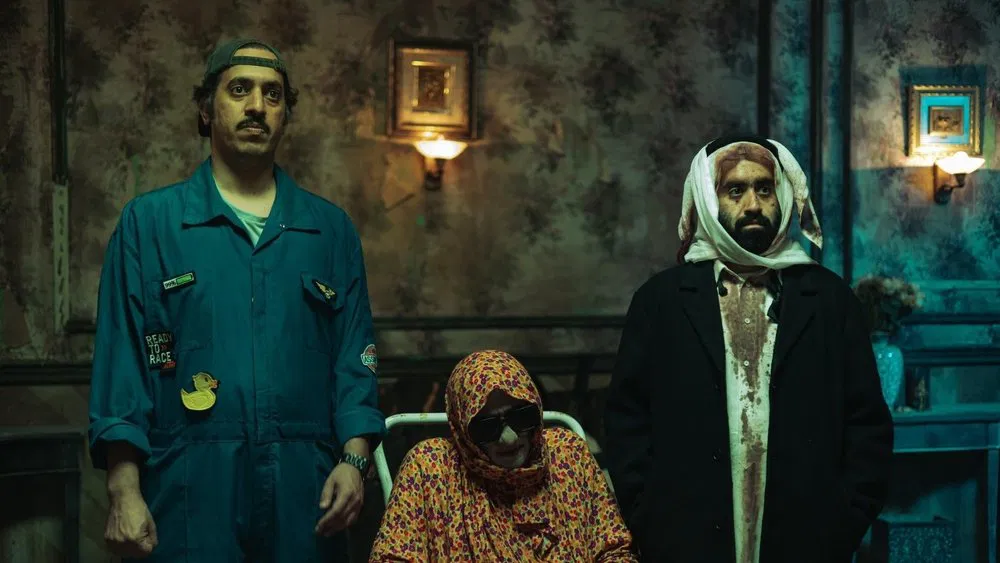
There is a short but impactful journey that can be analyzed to reach the current moment in which Saudi Arabia presented the film (Head to Head, 2023) « راس براس» . This journey seems to be a more expressive representation of the contexts of this new film, which represents the latest collaboration of the experimental pioneers: writer Abdulaziz Almuzaini and director Malik Nejer. Perhaps it reflects the general Saudi reality and the continuous experimentation that serves as a refuge for overall change.
From the beginning, the presence of the duo (Nejer and Almuzaini) coincides with the historical context of Saudi Arabia, which embraced change and empowerment of the youth through entertainment works. Vision 2030, of the Kingdom, had a particular focus on nurturing the entertainment sector in general, supporting and promoting it, and encouraging the private sector to contribute, with the expected contribution of the entertainment sector reaching 4.2% of the gross domestic product. This interest wouldn’t have existed if Saudi Arabia had not felt the need to surpass or outpace time itself at a certain moment. It created, through various models, wide spaces for continuous experimentation in all directions until the compass of strength and excellence was defined rapidly. Perhaps it found its solution in Myrkott Company, which Netflix enthusiastically supported for its latest production, Head to Head.
The film Head to Head, produced by Sirb in collaboration with the global platform Netflix, raises a number of questions regarding the beginning that led these filmmakers to the pinnacle of the current Saudi film industry. It explores the significance of the experimental shift from their usual production under the umbrella of animation and their transition towards a new film industry that relies on actors in their natural form to portray the imagination of the usual cartoonish characters.
Early beginnings with rapid development
The evolution of Nejer and Almuzaini's work, or the pursuit of creating modern Saudi comedy, can be traced back to the existence of the first-of-its-kind Jeddah Comedy Club in Saudi Arabia. The club opened its doors to host regular stand-up comedy performances, which further evolved and continued until 2014 when the second edition of the First Comedy Festival was launched. The festival has become the prominent Saudi platform for comedy production, targeting established comedy stars while also shedding light on and providing opportunities for emerging talents.
The festival introduced new talents cautiously in a society that was not accustomed to such performances before. It also held several seminars on the art of comedy, and gradually, the audience began to understand, appreciate, and become more enthusiastic. As a result, the number of participants noticeably increased, and the Saudi audience’s interest in comedy grew rapidly, reaching a remarkable stage of development and reception.
Simultaneously, alongside this movement that generated interaction, Myrkott Studio and its owners, including Nejer, Almuzaini, and others, presented some professional comedy works through a small number of self-funded individuals until the company stood on its own feet. Their works received significant response among the youth, and within a few years, they were able to produce several programs that garnered millions of fans within and outside Saudi Arabia. At the forefront was the program (Masameer) «مسامير».
Masameer is considered the first Saudi animated series to be exclusively streamed online. It undergoes a highly professional production process. It started with director Malik Nejer, writer Faisal Al-Amir, and writer Abdulaziz Almuzaini and expanded further with each iteration. Masameer undoubtedly benefited from those experiences and the overall movement, creating cartoon characters that represented various segments of Saudi society. Each separate episode globally reveals how Saudi Arabia can become a leading safe space for Arab production. It represents the new Saudi Arabia, as well as an entire generation that has grown tired of repetitive productions and stagnant characters that don’t convey anything meaningful.
The characters of Masameer shaped a comedic exception within Saudi society, which was not accustomed to such portrayals. They represent a new community with its own distinct humor and tone. The entertainment industry, in general, has come to realize the importance of producing stories from Arab reality rather than simply replicating or reinventing old, unfunny satire. These individuals understand their society well, and through their work, they provide critical perspectives on the Arab community as a broader entity, going beyond just a closed local environment or transcending our personal crises.
This is evident when browsing the Saudi channel Masameer and its animated films, which have become a gem in Myrkott’s productions and gained fame and popularity. A glance at the channel will reveal scenes that captivate millions of followers, showcasing this rebellious Saudi phenomenon and its impact on society.
The courage of Saudi existence has become more alluring with the new audience's interaction and their search for novelty. The support from external audiences who couldn't believe that there were young Saudis behind this completely liberated comedy also played a role. Therefore, the industry sought to venture into more than just experimenting with Masameer or even capitalizing on its success once again. This time, the enthusiasm led to the experimentation of the film Head to Head, which marks a new phase with its title focused on experimentation itself.
Experimentation or recklessness?
Head to Head seems to be an action film, representing the first collaboration of partners Nejer and Almuzaini in the cinema within non-cartoonish real worlds. The film tells the story of chauffeur Darwish, who accidentally gets involved with the biggest retired criminal from the airport. The gang of criminals then pursues him, and afterward, Darwish and Fayadh, the new CEO of the taxi company, embark on a mission to deceive the criminal and get rid of the big man’s body. All of this takes place in an overall chaotic and illogical world. The story produces Saudi laughter and excitement that appears unusual.
The film takes place in Saudi Arabia, in the fictional dark and mysterious city of Badhikha, ruled by villains and featuring real characters in a relatively cartoonish framework. Everyone moves in the darkness, and the city becomes a cover to escape from and distance oneself from as soon as possible. The revenge on the city as a whole may seem apparent or not fully apparent in most of the duo's works.
The city of Badhikha doesn’t seem entirely fictional; it may represent Saudi Arabia in an old era, with its rugged roads and some villains trying to secretly control it. The real heroes are saved by their kindness and agility, getting involved in problems that surpass them, and they are forced to save the city from the hands of villains. The journey of the heroes cannot be understood or sympathized with without knowing the secret of the old city, through which their naivety transforms into their quest for salvation. The only solution is to save the city from the villains.
Dark worlds influence the film, sometimes reminiscent of Hollywood and other times influenced by Indian cinema. Similar to Batman in the dark city, the work carries the usual errors of the typical first film: a scattered screenplay and a showy direction that tries to prove the strength of the filmmakers from various angles. It tries out everything without sticking to specific lines, whether it’s action, comedy, or drama, presenting them with the usual force and impact. Overall, it becomes a persistent attempt to prove oneself by representing everything. It is bewildering, but it can be learned from and built upon.
Despite everything, Head to Head remains a strong point in the duo’s career, and they have presented some of Saudi Arabia’s strongest productions in recent years through Masameer. It appears to be another gamble and a diligent pursuit of experimentation in a new area, aspiring to explore and test. Later stages can benefit from gaining more expertise during the creation of another work, one that is more intense and focused on a specific point. It is also a lesson that producing an animated film with exaggerated cartoonish characters is completely different from producing an action film that requires a different character design and interactions. It also requires a smarter vision from the director, who appeared scattered between directing and participating in one of the roles in the film.