In 1932, the world witnessed its first film festival in Venice, on the same continent as the first cinematic screening. Other film festivals followed in Europe and beyond, each with its role, prestige, history, and sometimes its own agenda and policies.
Undoubtedly, film festivals hold immense value for the film industry. They are not just cultural events and a civilizational facet but also the most crucial marketplace for releasing films, exchanging experiences, fostering knowledge, and networking amongst industry professionals. Additionally, they contribute to supporting the host country's tourism and cultural sectors, among other benefits.
As for our region, the most significant film festival is the Cairo International Film Festival, held every autumn. Additionally, there are the Carthage Film Festival, the Marrakech International Film Festival, the Luxor African Film Festival, and others. In the Gulf region, two noteworthy cinematic events have gained attention: the Saudi Film Festival and the Red Sea International Film Festival.
How did Saudi Film Festivals Start?
It is easy to observe that the Saudi cinematic movement began primarily with a political decision and determination. However, simultaneously, Saudi filmmakers had already shown interest in cinematic festivals before that. The Saudi Film Festival started in 2008 as an initiative by the Saudi Arabian Society for Culture and Arts in Dammam and the Literary Club in Dammam as well.
The 1st edition of the festival was personally attended by the Minister of Culture and Information at that time, Iyad bin Amin Madani. The inaugural edition was dedicated to honoring the Saudi director Abdullah Al Muhaisen, and the festival displayed 44 films, a substantial number given the circumstances at that time. The second edition took place in 2015 and demonstrated a higher level of professionalism compared to its predecessor. Since then, the festival has become a hub for Saudi directors from various regions, encompassing diverse professional and academic backgrounds.
Supporting Saudi Cinema
The most significant role that a film festival can play is to support the local film industry. This is the primary goal that the festival should achieve, especially in a country like Saudi Arabia, where cinema is still in its initial stages.
The number of films screened in the last edition of the Saudi Film Festival reached 88 Saudi films. On the other hand, last September, the Red Sea International Film Festival announced the "New Saudi Cinema" program within the short films category, coinciding with the Saudi National Day. Nineteen films were selected, ranging in duration from 5 to 44 minutes.
Muhammed Al Turki, the CEO of the Red Sea Film Foundation, stated that this program reflects "our ongoing commitment to supporting Saudi cinematic talents. It is a dedicated program for aspiring filmmakers who aspire to shape the future of Saudi cinema." The films in the program varied between documentary, narrative, and animation, such as the film (Saleeg) directed by Afnan Bawyan, (Khaled El Sheikh: Between the Thorns of Art and Politics) by Jamal Kotb, and (I’m Fine) by Faisal AlZahrani.
In addition to screening films, film festivals in Saudi Arabia include competitions focused on developing the structure of films and screenplays. They also offer a comprehensive package of programs, including seminars and training workshops. Furthermore, they release books and translations to contribute to building an academic and experiential knowledge base related to the film industry.
A Different Cinematic Experience for Saudi Audience
When it comes to presenting cinema to Saudi audiences, the Red Sea International Film Festival is a must-see experience.
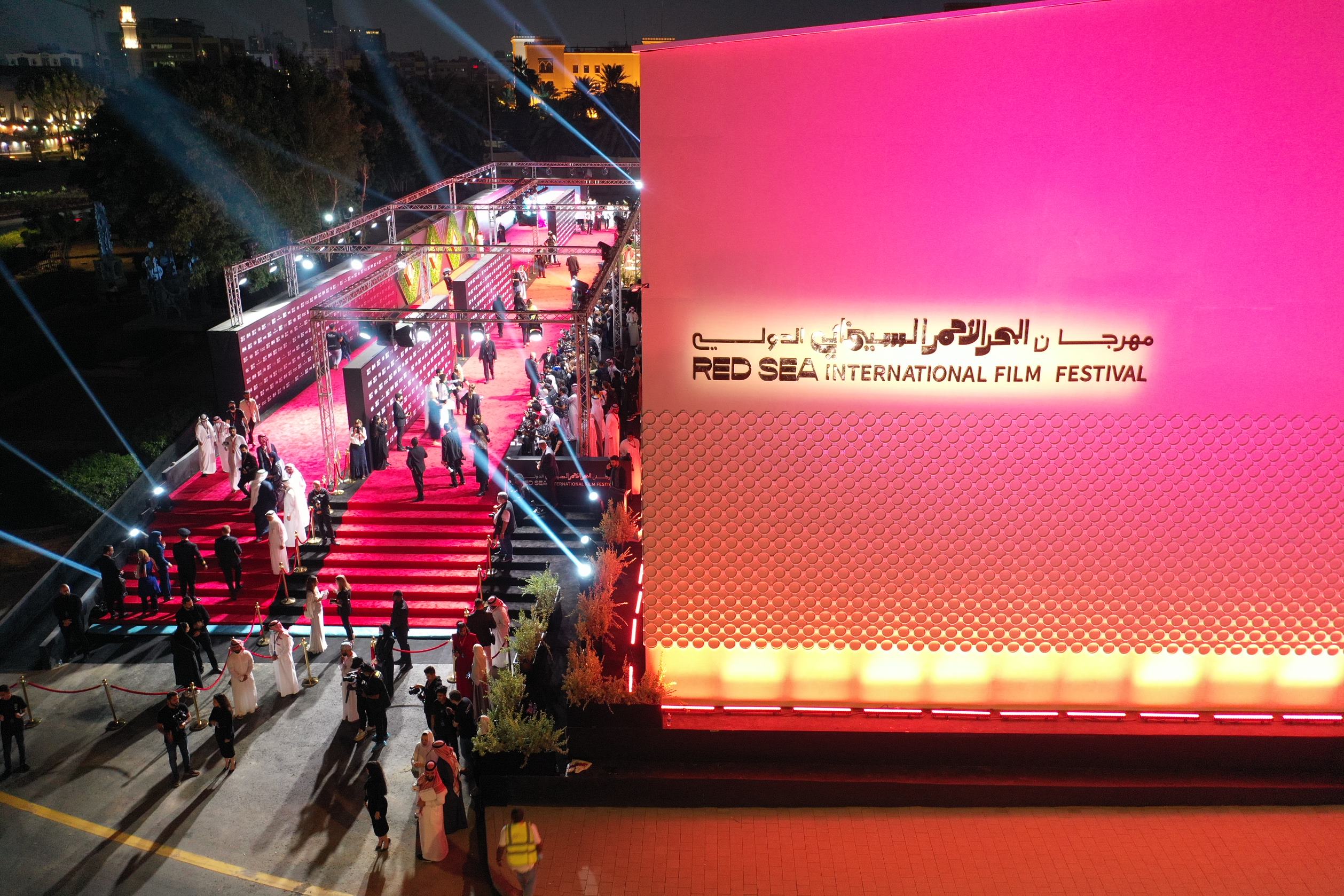
This festival is the first international film festival in Saudi Arabia, with its inaugural edition launched in December 2020. In its previous edition held from December 1 to 10, the festival showcased 131 films, including feature-length and short films, from 61 countries and in 41 languages. It hosted 34 films in their world premiere, 17 films in their Arab premiere, and featured 47 screenings of films from the Middle East and North Africa.
In turn, the Red Sea Film Festival includes several events and programs that enhance opportunities for communication between Saudi filmmakers and their counterparts from every continent. For instance, there is the Red Sea Souk, an active market within the festival. According to the festival's website, it "features programs dedicated to the film industry, including the Projects Market and Works in Progress presentations. It aims to build bridges of communication with the film industry sectors in both the Arab world and Africa."
The market also provides an unprecedented look into the best "productions and projects from the African and Arab market that the Souk hosts, attracting their creators. It includes specially coordinated networking sessions to encourage and support new talents and emerging filmmakers."
In fact, focusing on Africa is a crucial point not only for artistic reasons but also for social, historical, and cultural reasons. There is a close relationship between Africa and the western region of Saudi Arabia, given their geographical proximity. Additionally, Jeddah, being an Islamic port, has historically welcomed millions of pilgrims from Africa over centuries, influencing various aspects, especially in the artistic realm. An example is the singer Etab, the most famous Saudi artist of African origin, who was the first Saudi singer to perform entertainment arts on stage and the first Saudi singer to take a photo with the late Abdel Halim Hafez!
Tourism Promotion
"Since the release of the film 'The Hobbit,' the number of tourists has increased to 2.83 million, and visitor spending has risen by 10% to reach $7.2 billion by the end of 2014. Tourism experts also confirm that one in every five people is influenced by cinema in their travel decisions, and film tourism is a significant factor in attracting tourists to Germany and the United States."
The preceding paragraph was mentioned on the website of the King Abdulaziz Center for World Culture, known as "Ithra," which is one of the Saudi entities actively involved in the film industry. The website mentions that Saudi Arabia is strongly pursuing, as part of its Vision 2030 plan, the contribution of cinema to tourist attractions.
The writer Hany Besher mentions in an article titled "How Cinema Boosts the Tourism Industry Worldwide?" that Tunisia announced the launch of "Tunisia, Our Destination" last year. This initiative includes a tour that traces the locations where famous international films such as (Star Wars) and (Le) were filmed, among others. The route encompasses 12 sites spread across 9 regions from the north to the south of the country”.
Nevertheless, can film festivals contribute to this? Of course!
The organizers of the Red Sea International Film Festival chose Jeddah as the venue. This city has a history spanning hundreds of years and was listed as a UNESCO World Heritage site in 2014. Jeddah is known for its white buildings, carefully paved alleys, and traditional-style shops.
Similarly, last year, in partnership with the second edition of the Al Ula Arts Festival, the Red Sea International Film Festival organized diverse film screenings in the historic city as part of the "Al Ula Film Week." This region is considered one of the tourist destinations receiving considerable support and promotion in alignment with Vision 2030.
All of this, year after year, contributes to attracting tourists, and thus, contributes to the economic sector. It also plays a role in changing the stereotypical image of Saudi Arabia in the eyes of other countries.
Financial Support for Non-Saudi Films
Here, the Red Sea International Film Festival succeeds clearly, and two points can be highlighted. The first is the budget allocated for support, and the second is the benefit that filmmakers gain from the fact that the sponsoring country, Saudi Arabia, is situated at the heart of the region.
The festival offers the "Red Sea Fund," which covers the entire filmmaking process divided into four stages, starting with the development stage, and ending with the post-production stage.
Since 2021, the festival has supported over 200 films from around the world, with budgets sometimes reaching up to half a million dollars for each film.
However, the festival funded several films that were screened and/or garnered awards at major international festivals. These include the Moroccan film (The Mother of All Lies, 2023), the Sudanese film (Goodbye Julia, 2023), the Yemeni film (The Burdened, 2023), the Tunisian film (Four Daughters, 2023), the Egyptian film (Hamlet from the Slums), the Palestinian film (Dear Mr. Tarkovsky), and the Iraqi film (Hanging Gardens).
Another point or advantage that the festival provides to these films, in addition to the budget, which is considered the most important, is the absence of a specific agenda imposed by the orientalist perspective often associated with foreign donors. It is not necessary for a film to be about circumcision, revenge, or polygamy to receive support. Moreover, Saudi Arabia, like other Arab countries, is less strict in applying political correctness standards in films, standards that have had a negative impact on the film industry globally.
Such an approach is bound to significantly impact the richness, diversity, and authenticity of the topics explored in films. It allows for a more genuine, realistic, and, consequently, aesthetically, and artistically appealing portrayal. Middle Eastern and North African films can break free from the clichés and bring forth stories deeply rooted in the realities and beauty of life, unbound by restrictive conventions.
Yet, some argue that the budgets allocated to the cinema sector in Saudi Arabia are still disproportionate to the ambitious goals set by the Kingdom.
The report in the newspaper titled "Saudi Cinema Fund: Ambitious Goals with Limited Budget" mentions, "If the Kingdom intends to invest in producing 'international' films, the support amount will not be sufficient to complete two films per year, considering the average budget of globally produced films." In another part of the report, it states, "In addition, the world and major international film festivals show a trend towards the 'expensive' Arab cinema. Cinema markets no longer sympathize with films coming from third-world countries with low budgets and limited production techniques, but balance between film subjects and their production levels. It is expected that the scrutiny will be stricter for cinema coming from Saudi Arabia, a wealthy country focused on global expansion and competition."
What else?
Speaking about the impact of film festivals can be extensive, with effects that are challenging to encapsulate in just one or two articles. However, as the level of cinematic festivals in Saudi Arabia continues to grow, the impact it will leave, both locally and regionally, is expected to be powerful, enduring, and multi-faceted. This is especially true in the financial aspect, and it is hoped that Saudi festivals will continue to fill this role professionally and without discrimination.