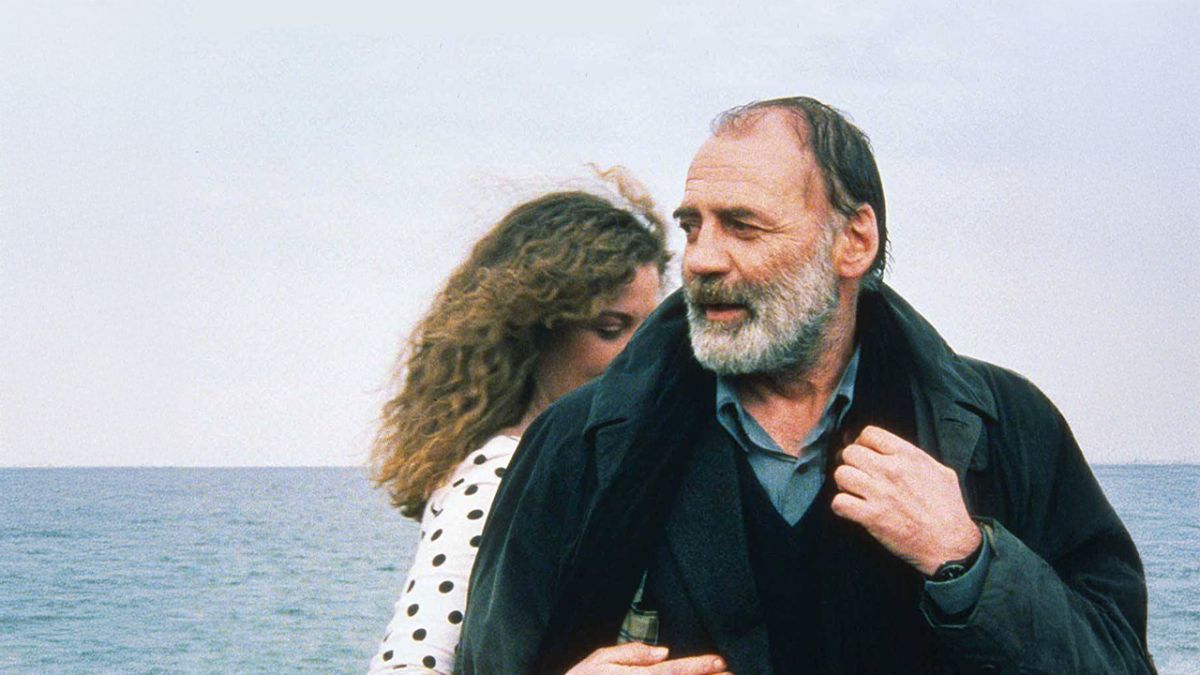
(Eternity and a Day, 1998) is a thought-provoking title that invites both philosophical observation and poetic rumination. Any fresh reading of the film must therefore attend to its implications. Such an approach is substantiated by Theo Angelopoulos’ oneiric atmosphere and existential poetics, which permeate both the film’s visual tapestry and its aural texture.
The aesthetic principles that constitute the Greek auteur’s unique vision are omnipresent throughout the work. His slow-paced, solemn, and contemplative approach is well-suited to the film’s central premise: a man knows that he will die the following day. This premise provides fertile terrain for Angelopoulos to deploy his well-established ocular poetics and durational treatment of time.
The man confronting his imminent mortality is none other than a self-portrait of an aging Theo Angelopoulos: Alexandros, portrayed by Bruno Ganz. Here, Angelopoulos internalizes his recurring thematic concerns. Instead of interrogating collective memory and investigating the geopolitics of the Balkans, he turns inward to examine personal memory and blur the illusory boundaries of time.
“He has made everything beautiful in its time. He has also set eternity in the human heart.” Ecclesiastes 3:11
This biblical verse situates us within the existential territory that Angelopoulos has designated for us. Humans are temporal beings(beings-in-time) beautiful in their time. Yet they are metaphysically guilty of their mortality, guilty in the sense that they cannot escape its inevitability. Still, nothing liberates us more than the finitude of our existence. It is through the realization of this state of evanescence that we begin to adopt our own ethics of living. Death is thus the quintessence of existentialism because it urges us to create and pursue meaning. Eternity signifies humanity’s perpetual pursuit of meaning: eternity is set in the human heart. Angelopoulos explores this point in the film- however, he does so in a heightened manner. He asks a simple question: How should a dying man live his last hours?
I will try to elaborate on the significance of the titular phrase by illuminating three instances of artistic bravado in which sound, color, and intellect converge to illustrate eternity in its fullness while simultaneously confining it within a day.
By the Sea
Alexandros wanders. The eternity set in his heart triggers a longing for moments that feel eternal - moments when love seems permanent and the human embrace feels tight. For what does a dying man have left but eternity as the only direction toward which he can orient his gaze? The seaside sequence, in which friends, family, and his wife Anna gather to celebrate the birth of their daughter, crystallizes his state of mind. We first return to this dreamlike memory when Alexandros visits his daughter to say goodbye. With sorrowful tenderness, his mind drifts involuntarily to that radiant day. But how does Angelopoulos navigate eternity?
Thereafter, Angelopoulos enters and exits the sequence at will. We never know for certain whether what we witness is a memory or a dream; it is likely a blend of both. The inexactitude here is not beside the point - it is the point itself. The flashback becomes his scalpel, incising deeply, eviscerating the aching beauty of the moment. It embalms the luminous seaside day, exposing the fragility of time. After all, as one of the children states in the opening voice-over, “Time is a child that plays dice on the shore.”
This seamless transition between the present and flashbacks negates linear time. It evokes, rather, the eternalist view, which holds that the past, present, and future exist equally. Time, in this sense, is like space. Angelopoulos accesses the flashback as effortlessly as moving from his daughter’s apartment to the seaside. This eternalist view is closely akin to the Augustinian conception of time. In the Confessions, Augustine argues that the past, present, and future are not fixed temporal zones but rather different modes of the present: the present of past events (memory), the present of current events (perception), and the present of future events (expectation). In the film, memory and perception merge, juxtaposing the seeming eternity of the moment with its inherent flickering.
Eternity is not only present in temporal conception; it is also palpable through sensory experience. The seaside sequence evinces the duality of eternity in minute strokes. It begins bright and sunny, gradually shifts to gloomy and cloudy, and ultimately culminates in rain. The duality of eternity thus manifests through color, sound, and ambience. Eternity is both the intimacy of kissing one’s wife in the rain and the dread of facing the fierce waters alone. Any moment lived in its full intensity and nowness - liberated from all but pure sensory experience - is an encounter with eternity.
The titular phrase closes both the sequence and the film. Alexandros asks Anna: “How long will tomorrow last?”, to which she responds: “Eternity and a Day.” Alexandros touched eternity through that seaside day. Yet what does “Eternity and a Day” really mean? Why append a day to eternity? Is eternity not supposed to encompass everything? What is left of everything, then?
The phrase is profoundly Derridean. Derrida resists totalizing claims. He insists that no text can fully encompass meaning; there is always a remainder that escapes. This takes us to the film’s second instance of brilliance.
The Unfinished Poem of Dionysios Solomos
No text is ever complete, as Derrida always reminds us. In the film, Alexandros attempts to complete the unfinished poem of Dionysios Solomos, The Free Besieged. The poem, like many of Solomos’ works, feels alive and pulsating - despite, or perhaps because of, being fragmentary and incomplete. It lives through Alexandros’ engagement as he negotiates with language to fill the gaps and bring closure. Yet he cannot, and never will, succeed; some remainder will always escape.
Moreover, the oxymoronic nature of the poem’s title echoes Derrida’s dialectic of presence and absence, which posits that meaning and reality are never present in a straightforward way. It is, rather, the interplay between what is present and what is absent that generates meaning. We can observe this in two cases: the poem and Alexandros’ deceased wife, Anna. Some parts of the poem are there; some are missing, and the missing verses are almost as significant as those present. Anna also mirrors this dynamic- she is dead, yet she dominantly hovers over her husband’s thoughts. In this way, both the fragmentary nature of the poem and Anna’s lingering presence demonstrate that absence is not a latent void but rather a constitutive force that shapes meaning.
Derrida’s concept, exemplified by the unfinished poem, offers one way of understanding the logic behind appending “a day” to eternity. Angelopoulos mirrors Derrida’s resistance to totalization. He suggests that the gaps, the missing parts, and the remainders we cannot grasp are the very things that render moments eternal. Eternity emerges through temporal ellipsis, the film’s immunity to narrative closure, and raw sensation. This culminates in the film’s third instance of cinematic mastery, where Angelopoulos suspends time itself - a moment of technical concretization where eternity is realized in sound and image.
The Bus Ride
During his wandering, Alexandros meets and befriends an Albanian refugee boy - a characteristic nod to the geopolitical tensions of the Balkans from Angelopoulos. Alexandros and the boy board a bus toward the end of the day. A group of musicians joins them and begins to play. They perform the score of the film, which is also the same music that has been Alexandros’ only contact with the world over the preceding months. A moment of technical genius blossoms when Angelopoulos seamlessly switches the music from the diegetic performance of the musicians to the orchestrated score recorded for the film.
Angelopoulos successfully creates a sense of eternity by stretching the music and suspending the moment. Everything else falls silent; only the sound of the music persists. Throughout, the camera remains fixed on Alexandros and the boy, and we are able to perceive only the delight that the music evokes in them. The prolonged fixation of the camera creates the impression of a freeze-frame. The stillness of the moment mirrors the stillness of eternity. Eternity becomes an elongated moment that resists division. They are so absorbed in the experience that they seem to transcend it and brush against the eternal - another moment liberated from all but pure sensory experience.
The relationship between Alexandros and the Albanian boy ultimately reveals a graceful ethics of living and offers Angelopoulos’ answer to the film’s central question: How should a dying man live his last hours? On the final day of his life, Alexandros does not retreat into solipsism and despair. Instead, he chooses to help the boy. He teaches him what a poet is and recounts the story of Dionysios Solomos. Alexandros opts for grace rather than nihilism. His actions embody the prophetic hadith: “If the Hour starts to happen and in the hand of one of you is a palm shoot or seedling, then if he is able to plant it before the Hour happens, let him plant it.”
It should be said without hesitation that the film transcends any philosophical endeavor that attempts to contain it. Angelopoulos miraculously captures eternity through the illusion of suspending and bending time at will. We encounter eternity in the seaside reverie, the story of Solomos, and the transcendent bus ride. The key to the film - as with many of Angelopoulos’ works, The Beekeeper being a clear example - can be found in the opening scene, where the children have the following exchange:
“What do you know about the ancient city?”
“Grandfather says that it was a happy city that was swallowed by an earthquake and that it has slept under the sea for centuries. It comes out of the water once a month, for a very short time, when the morning star regrets having to leave the Earth and stops and contemplates it. And then everything stops. Time also stops.”
The Greek filmmaker hypnotizes us and suspends time itself - most vividly evident in the bus ride sequence. He also manages to poetically mystify death; the vast blue sea both opens and closes the film. Where the ancient Egyptians described death as “going out to the light,” Angelopoulos envisions it as “going out to the sea.” By appending “a day” to eternity, he suggests that eternity can only occur within the confines of real time, within the grip of twenty-four hours, and ultimately within a single moment. Within each present moment resides an eternity, one revealed through loss, incompleteness, and pure sensory experience.