The bond between the city and cinema in the Arab world offers a rich lens through which to read social and urban transformations from the twentieth century to today. The city on screen is never merely a silent backdrop; it becomes a living visual memory and an active force shaping the destinies of characters. Few artistic forms have captured the pulse of the city and the experience of urban modernity as sharply as cinema, whose images and sounds granted these cities a second life—turning them into vivid archives of historical change.
Arab filmmakers gradually deepened their gaze toward the city, treating it as a visual archive safeguarding collective memory and resisting erasure. In the early decades of the twentieth century, Cairo, Beirut, and Damascus were often used as charming modern backdrops without shaping the films’ narratives. Cairo in (Baba Amin - 1950), for instance, appears in polished shots of the Nile sidebanks and European-style downtown buildings—an aesthetic showcase of modernity rather than an exploration of how the city influences its people. This simplified representation echoed Hollywood’s own reliance at the time on decorative panoramas.
But the cinematic landscape shifted with the rise of the new realism in the 1950s and 1960s, when filmmakers began to treat the city as a mirror of social structures and a space of conflict and change. In (Cairo Station - 1958), Youssef Chahine portrayed the central railway station as a compressed social universe where countryside meets metropolis, wealth meets poverty, and hope collides with disillusionment. The station becomes a self-contained world reflecting the contradictions of mid-century Egyptian society.
With this shift, the city turned into a pulsating archive of collective memory—no longer a decorative setting or neutral mirror, but a character that remembers and records its own history. Salah Abu Seif captured this vividly in (El Osta Hassan - 1952), where Cairo’s geography embodies its class memory: the working-class district of Boulaq stands next to the aristocratic Zamalek, separated only by a bridge, yet the gulf between them is vast and telling. Similarly, Marwan Hamed’s (The Yacoubian Building - 2006) uses a historic downtown building as a visual metaphor for modern Egypt, gathering under one roof a cross-section of society. The building’s narrative traces its journey from the monarchy to the post-1952 transformation of its rooftop into improvised dwellings—turning the structure into a witness to shifting political and social tides. Its ornate facade speaks of an aristocracy fading away, while its overcrowded rooftop reveals new waves of marginalization. The building becomes a visual document of urban expansion and growing poverty, and a record of the broken promises of the modern state.
Syrian cinema, in parallel, has portrayed the city as a living national memory bearing witness to the turbulence of history. In (Ahlam el-madina - 1984) by Mohammad Malas, Damascus appears as a character recalling the 1950s, capturing both daily life in its old alleyways and pivotal events such as the 1958 union between Syria and Egypt and its subsequent dissolution. The city becomes a vessel of collective memory: its streets observe what its people endure. Likewise, Beirut appears in Lebanese cinema as a witness to the civil war and its aftermath. In Maroun Bagdadi’s (Beirut Oh Beirut -1975), the city pulses with vitality just before the war; later films show a divided, wounded metropolis marked by bullet-scarred buildings that silently narrate years of conflict. In many such works, the city seems to remember more faithfully than its inhabitants—preserving victories, losses, and scars across generations.
By the twenty-first century, some filmmakers began treating the city as an archive in danger of vanishing, using the camera to preserve what might soon be lost. Tamer El Said’s (In the Last Days of the City- 2016) plays like a preemptive elegy for Cairo before the 2011 revolution, capturing downtown streets with a mixture of longing and dread, as if filming a living being on the brink of disappearance. Likewise, a number of Egyptian directors highlight the city of Alexandria as a cultural text with multiple temporal layers. Where cafes, old cinemas, and ancient buildings carry memories of a prosperous cosmopolitan time followed by decline. In contemporary Arab cinema, the city becomes both personal and collective memory—its architecture accumulating layers of time, while the camera becomes a tool for saving its fading details and transforming its urban landscape into a living record of a society in flux.
The City as a Living, Breathing Character
Arab cinema’s artistic gaze has evolved beyond treating the city as a mere stage, instead casting it as a living organism—a central character with its own history, inner conflicts, and the power to shape the fates of others. The city “breathes drama”: it is not passive but a source of tension, calm, or conflict depending on its shifting rhythms. On screen, it often takes on human traits—its pulse may be chaotic or subdued; its wounds visible in war-scarred landmarks; its moods reflected in colors, sounds, and seasonal light.
This raises a central question: how does the city influence characters’ destinies?
At times, it dictates the protagonist’s pace of life and shapes their sensibility. In (Microphone - 2010), the young man’s daily rhythm reflects Alexandria’s fast and unruly energy, defining his aspirations and artistic identity. In more dramatic contexts, divided cities forge the identities of their inhabitants, as seen in Ziad Doueiri’s (West Beirut -1998), where the civil-war-torn city becomes an enclosed world shaping the lives of the film’s teenagers. Barricades, snipers, and ruined streets are not just scenery—they shape the characters’ fears, choices, and emotional horizons. The city’s fracture becomes an internal fracture within its people.
Some characters struggle against the city’s influence but rarely prevail. Sheikh Hosny in Daoud Abdel Sayed’s (The Kit Kat - 1991) tries to preserve his warmth and integrity despite poverty and blindness, yet Cairo’s pressures corner him, forcing painful compromises. Others adapt to the city to survive, but at the cost of innocence or moral clarity. (The Yacoubian Building) again offers multiple examples: the poor youth pushed toward extremism after losing all opportunities; the principled journalist worn down by institutional corruption; the powerful businessman sinking deeper into illicit deals. Their compromises trace the logic of a city that rewards survival more than integrity.
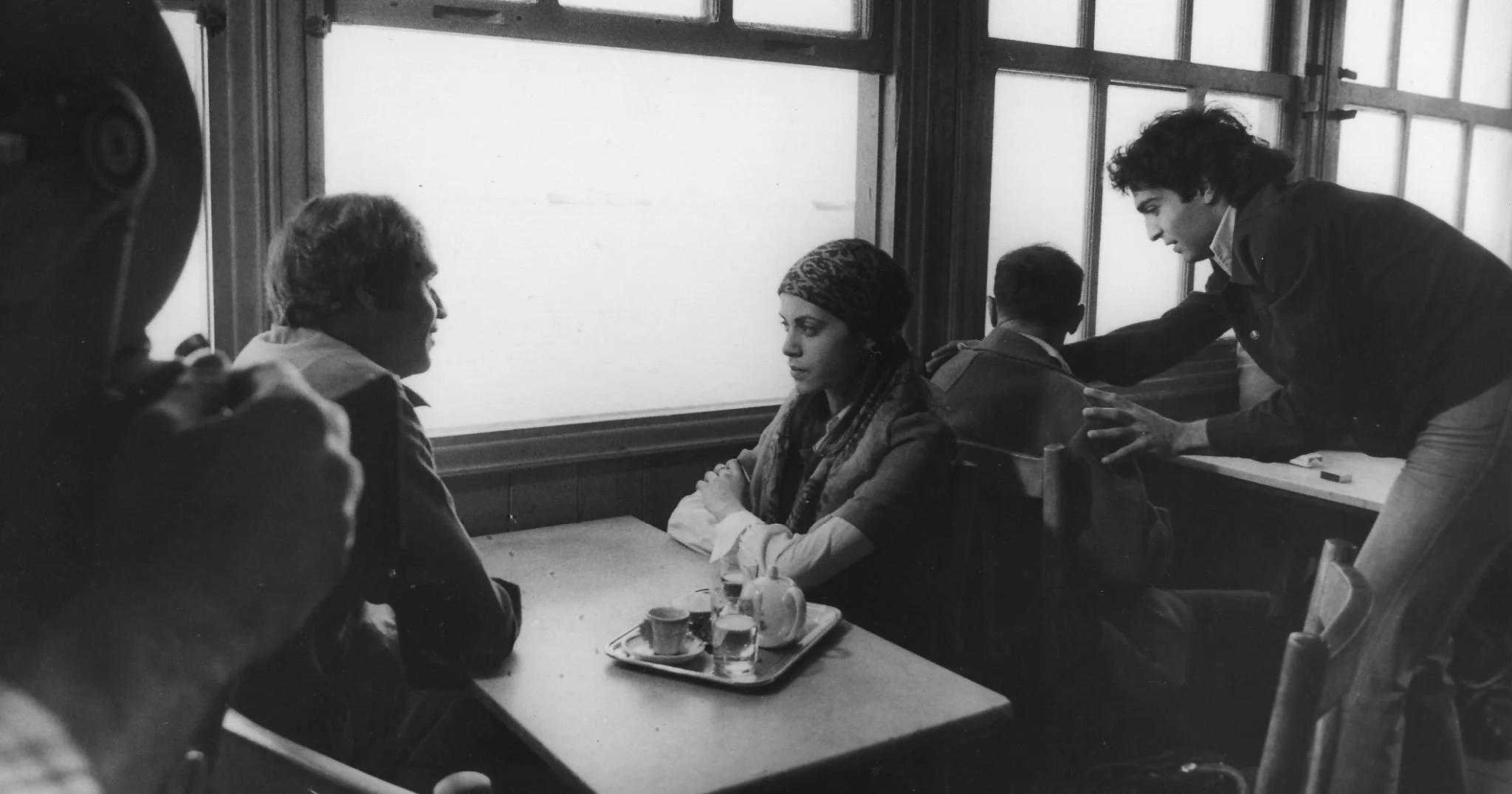
Some filmmakers excelled at turning the place itself into a co-protagonist pulsing alongside the characters. Mohammad Khan stands out here: his films possess a strong visual memory and a keen sensitivity to the spirit of place. Cairo’s streets and neighborhoods in his work function like true companions to his characters. In (A Dinner Date - 1981), set in Alexandria, the city’s cold coastal air and dark winter sea mirror the emotional chill between the couple at the film’s center. In contrast, the open, bustling street scenes in (Dreams of Hind and Camelia - 1988) and (Fares el-madina - 1993) express the characters’ yearning for freedom beyond their constricted realities. Narrow alleys tighten around them when crises peak; open spaces widen when hope emerges. Thus, in Khan’s cinema, the city becomes a living, breathing organism with the characters; It narrows and suffocates them when the conflict intensifies, and gives them breezes of relief when a way out of the distress appears.
Perhaps the clearest embodiment of the city as a dramatic character appears in Daoud Abdel Sayed’s (The Search for Sayid Marzouk - 1990). The protagonist wanders through Cairo during a surreal night searching for a mysterious man named Sayid Marzouk. The nocturnal journey reveals two contradictory faces of the city: alluring and seductive at one moment, menacing and vast the next—a multi-headed creature capable of devouring its own. Sayid Marzouk himself becomes a symbol of Cairo with all its contradictions, temptations, and dangers.
Architecture as a Visual Language of Conflict and Transformation
If the city in cinema is a living memory and a dramatic protagonist, then its architecture is a silent visual language that speaks the buried class and political struggles. Architecture is not a mute physical structure; it is one of the most significant cultural elements reflecting a society’s civilizational model and historical conditions. Ibn Khaldun notes in his “Muqaddimah” that “reading the architectural behavior of a people is the best way to understand their history,” meaning that observing buildings—through their forms, styles, and layouts—reveals the prevailing cultural ethos and the external influences a society has absorbed. Architectural heritage thus stands as a vivid visual archive of civilizational history and its transformations.
Cinema, drawing from this idea, approached architecture as a visual text whose meaning exceeds its functional or aesthetic shape. The height of a building, its style, or even its structural decay are never neutral details; they are signs indicating wealth, power, or socio-political shifts in a particular historical moment.
This visual reading of architecture appears clearly across numerous examples in Arab cinema, where walls and alleyways become expressive protagonists narrating the history of people and place. In Cairo, for instance, heritage or colonial buildings are frequently used to read political and social transformations. (The Yacoubian Building) is the clearest example: its architecture became a mirror of Egypt’s class metamorphosis over half a century. The new bourgeoisie replaced the pashas in the upper floors during the republican era, followed by waves of the poor moving onto its rooftop after the revolution. Within a single architectural body, layers of residents chronicled the shift from monarchy to socialism to neoliberalism. One building became the very archive of modern Egypt’s class struggles.
In postwar Beirut, modern architecture carried implicit political messages. The glass towers and seaside luxury hotels—depicted in films like (Caramel - 2007)—mask the wounds of the old city. Their glossy facades appear like makeup on an injured face: they cover but do not erase the bullet scars on the stone buildings that still testify to years of civil war. This contrast between a polished surface and a distressed interior becomes a visual statement on efforts to suppress collective memory beneath the glitter of modernity.
Traditional architecture in some Arab cities has also functioned as a dramatic element symbolizing either resistance or social entrapment. The old Damascene house—with its central courtyard, fountains, and rooms arranged around the inner patio—appears in (Ahlam el-madina) as a beautiful yet suffocating social prison. These inward-looking houses, with their high walls and shuttered windows protecting family privacy, preserve tradition but also enforce society’s strict surveillance—especially over women. The thick walls become a record of social repression, containing within them hierarchies and generational conflict.
Tunisian cinema offers another reading. In Nouri Bouzid’s (Man of Ashes - 1986), the city becomes a nightmarish labyrinth that traps the protagonist. The narrow, tangled alleyways and tightly packed blind-walled houses make escaping the old quarter nearly impossible. Here, traditional architecture is neither nostalgic nor poetic; it becomes claustrophobic, reflecting a stifling social reality of rigid customs and relentless communal scrutiny.
In the Gulf, contemporary films explored how rapid modernization shapes experiences of aspiration and isolation. In Haifaa al-Mansour’s (Wadjda - 2012), Riyadh’s streets symbolize the space of possible dreams for a girl navigating a rapidly changing urban landscape. Modern buildings and high walls dominate the frame, yet they serve as a backdrop for a young protagonist seeking her voice in a city rushing toward the future. In (The Perfect Candidate - 2019), Saudi Arabia’s architectural scene becomes a mirror of social transformation: modern institutional facades coexist with a lingering sense that the city is still learning a new language of freedom. Modernity here is not mere visual embellishment; it forms part of a cultural struggle between tradition and emerging possibilities.
Emirati cinema moves in another direction. In Ali Mostafa’s (Shabab Sheyab - 2018), Dubai—with its spectacular skyscrapers—serves as an ironic backdrop to a generation searching for meaning in a hypermodern city. Its glassy spaces, despite their beauty, reveal the fragility of modern life.
Cinema does not treat architecture in these works as a static backdrop but as a temporal document. Between the traditional Damascene courtyard and the Gulf’s glass towers lies a single narrative thread: the Arab city is living through its most intense transformation in a century, and cinema documents this with both critical insight and human sensibility.
Thus, the story of the city in Arab cinema ultimately becomes the story of an entire nation grappling with the pressures of modernity and identity. Cinema has read social changes through the architectural fabric of Arab cities: from the traditional “hara”, symbolizing solidarity and communal warmth, to the high-rise complexes symbolizing alienation and widening class divides; from lively old markets, the heart of local economies, to gleaming malls reflecting globalized consumer culture. On screen, the “hara” became an icon of a cohesive past, while modern architecture became the emblem of a fragmented present. One need only compare the warmth of neighborhood life in an old film like (Love street - 1959) with the emotional coldness among residents of the massive building in (The Yacoubian Building) to see how cinema exposes the shift from a communal society to a stratified one filled with stark contradictions.
Reading the Arab city on screen reveals a three-dimensional structure where history, society, and aesthetics intertwine. Cinema here is not an artistic luxury but a unique epistemological tool blending documentation with poetry to understand the evolution of urban life and social reality. It dissolves boundaries between the real and the imagined, inviting us to contemplate a place as a mirror of ourselves.
As a dramatic protagonist, place compels criticism to move beyond form and engage with the urban fabric as an indicator of societal conditions. Amid the search for identity in a time of accelerated modernity, cinema reminds us that our cities are not mere concrete and stone—they are cultural beings carrying the memory and soul of a nation. Preserving the spirit of the city is, at its core, preserving our collective self and our identity in the face of time’s persistent questions.