Years ago, while having a discussion with a friend interested in cinema, I found myself unable to explain the reasons behind loving the film Breathless (1960), along with many other films by the late French director Jean-Luc Godard as well as the works of the French New Wave filmmakers. The film, as well as the wave in general, draws its greatness and significance from a basic idea: rejecting the conventions of international cinema and Hollywood in cinematography and directing. However, I will not accept this to be the only reason behind liking the film. That is why I set the challenge to myself and my friend as well, for the film to have a meaning that transcends its technique. Theodor Adorno1 says, “Anything that does not serve a function in an artistic endeavor should be abandoned”. Or, more precisely, an artistic work has to convey something that goes beyond its artistic technique. In this sense, this article is an attempt to understand what the film says with its technical breakthroughs, without necessarily referring to other films of Godard or the French New Wave, but through utilizing the film itself as the only focal point.
Despite being relatively old, it is hard to watch Breathless without noticing a deep sense of its modernity. The viewer is immersed in a profound modern feeling despite the black and white screen and the old vehicles, old Paris, and the old clothing styles. The film does not reflect the sixties that saw its release but is primarily indicative of a contemporary style and understanding of modern life in France, in the blurry and mysterious sense of modernity. This is manifested through the filmmaker’s own style, where Godard's technique, as stated by him, stems from his desire to contribute to shaping what he wants to see in cinema. He starts from a defining moment, as an ordinary critic writing in André Bazin’s magazine Cahiers du Cinéma, where he mentions films that he likes and others that he does not for many critical reasons. Then, he finds himself in dire need to contribute to the films themselves instead of mere theorizing. This led to a technical revolution that made him a genius filmmaker, shaped by his critical background and low budget.
***
The late academic and critic Edward Said presents an artistic reading of the works of many artists and writers in his critical book On Late Style2, which is based on an idea introduced by the most prominent music critic, Theodore Adorno, about Beethoven. This idea focuses on the centrality of the end of the artist’s life, which allows him to rebel against conventional creative patterns to discover and create new ones. Edward Said traces the personal lives of the artists that empower them to reach a technical point in their novels, for example, that are not necessarily subject to the traditional standards that constitute what a novel should be like. This phase is a result of a life and history rife with critically successful works, at the very least. Both Adorno and Edward Said agree on rejecting the popular interpretation that radically different late works of prominent artists are not necessarily due to the depletion of the creative capabilities of those artists. On the contrary, Edward Said emphasizes that there is a creative horizon that an artist may not reach until he gets to a stage where he stops caring about the opinion of others, which qualifies him for enormous technical discoveries.
However, if we were to go back a little to an advanced stage of understanding the works of art, we would find that the classicism and techniques that everyone agrees upon are themselves a direct result of previous cycles of breaking the rules that preceded them but at an earlier date. Bach, for example, who is a master of “Fugue”, presented pieces that use the same Fugue and break its own rules in abstract creative ways. Perhaps the most important pattern we can see here in this early method is that the founding artist breaks the rules instead of building upon them, which is why Bach, for example, is crowned as the godfather of classical music even though he did not write symphonies. In this sense, we can consider Godard in his film Breathless, a cinematic godfather par excellence. As soon as we look into the film and the technique in it, we can see that it breaks the rules from that very foundational point of view. This can be referred to as the "Early Style," a method rooted in the initial conditions faced by a critic attempting to present his creative vision for the first time rather than merely receiving and commenting on existing works. These conditions, coupled with a low budget, enable the artist's first films to achieve creative and technical breakthroughs.
While films before Breathless adhered to the principles of "completeness" or "continuity," Breathless does the opposite. For instance, when cinematic conventions call for a long take during a dialogue, Breathless interrupts the image with a "jump cut." Conversely, when conventions dictate a jump cut, Godard keeps the camera rolling without editing or changing the angle, giving the impression of someone holding and moving the camera. This breaking of cinematic rules—partly due to the film's limited production budget—is closely tied to Godard’s artistic and critical vision. A limited budget meant fewer cameras, which continuity typically requires. Thus, the budget constraints became a catalyst for Godard to devise innovative solutions, leveraging his understanding of traditional rules. These creative breakthroughs might not have emerged if Breathless hadn't been his first film.
At its core, Godard’s technique in his first film is grounded in a radical idea—at least radical for its time—that he wants the viewer to be constantly aware that they are watching a film. Before Breathless, the primary aim of filmmaking techniques was to make the viewer forget they were watching a film, achieved through masterful cinematography, continuity, and multiple angles. However, Godard does the opposite. Breathless emphasizes that it has something to say through its imagery, not just its plot. The film brings us back to the reality of cinematography, editing, and filmmaking itself rather than immersing us in the illusion of the story and plot. Godard confirmed this approach in a famous interview with Dick Cavett3. When asked,: "Don't you have a cinematic script?" Godard replied: "I have a script, but it's not like scripts here in America." He showed some of his upcoming work scripts, which appeared as pocket notebooks with only a few sentences on each page. Later in the interview, he added: "The film and its making are not based on writing as much as on cinematography and editing. 50% of my films are cinematography, and the other 50% are edited montages."This brings us to the question: What does the camera say? And what does the montage say in the film? Can it be said that they are just experimental attempts to break past creative patterns?
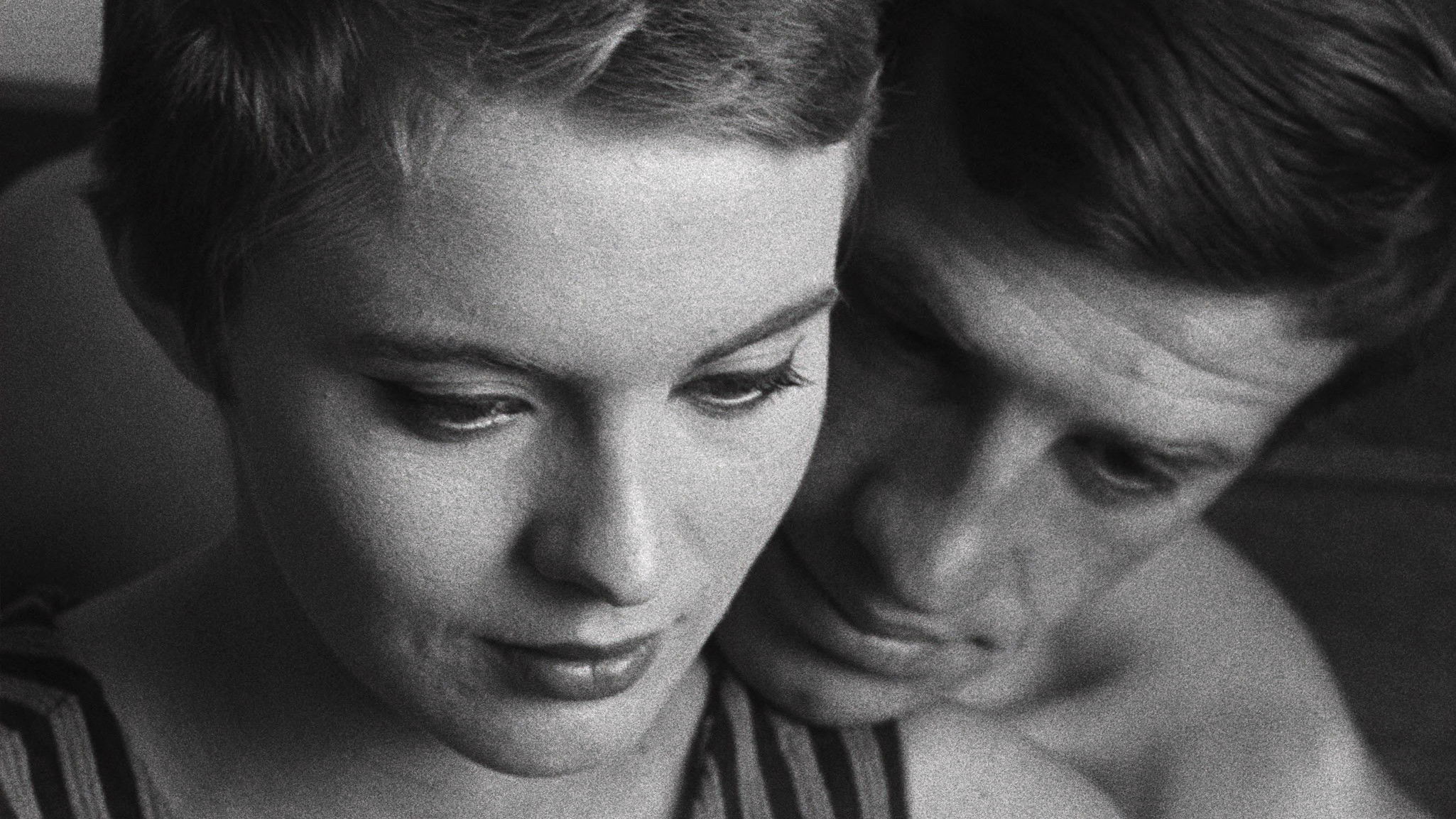
The longest scene in Breathless features Michel and Patricia in her room. It takes up to 25 minutes of a 90-minute film characterized by fast-paced locations and scenes that make tracking time difficult. This scene lacks significant dialogue and isn't a dramatic climax. Instead, it embodies Godard's aim: to demonstrate how image, editing, and acting can convey something visually and cinematically profound without relying on dramatic climaxes or exceptional writing. The scene and the entire film aim to communicate through imagery rather than language, ideas, or events, emphasizing cinema's intrinsic value as a visual medium independent of literature or music. The most important elements in the scene are the simple, everyday actions of Michel and Patricia: Michel playfully flipping on the bed, Patricia looking in the mirror while getting dressed, their meaningless conversation, and the subtle, indifferent interactions between them. For example, when Michel tries to lift Patricia’s skirt, she slaps him without emotion, and they continue their playful banter.
The viewer must look beyond the words to the characters’ faces and actions to discern the truth of their dialogue. Does Patricia genuinely contemplate her feelings for Michel? Does Michel truly love Patricia when he shows no empathy? Their faces reveal neither clear truth nor ambiguity, only an enigmatic dynamic that transcends language and plot. These dialogue shots confront the viewer with self-expressive images of playful moments full of visual connotations that only a self-aware film can capture: the contours of the moment, the features of cinematography, and acting that elevate the scene to an abstract sense, almost like a documentary.
The film continues to present the same idea in the rest of the film’s themes and scenes, as it tries to understand the two main characters in the same way, through the minor visual details and not through the plot or dialogue: Michel is pursued by the police for killing a police officer with a strange indifference. He steals cars and robs people without a guilty conscience or second thoughts. He also steals coffee and magazines, which we discover through the same visual games that we see in his scene with Patricia. At the same time, we see Patricia in a cultural community working as an American journalist in Paris, meeting another American to drink coffee and hang out in a dialogue that the director interrupts with a montage to highlight its artificial cultural aspects. It is as if he wants to declare his actual problem with dialogue with the montage itself. She also attends a cultural meeting with a French philosopher who tries to transcend clichés in his answers to journalists’ questions and who feeds the dialogue itself with an out-of-context and unexpected flirting with Patricia herself. The scene shows her expressions and self-fascination during the press interview after he flirted, to show her personality through the image as well and not only through her presence in this same cultural community.
These technical breakthroughs in 'Breathless' highlight its sharp, clear, aesthetic, and artistic functions. Like the early works of cinema pioneer Charlie Chaplin, Godard’s film asks: how can an image convey what language, literature, and music cannot? It is the image as a dimension of being, not just a signifier. Godard’s foundation in cinema lies in this abstract dimension, where the image speaks. His work breaks conventions and challenges norms, unburdened by technical and market constraints resulting from his critical background and limited budget. 'Breathless' wasn't made to appease the public but to showcase creative excesses that often mark the beginnings of artistic innovation. This "Early Style" precedes market and box office influence, which eventually shape and sometimes constrain creativity. Godard’s techniques have influenced filmmakers like Woody Allen, Martin Scorsese, and Quentin Tarantino, who integrated his innovations into more commercially viable structures. This influence cements Godard as one of the foundational figures in global cinema.