Adaptation was common practice in Egyptian cinema, with many films based specifically on American originals. Screenwriters believed that the American film — with its traditionally compelling or exciting plot — could provide strong material for a successful Egyptian production that would satisfy audience expectations. This may be true; however, adaptation has its own rules and precautions. This article examines an Egyptian film that failed to effectively render the plot of its American source.
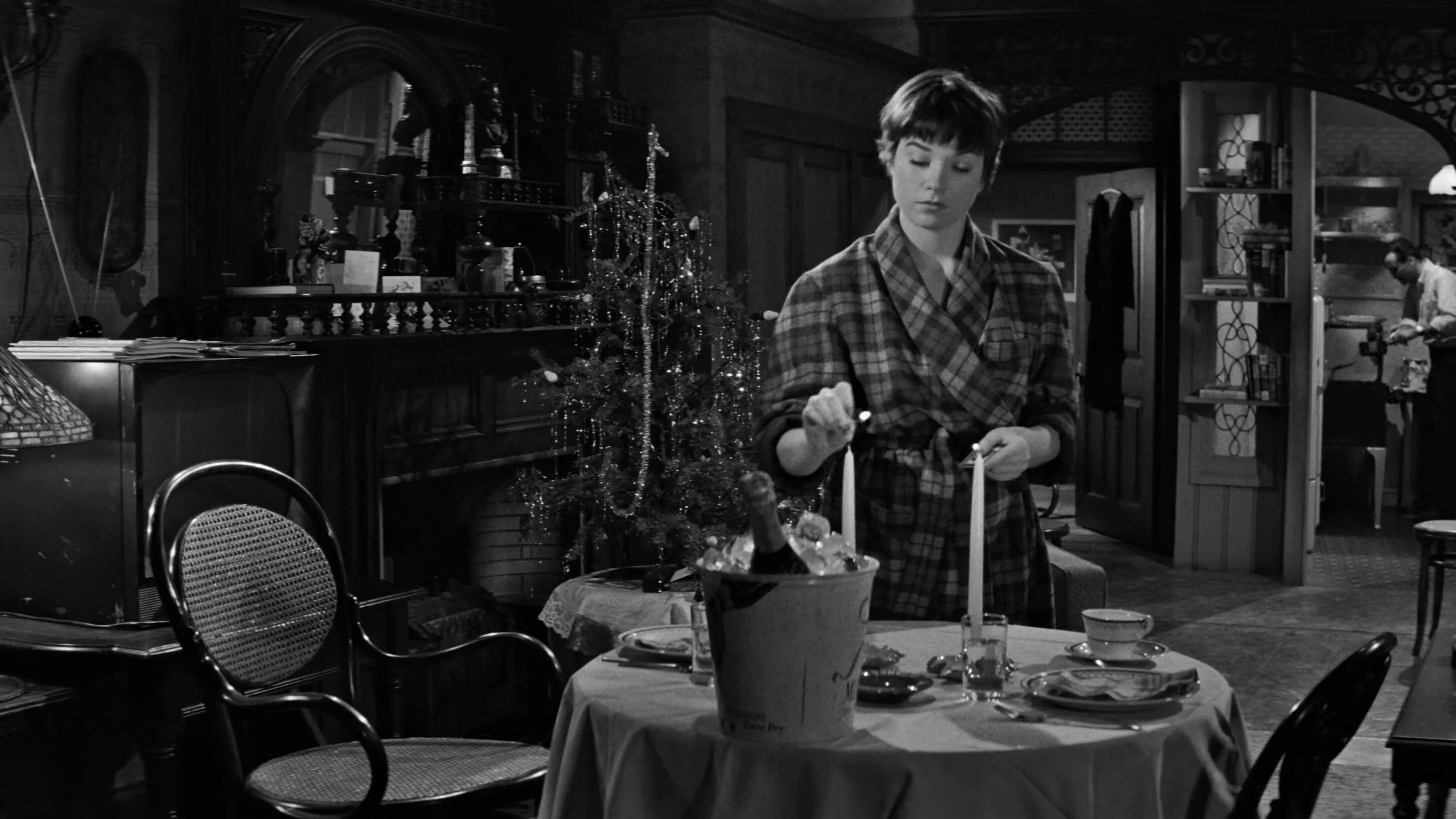
The Egyptian film Azmat Sakan (أزمة سكن, 1972), directed by Helmy Rafla and scripted by Faisal Nada, opens with the theme of a housing crisis. The female protagonist, Afaf, played by Mervat Amin, searches unsuccessfully for an apartment, while the male protagonist, played by Mohamed Awad, is forced to commute daily from his village to Cairo for lack of somewhere to live. The American film it draws on, (The Apartment), directed by Billy Wilder in 1960, opens with a reference to the growing population of New York City before moving swiftly into its main plot — which the Egyptian film adapts only superficially.
The story of The Apartment revolves around a young bachelor, played by Jack Lemmon, who lends his apartment to his bosses at work so that they can meet their mistresses there — an arrangement that causes him endless trouble. The film’s most distinctive quality is its screenplay, particularly its characters and dialogue. From the outset, we see the protagonist’s predicament: he cannot even enter his own apartment, which he has surrendered to a succession of company managers, partly because he is too naïve to refuse, and partly because he hopes to advance in the company in exchange for these services.
Azmat Sakan attempts to preserve the key traits of the protagonist — a good-natured, somewhat naïve bachelor — but there is a significant difference in how the two performances are handled. In The Apartment, Jack Lemmon’s performance is restrained, and the comedy arises naturally from the situations he faces and his reactions to them. In Azmat Sakan, the comedy relies instead on comedic set-pieces and jokes.
Azmat Sakan does succeed in transposing the events into an Egyptian context. In the original, The Apartment belongs to the male protagonist and he alone is exploited; in the Egyptian film, the company rents the apartment and assigns it to the employee on the condition that the manager may use it whenever he wishes. The female protagonist, played by Shirley MacLaine in the original as an elevator operator in the office building, is reimagined in Azmat Sakan as a woman searching for an apartment alone, played by Mervat Amin — a search she only resolves by disguising herself as a man.
Through this character, the film attempts to address the difficulties facing women living independently — the landlord’s refusal to sign a lease with her, the harassment from other residents in the building. The portrayal, however, is one-dimensional: the character remains superficial, and the issue is handled in an almost purely comedic manner, under the assumption that this is what comedy requires.
The female protagonist’s central conflict in The Apartment takes the form of her love for one of the company’s married managers, who repeatedly promises to leave his wife for her, though the right moment never arrives. In the Egyptian film, no such relationship exists between the female lead and anyone — a consequence, in part, of her being entirely removed from the company setting.
As a result of the many changes made to her character, the female protagonist of Azmat Sakan loses much of the depth her original counterpart possessed. In The Apartment, the protagonists’ relationship develops through several carefully constructed stages. The male protagonist first develops feelings for the female protagonist and tries to ask her out. He then loses hope upon discovering her relationship with the manager, in one of the film’s most memorable scenes: he finds a broken mirror in his apartment after the manager’s visit, and when he returns it, realizes it belongs to the female protagonist — who looks at the broken mirror and says she prefers it that way because it resembles how she feels.
Shaken, he tries to move past his feelings. His resolve quickly falters, however, when he returns home to find her unconscious after a suicide attempt — prompted by a revelation at the company’s New Year’s Eve party that the manager she loves has a pattern of exploiting women in the same way. At this point, the bond between the two protagonists begins to deepen as she recovers and comes to recognize his genuine kindness.
In the end, the male protagonist decides to stop allowing his apartment to be used — a decision driven by his feelings for her — and the film closes on New Year’s Eve as she visits the apartment and their relationship begins to bloom.
This entire arc of character development is almost entirely absent from Azmat Sakan. The relationship between the two leads develops abruptly and without logic. In one scene, Mervat Amin asks Mohamed Awad to pose as her brother before the landlord to help her secure the lease; he refuses at first, then agrees the following day. He visits her, but moments later she is already disguised as a man to sign the contract. In the next scene, they meet again and a romantic relationship begins between them.
The endings of the two films share a similar premise — the male protagonist decides to stop allowing the exploitation of his apartment — but in Azmat Sakan, this resolution arrives only after a series of moralizing speeches: first from his father, then from one of the company’s managers, played by Youssef Wahbi in his characteristic mode of counsel and guidance, and finally from the female protagonist herself. In The Apartment, by contrast, the protagonist’s decision arises organically from his love for the woman, and his refusal to hand the manager the key to meet her there makes her final visit to the apartment feel spontaneous and earned — rendering the closing scene far more delicate and affecting.
The adaptation succeeds in certain limited respects — establishing the main character and transposing the events from an American to an Egyptian setting. It fails, however, in more fundamental ways: the characters lose their depth, the pursuit of comedy comes at the expense of dramatic situation, and the supporting cast is expanded only to generate additional jokes, growing increasingly superficial in the process. With the film’s constant drive toward humor — at times even in scenes that call for seriousness — the dialogue loses much of its weight and meaning.
Faisal Nada’s screenplay adds nothing new to what Billy Wilder achieved in the original. The original remains superior in both quality and entertainment. Azmat Sakan does not engage seriously with any of the problems it raises; it approaches them only minimally and fails to construct characters with whom the viewer can genuinely empathize. This is a recurring weakness of superficial comedy.