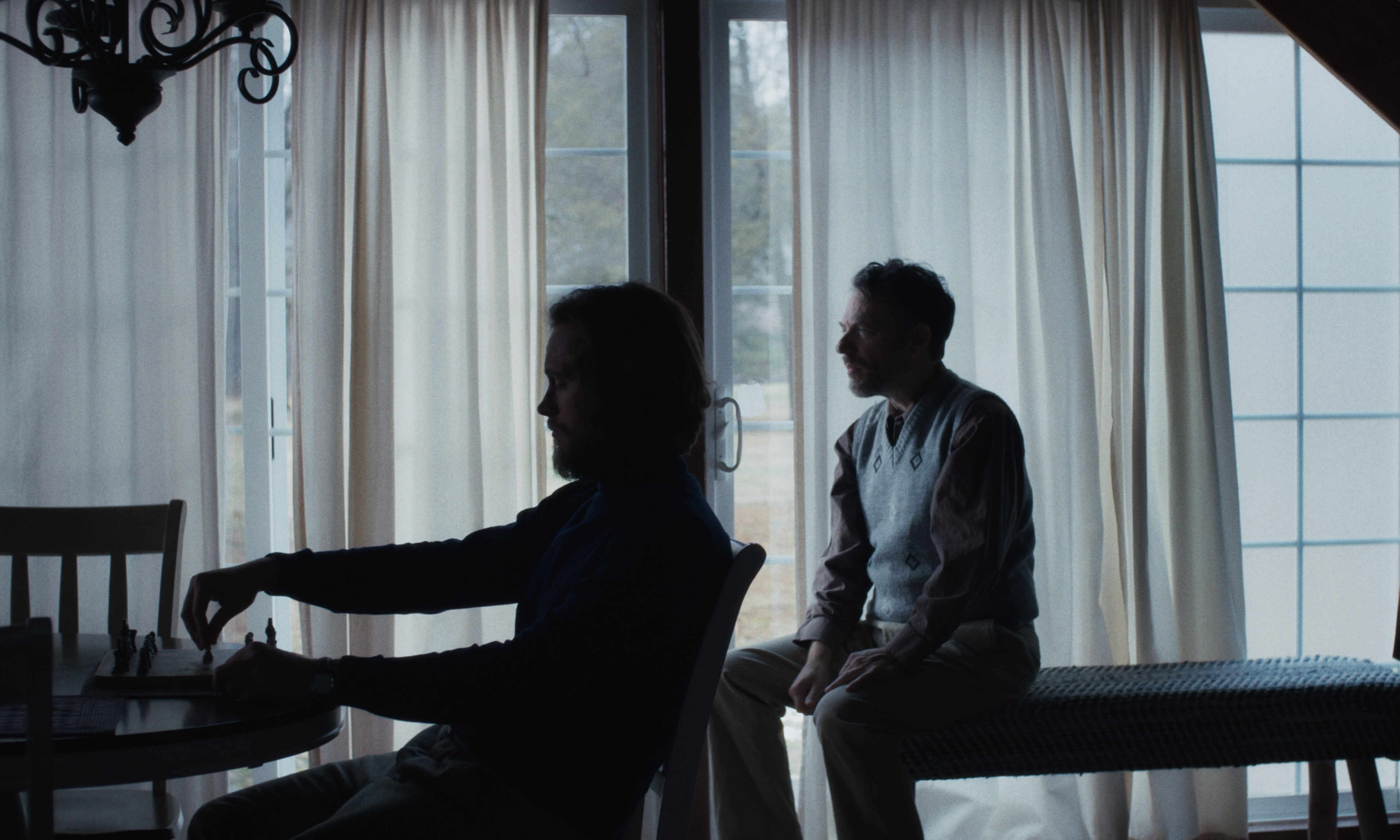
And Then Comes Winter, directed by Gigi Hozimah, is an independent film that unravels the illusion of emotional security often believed to unite loved ones in times of hardship and war. While many assume that such extraordinary circumstances naturally foster solidarity, reality proves otherwise. Social studies have shown that war frequently erodes even the most intimate emotional bonds. Love, which ought to serve as a refuge, becomes a harsh test under the pressures of conflict, as suppressed emotions erupt in anger or harden into silence.
Rather than approaching this premise as a straightforward social issue, Hozimah reframes it within a cinematic language firmly rooted in the traditions of art cinema. Here, war functions as an external force of isolation while simultaneously providing the backdrop against which a far deeper, internal isolation is examined. It is less a political subject than a psychological landscape.
Winter descends upon an unnamed country on the brink of war, where fighting has broken out not far from the home of Liv (Maritza Vives) and Adam (Jody Bardin), a middle-aged couple living together in a fragile state of quiet routine. Their home soon becomes a temporary refuge for a young displaced couple, and all four characters find themselves suspended in an anxious state of waiting. To reduce the film to this premise alone, however, would be to underestimate its richness, for beneath its restrained surface flows a torrent of long-repressed emotions, like molten lava concealed beneath a thin layer of snow.
Hozimah's screenplay follows an intricate narrative path in which past and present continually intersect, intertwining with subjective memories and psychological associations. This structure is established from the opening sequence, which introduces the film's three essential components: the isolated woodland setting, the temporal dimension announced through winter's pristine snow and bare tree branches, and the looming threat of war.
Liv wanders peacefully through nature, yet something immediately unsettles our perception of reality. The soundtrack becomes detached from the image as the ticking of a clock replaces the natural sounds of the forest. Gradually, the colors lose their vibrancy. Liv eventually stops and faces the camera directly before the sound of a nearby explosion shatters the stillness. She screams, and awakens from a dream. In its remarkable simplicity, this opening sequence reveals the source of the protagonist's unease: the approaching war has already disturbed the conflict that lies dormant within her.
As the story unfolds, it becomes clear that an invisible psychological barrier separates Liv from her husband. She retreats into silence, refusing to articulate her fears, while Adam repeatedly attempts to bridge the emotional distance between them. Yet despite sharing the same house, they remain profoundly disconnected.
Their emotional estrangement is established in their very first exchange. The dialogue is deceptively simple yet remarkably revealing. Upon hearing gunfire drawing nearer, Liv quietly remarks, "It's getting closer." Adam replies, "Yes... it's getting colder."
The exchange suggests not merely two different observations, but two entirely different emotional realities - as though each inhabits a world inaccessible to the other.
This separation is reinforced visually throughout the film. The camera frequently isolates each character within separate compositions, relying primarily on close and medium shots. Even when both appear within the same frame, architectural elements inside the house create visual divisions that keep them apart. The sense of alienation extends beyond composition itself. The restrained camera movement and deliberately measured pacing deepen the emotional distance, allowing silence and waiting to acquire substantial dramatic weight. The characters become prisoners of their own psychological emptiness.
The narrative is especially invested in Liv, who wears emotional withdrawal almost like a coat and scarf protecting her from the outside world. Yet the audience is granted access to her inner life through the film's carefully constructed flashback sequences.
As David Bordwell argues in his seminal essay The Art Cinema as a Mode of Film Practice and later in Narration in the Fiction Film, the flashback in art cinema transcends its classical role as a mere device for organizing narrative causality. Instead, it becomes a defining structural feature of Art Cinema, closely aligned with the principles of Auteur Cinema. Rather than serving plot mechanics alone, it functions as a means of exploring subjective experience and psychological estrangement. Hozimah employs flashbacks in precisely this manner, transforming them into reflections of Liv's fragmented consciousness and lingering emotional trauma.
These sequences create a striking aesthetic rupture through their use of black-and-white cinematography. Within them, Liv recalls intimate moments with Adam while recounting stories from her past, including a flashback nested inside another flashback. Through these memories, we learn that silence has long defined her existence. After leaving her war-torn homeland for another country where she hoped to begin anew, she discovered that the invisible borders of her former life had traveled with her, embodied in the values instilled by her parents.
This sequence inevitably recalls Alain Resnais' Hiroshima Mon Amour (1959). Both women suffer punishment born of love and emotional attachment, yet they respond differently to their pain. The heroine of Hiroshima Mon Amour ultimately gives voice to her suffering, whereas Liv embraces silence. Instead, she channels her emotions into memories, the smashing of household objects, sleeping alone in her car far from home, and writing letters to her husband. These become outlets for an anger that never finds spoken expression except within her dreams.
In both films, memory returns through flashbacks not as recollection alone, but as a living present that continually reshapes the heroine's relationship with the world around her. Hozimah's flashbacks therefore become far more than narrative interruptions; they function as a distinctive stylistic signature, like cracks through which buried memories seep into the present. They expose the protagonist's emotional suffering while illuminating the subtle processes through which psychological wounds are formed.
The film's use of dualities extends beyond Liv and Adam. The younger couple—Andrei (Jean-Calixte Gros) and Susan (Emily Dale White)—are deliberately positioned in contrast to their older counterparts. Yet a closer look reveals that the differences between them are less substantial than they first appear.
Unlike Liv, Susan is consumed by the fear of death brought on by the advancing war. She is overwhelmed by anxiety for her family and constantly seeks reassurance from her husband, longing for words capable of calming her fears. In this respect, she resembles Adam, who persistently attempts to penetrate the emotional silence surrounding his marriage.
Andrei, by contrast, mirrors Liv. He rarely expresses what he feels and harbors few expectations that the deteriorating situation will improve. The younger couple may therefore be understood as an earlier version of Liv and Adam—as though Hozimah places the same relationship at two different stages in time: one still struggling against emotional collapse, the other gradually surrendering to it.
The importance of emotional solidarity between partners in moments of extreme crisis reaches one of the film's most powerful expressions in a sequence that begins during a rare moment of relative calm. The four characters sit together in apparent tranquility before the sudden blast of an air-raid siren shatters the silence. They hurriedly put on their gas masks and sit wordlessly on the sofa.
The camera slowly moves across the frame, observing the fear etched on the women's faces while each man instinctively reaches toward his partner in an attempt to comfort her. The sequence unfolds at an intentionally measured pace, allowing fear and tenderness to coexist beneath the relentless sound of the siren.
Its significance lies not only in what occurs within the frame but also in its manipulation of cinematic time. Waiting ceases to be merely the characters' experience and becomes the audience's as well. Time itself is transformed into an oppressive dramatic force, no less burdensome than the war outside.
When the air raid finally ends, Susan's fear remains palpable. She instinctively turns to her husband in search of reassurance, only for Andrei to confess that he cannot offer it. Ironically, war may be the very circumstance that finally brings them emotionally closer. They begin to dance together, a quietly poignant gesture that reflects the human impulse to preserve intimacy even amid catastrophe.
Liv and Adam's relationship unfolds in stark contrast. When Adam attempts to draw closer to his wife, she withdraws. Frustrated, he reproaches her for making the war even more painful than it already is.
Liv responds with a devastating question:
"Which war?"
The war that has driven them apart?
Or the one that has trapped them together beneath the same roof?
The impact of this question rivals the emotional force of the air-raid siren itself. Hozimah intensifies its effect through meticulous mise-en-scène. The older couple occupies the foreground, enveloped in cold lighting and visually separated by architectural divisions within the house. Behind them, the younger couple embraces under noticeably warmer light.
Through this carefully orchestrated composition, the frame itself becomes a dramatic structure. The arrangement of bodies within space extends the emotional relationships between the characters, while lighting, depth, and spatial organization cease to function merely as aesthetic elements and instead become integral components of the film's storytelling.
Because characters such as Liv and Andrei refuse to articulate their inner emotions, the screenplay employs an elegant narrative strategy. Andrei confronts Adam only after reading a letter Liv has written to her husband—a letter in which she expresses her desire to face the war together and recover their love despite everything that has happened.
This dialogue is mirrored by another intimate conversation, this time between the two women. Liv finally opens herself to Susan, who is astonished by Liv's composure and apparent lack of anger, remarking that she resembles Andrei in this regard.
In effect, each spouse comes to speak through the other's partner.
Yet these exchanges produce very different outcomes. Adam apologizes to Liv for having lied to her, while Susan suddenly disappears following her conversation with Liv, leaving Andrei alone to confront the consequences of his silence and emotional detachment. It is as though Susan has learned Liv's painful lesson early enough to avoid sharing her fate.
This narrative construction reveals one of the film's most compelling paradoxes. Transformation never occurs through direct confrontation but rather through intermediaries. Adam reaches Liv only through Andrei, while Liv is able to reveal herself only before Susan. War, the film suggests, has disrupted even the most fundamental forms of communication, making confession possible only through the presence of a third person.
And Then Comes Winter belongs to a cinematic tradition that fully understands the expressive power of the image—the very foundation upon which cinema was built before synchronized sound introduced the realism that later occupied so many film theorists. Throughout the film, meaning is generated primarily through visual expression rather than explicit dialogue.
Winter itself functions as one of the film's most significant visual metaphors. Its presence extends far beyond indicating season or climate. Instead, it becomes a symbolic representation of emotional paralysis, the frozen state imposed by war not only upon the outside world but also upon the intimate relationships unfolding within the house.
As the film draws to a close, Susan disappears, and Adam leaves. Yet the emotional paralysis that has defined the narrative does not dissolve with their departure, nor does the war come to an end. Liv and Andrei remain enveloped in silence, while the distant sound of shelling continues to reverberate in the background. What has changed is not the world surrounding them, but the nature of the relationships within it.
The film's decision to confine the entire narrative to a single location transforms space into an active narrative force. The house is far more than a temporary shelter from the violence outside; it becomes a psychological arena where unresolved tensions are forced into the open. Wooden pillars, heavy curtains, and shadows cast across the walls resemble the bars of a visible prison, intensifying the characters' sense of entrapment. The home gradually tightens its grip on its inhabitants, compelling them to confront everything they have long postponed within its walls.
Even the communication towers surrounding the house acquire a striking visual irony. They imply the possibility of connection while simultaneously underscoring its impossibility. Symbolically, they reflect Liv's inability to communicate emotionally with her husband long before the telephone lines themselves are severed. Once communication with the outside world collapses, the characters' physical isolation merely mirrors the emotional isolation that has existed between them all along.
Hozimah's command of cinematic language reaches its fullest expression in her use of off-screen sound. The war is rarely shown directly, yet its persistent sonic presence is enough to dominate the consciousness of both the characters and the audience. By refusing to visualize the battlefield, she extends the film's world beyond the visible frame, granting the unseen conflict a constant and unsettling presence.
This approach closely aligns with what film theorist and historian Michel Chion describes as acousmatic sound, sound whose source remains unseen, thereby acquiring a unique dramatic authority. Because the audience never fully witnesses the origin of these sounds, the imagined threat becomes even more oppressive than one explicitly represented on screen. The recurring explosions and distant combat fill the spaces between the characters, haunting them relentlessly and reinforcing the pervasive atmosphere of fear.
Ultimately, if one were to consider the many ways mainstream cinema might tell the story of two couples trapped inside a house during wartime, the possibilities would seem almost limitless. Auteur cinema, however, is rarely concerned with what story is being told; its true concern lies in how that story is told.
This principle perfectly reflects Gigi Hozimah's position as an auteur filmmaker who both writes and directs her own work. Such creative unity lends her films a rare coherence of vision. In her cinema, writing and directing are inseparable: the image grows organically from the word, and the word itself already contains the seed of the image.
And Then Comes Winter therefore demands an active mode of spectatorship. It asks viewers not simply to follow a narrative but to participate in constructing its meaning through attentive observation. The film's creative decisions—its visual compositions, rhythm, silence, and spatial organization—carry far greater expressive weight than overt dialogue ever could.
Hozimah deliberately elevates the film above the conventions of commercially driven entertainment. Rather than pursuing rapid narrative gratification or emotional excess, she embraces the contemplative aesthetics of art cinema. Her concern is not with documenting the events unfolding outside the house, but with revealing the invisible emotional landscape within it. This is precisely what makes And Then Comes Winter such a faithful expression of its director's artistic vision.
That vision manifests itself in every aesthetic choice: the deliberately unhurried pacing, the eloquent visual silence, and the sparse dialogue that consistently communicates more through what remains unspoken than through what is actually said.
When Liv asks Adam, "Which war do you mean?", she is not expecting an answer. The question itself reveals the film's central insight: there is never only one war.
One war is heard but seldom seen, unfolding beyond the walls of the house.
The other is plainly visible in the characters' gazes, their silence, and the emotional distance separating those who continue to share the same roof.
If the first threatens life itself, the second threatens the very possibility of living together.
The film ultimately leaves us with a haunting question: Which war is truly more destructive—the one that devastates cities, or the one that turns the people living beneath the same roof into strangers?